Frankenstein movies

House of Frankenstein (1944)

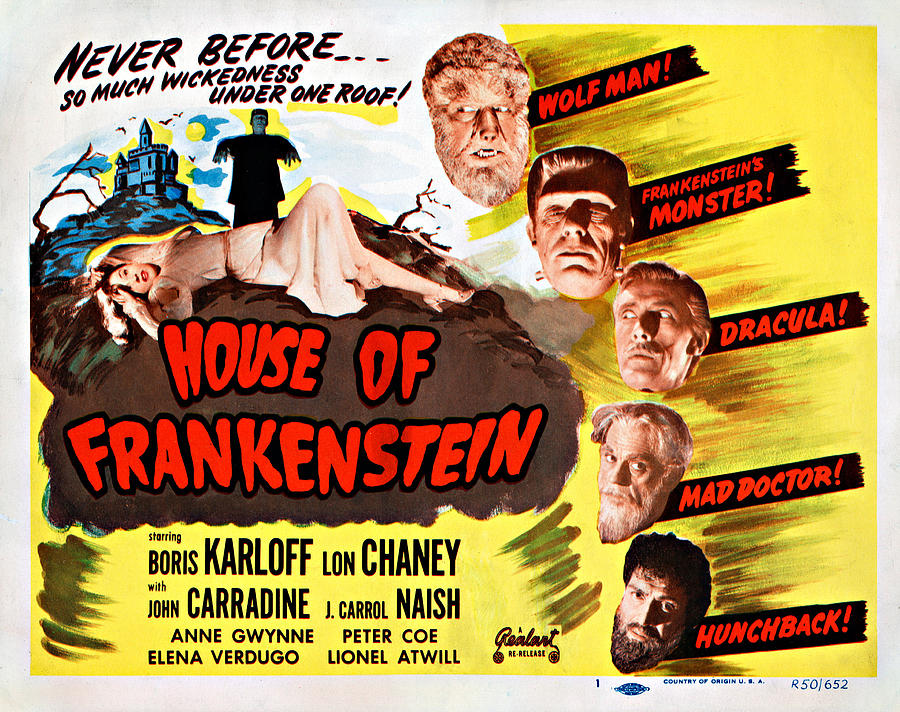
House Of Frankenstein, 1950 Re-issue by Everett

Well.

This must have been the conversation among Universal execs: “Frankenstein Meets the Wolfman did pretty well. What say we add even more monsters for our next picture?” And so was born House of Frankenstein, which was promoted as a five-monster picture: Three of them we know well at this point (Frankenstein’s monster, the Wolfman, and Dracula), but the other two aren’t exactly monsters (the “Mad Scientist” and the Hunchback). We’ll get to them in a bit.

The big news is that Karloff is back, and he’s deservedly at the center of this movie. But he doesn’t appear as Frankenstein’s monster. Instead, Karloff’s character (Dr. Niemann) is the brother of Dr. Frankenstein’s assistant (presumably Fritz from the first movie, I guess). Niemann learned from this brother many of Dr. Frankenstein’s secrets. And Niemann very much wants to continue Dr. Frankenstein’s experiments himself. So that makes Niemann the “Mad Scientist.” (One wonders why they didn’t just make him another Frankenstein relative.)
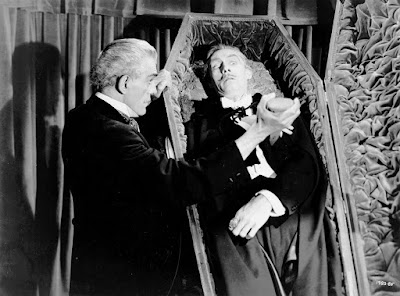
Karloff and Carradine

John Carradine plays Dracula, which I think was an odd choice. Gaunt, mustachioed, and American, Carradine looks nothing like the popular conception of Dracula. Lon Chaney reprises his role as the Wolfman, and Frankenstein’s monster is played by a then-popular western movie actor named Glenn Strange.

Howling at Home: Monster Mash-Ups in House of Frankenstein (1944) and House  of Dracula (1945) - Diabolique Magazine
Chaney and Elena Verdugo

Rounding out the “monsters” is J. Carroll Naish, who plays “Daniel” (surely one of the least likely names for a supposed monster). Daniel happens to be a hunchback, and sure, he does some bad stuff like killing people for his “master,” the Mad Scientist. But Daniel is a sad figure, mocked by the woman he loves and mercilessly worked by Karloff. In fact, in my mind, Daniel is the only sympathetic character in this whole movie. Still, Universal played him up as “The Hunchback” (presumably to trade on the fame of the Hunchback of Notre Dame, who was of course played by Lon Chaney Sr., the father of the man who plays the Wolfman in this film).

IN THE SHADOWS: J. CARROL NAISH | This Is My Creation: The Blog of Michael  Arruda
Naish as Daniel

The Plot: When the movie opens, Dr. Niemann is in prison with his hunchbacked assistant, Daniel, serving time for stealing bodies and such. But a freak storm allows the two of them to escape, and they set out (as one does) for Frankenstein’s castle. Along the way they encounter a traveling “chamber of horrors,” kill the proprietor, and accidentally bring to life the skeleton of Dracula. There ensues a brief sub-plot focused on Dracula, but he soon dies from exposure to sunlight, and Niemann and Daniel continue on their way journey to Frankenstein’s castle. Seriously: The segment with Dracula feels grafted on as an afterthought, and makes absolutely no contribution to the plot.

When Niemann and Daniel finally arrive at the castle, they discover the bodies of Frankenstein’s monster and the Wolfman frozen in ice. (Does this sound familiar? Recall that Larry Talbot, aka the Wolfman, had discovered Frankenstein’s monster frozen in ice in the same castle in the earlier movie.) Anyway, there’s a lot of stilted, obligatory exposition by characters to help us understand that the water came from when the villagers blew up the dam in the last movie.
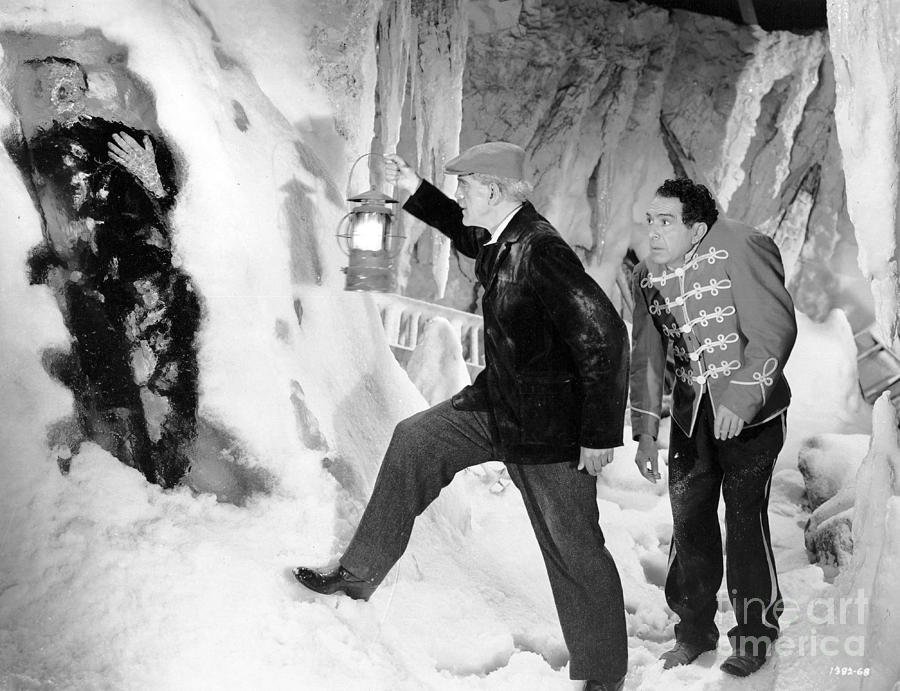
House of Frankenstein 1944 by Muirhead Gallery
Since when does a lighted lantern cast a shadow?

Karloff does what any of us would do upon encountering two unholy, lethal monsters; he ponders a moment and opines, “They may know where the records are! We’ll set them free, and they’ll help us.” So Niemann and Daniel thaw out the bodies. The monster is in some kind of coma, but the wolfman immediately transforms back into Larry Talbot. And Larry’s upset: “Why did you free me from the ice that imprisoned the beast within me?”

We now move to the brain-swapping fiesta: In order to convince Larry to help him find Dr. Frankenstein’s records, Niemann promises that he’ll transplant Larry’s werewolf brain into the monster’s head. (I’m not sure why this would be an improvement, but OK). Conveniently, Daniel wants for his own brain to be transplanted into Larry’s body, because Daniel doesn’t wants to use the new body to attract a gypsy girl that they’ve picked up along the way. Meanwhile, Niemann just wants to revive the monster.

Then things go awry, and all the monsters end up dead. We already know about Dracula, who met his demise the first 25 minutes or so. The gypsy girl, who has fallen for Larry, learns that he’s a werewolf and shoots him with a silver bullet just as he’s killing her. So they’re both now gone. Then Daniel, who loved the gypsy girl and blames Niemann for her death, strangles Niemann, but he’s interrrupted by the monster, who Niemann has just brought to life, and the monster throws Daniel out a window, to his death. The monster then picks up the injured Niemann, and helps to lead him out of the castle just as the villagers, with their torches, storm the castle. But the monster encounters quicksand, and he and Niemann sink to their deaths.

House of Frankenstein" ending | Classic monster movies, Hollywood monsters,  Scary movies
Well, this is another fine mess you’ve gotten us into!

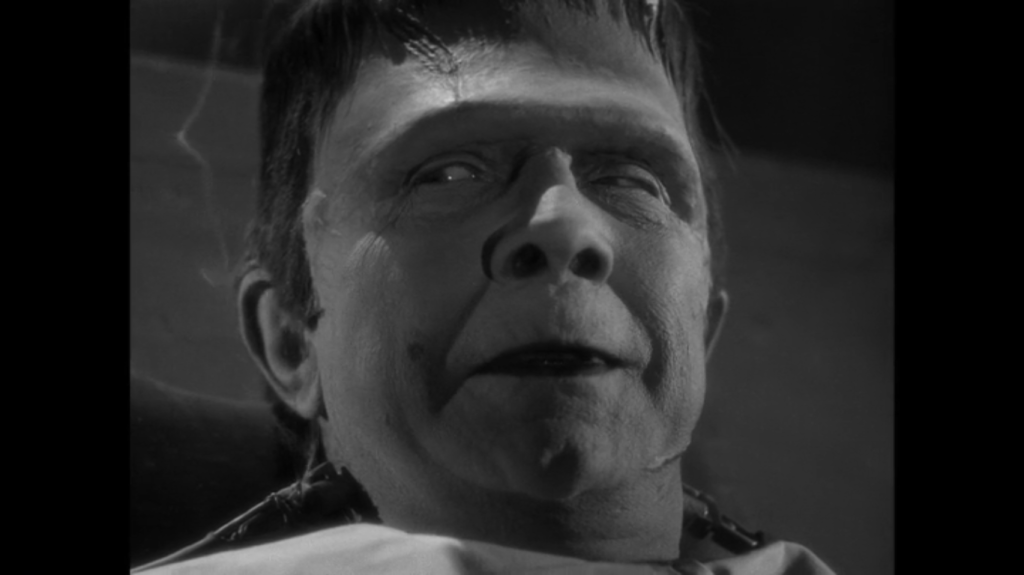
The Monster: Glenn Strange was a prolific actor who almost exclusively did westerns. But for this movie, his 6’5″ frame seemed to fit the bill for Frankenstein’s monster. In fact, legend has it that Strange was working on a western at Universal when the make-up guy, Jack Pierce, made up Strange to look like Frankenstein, just for fun. The result was so good that Strange would later be cast for this movie. It’s said that movie audiences accepted Strange as the monster–certainly better than they accepted Lugosi in that role. And as if to put a fine point on it, when Karloff died in 1969, the Frankenstein photo that accompanied his AP obituary was actually that of Glenn Strange. If you’re interested in learning more about Strange, there’s a good article here.
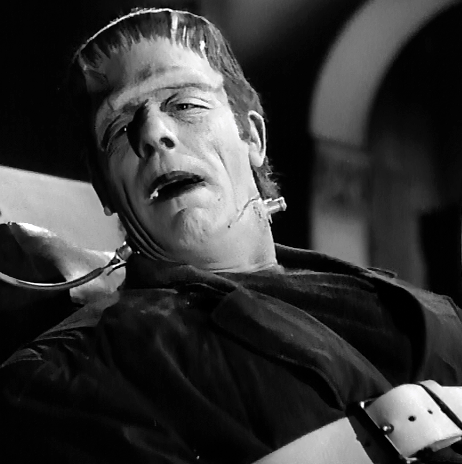
Classic Film and TV Café: The Houses of Frankenstein and Dracula
Hmmm. That’s Strange.

Anyway, the monster doesn’t come to life in this movie until the final scenes. It’s not a huge role, but it’s an important one, given the movie’s title and, perhaps more importantly, given the ironic twist of having the original monster (Karloff) meeting his demise alongside the new one (Strange). Strange, by the way, would go on to play the monster in several more Universal films.

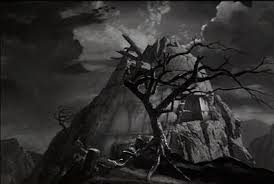
The Atmosphere: I really liked the feel of this movie (though the plot stunk). Although the hodgepodge of scenes really don’t hang together, each one is a gloomy, atmospheric set-piece. The castle interiors, the barren countryside shots, the dank prison, the creepy traveling chamber of horrors, the usual Universal mad-scientist’s laboratory, even the Gypsy camp. Every scene has that brooding, other-worldly quality that makes you feel uneasy, even while you’re scoffing at the outlandish dialogue.
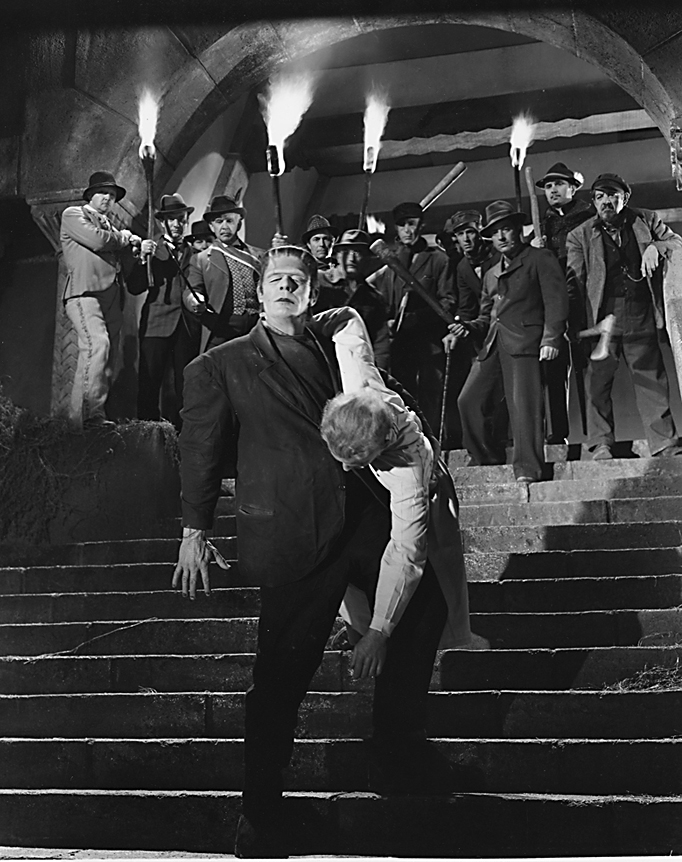
Under a 'Frankenstein' Moon: Astronomer Sleuths Solve Mary Shelley Mystery  | Space
The villagers don’t seem to be in any hurry.
House of Frankenstein | Scifist
Dracula’s skeleton begins to regenerate flesh and blood

General Comments: In many ways, this is a silly and pointless story. There’s no real story arc (or perhaps there are too many competing subplots). You really don’t care much about the fate of most of the principals, and there’s very little in the way of scary scenes. As noted above, the atmosphere is thick and well-done, but it’s not enough to carry a film for an hour and a half. Still, it’s almost worth it to watch Karloff at work again. Even when he plays a mad scientist, his believable earnestness and captivating charm show through.

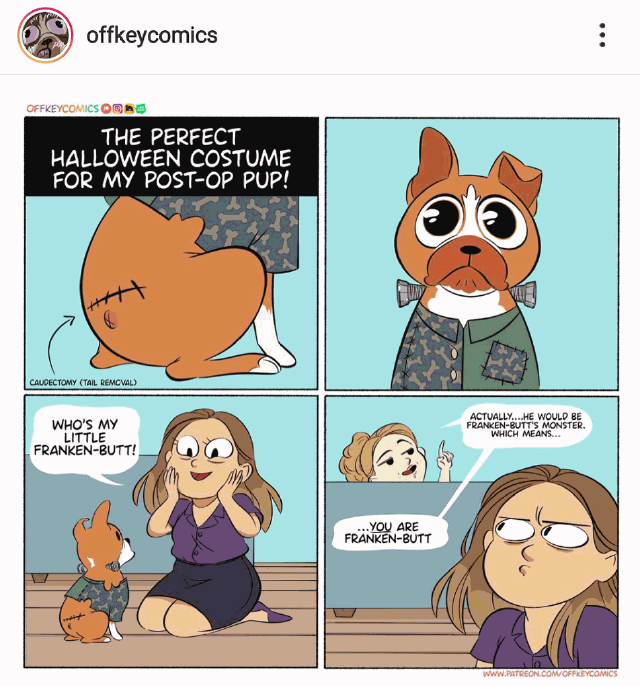
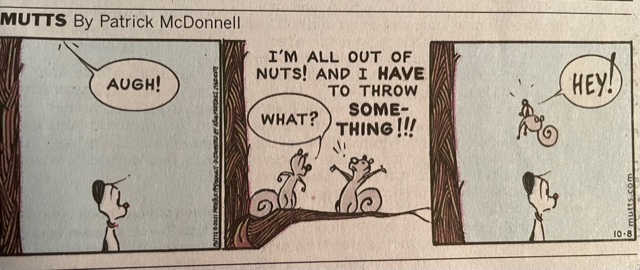
FRANKENFUNNIES: We’ve received another Frankenstein-related cartoon, this one from loyal reader Jonathan C. The connection to Frankenstein, though, is not obvious. See if you can divine the link:
Tomorrow: You’ll look back on today’s film as high art when you experience Abbott and Costello Meet Frankenstein. (That will be the last of the Universal films that we review, by the way.) You can watch it on YouTube. At the very least, check out this trailer.
Frankenstein movies

Frankenstein Meets the Wolfman

Movie Posters:Horror, Frankenstein Meets the Wolf Man (Universal, 1943). Half Sheet (22"
X 28").. ...

I would have titled this one “Frankenstein Jumps the Shark.” Universal was clearly running out of new ideas for the Frankenstein series, so they decided to spice things up with a second monster.

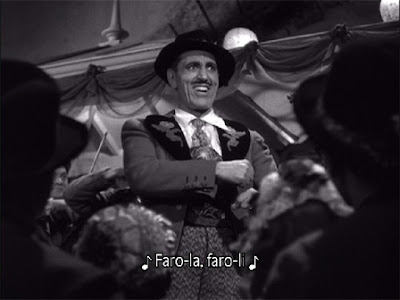
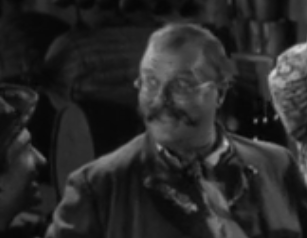
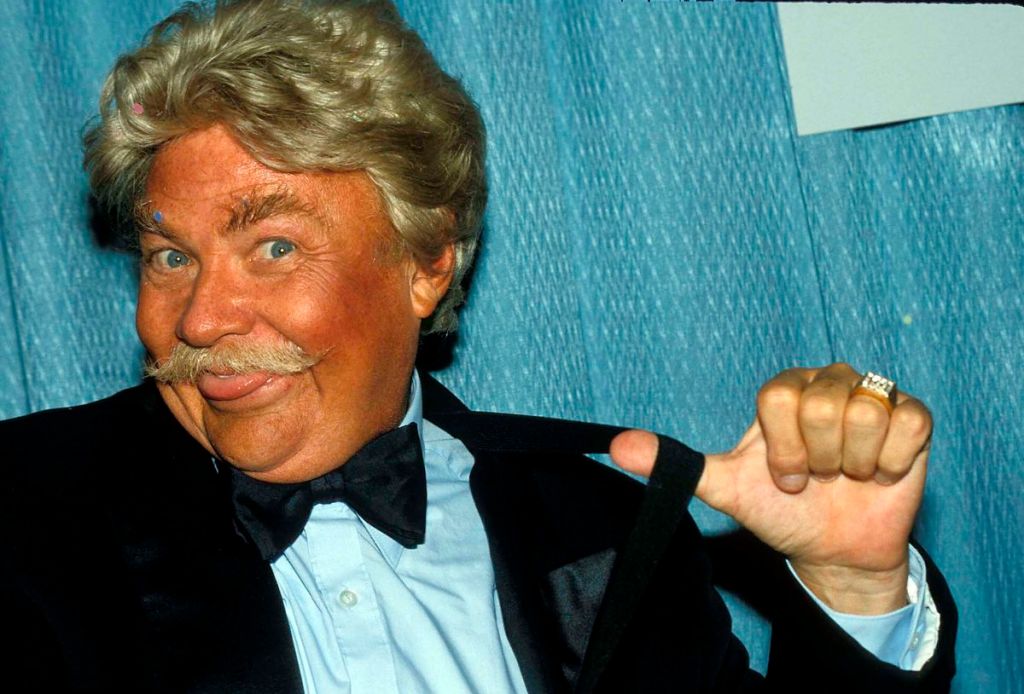
The logic seemed to run thus: Universal had had a hit with Frankenstein, and the Wolfman had been received well, so why not put the two into the same movie? (The answer to that question is: Because it’s pointless and stupid, but Universal execs didn’t see it that way.) What’s more, they felt no need to keep their growing stable of monsters associated with specific actors; they seemed to believe that actors and monsters were entirely interchangeable. So here we have the man who had played Frankenstein’s monster in the last movie (Chaney) now playing the Wolfman instead. And Lugosi, who earned his fame playing Dracula and in the last movie played Ygor, now plays Frankenstein’s monster. Meanwhile, Lionel Atwill, who had been Inspector Krogh in Son of Frankenstein, and then played Ludwig Frankenstein’s assistant in Ghost of Frankenstein, now has been drafted to play the mayor of Vasaria. Oh, and for good measure, a lot of screen time is given to a flamboyant Vasarian villager who looks a lot like Rip Taylor.

Lon Chaney, Jr. is a clunky actor. His character here is sad, melancholy, with an air of the tragic. I kept wanting to slap him out of it. His character on the screen seems more like an unemployed shoe salesman than a cursed werewolf. But since Chaney played the Wolfman in the first Wolfman movie (1941), they seem to have opted for continuity, in this case at least.

The Plot: The plot is contrived and silly, with plot holes large enough to drive Inga’s hay wagon through. It starts out promisingly enough, with grave robbers breaking into the coffin of one Larry Talbot (Chaney), who’d become a werewolf in 1941’s The Wolfman.

Quick tutorial for those of you who don’t know your Universal monster lore: a person who’s bitten (but not killed) by a werewolf becomes one himself. And as such, each time the moon is full, the afflicted individual will transform into a wolf and kill others. Once day breaks, the person is restored to his normal human form. The only way to end the cycle is for the person to be pierced with a silver bullet, or perhaps some other silver object.

Anyway, the grave robbers open Talbot’s grave, but unfortunately for them they chose the night of a full moon to do their work. You can guess what happens next….

Frankenstein Meets the Wolf Man (1943) - IMDb
Here–let me give you a hand

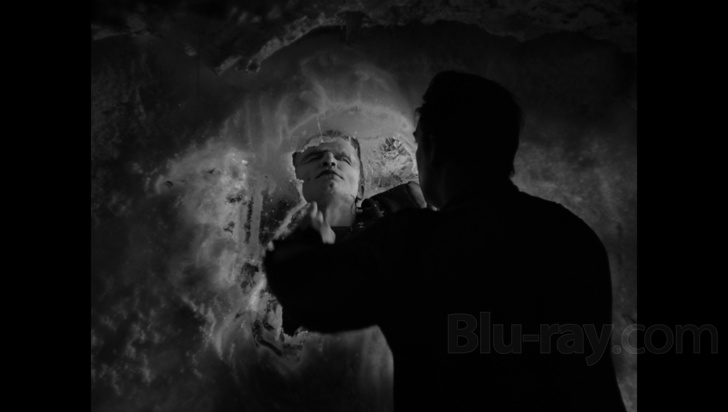
The first half of the movie is essentially your basic werewolf story–Chaney goes on a killing spree that night, and wakes outdoors in the morning in human form. He is found and sent to a hospital for a head wound (which was acquired in the earlier Wolfman film) where one Dr. Mannering treats him. Talbot comes to recognize his curse, and decides to find seek the help of Dr. Frankenstein (?!) as the one person who could end that curse. Chaney travels to Vasaria and learns, to his disappointment, that Dr. F had died in the last movie (Ghost of Frankenstein). But wait! Through some plot contrivances Chaney winds up at the old Frankenstein castle. And at exactly the halfway point of the movie (to the second!), he finds the creature frozen in ice. He cracks the ice with a rock, and the creature (played by Bela Lugosi) is free, alive and kicking.

Frankenstein Meets the Wolf Man Blu-ray
Frankenstein’s monster, on the rocks

Meanwhile, that doctor who’d originally treated Talbot back in Britain tracks him down for some reason, and becomes the star of the show. He becomes obsessed with Frankenstein’s experiments, and ends up continuing them himself, somehow with the object of transferring Talbot’s life energy to the creature. (I told you this was a silly plot.) As if it’s not clear enough that the doctor is taking on the role of Dr. Frankenstein, Universal decided to make his name “Frank.” I’m not making this up. Anyway, we eventually arrive at the climax, where Frank succeeds in fully restoring the creature just at the moment that Talbot (thanks to a full moon) transforms into the Wolfman. But then, a flood washes everyone and everything away when a villager (they guy who looks like Rip Taylor, above) blows up a dam.

This story feels very much like it was made up on the fly, like the campfire game where successive people add a short segment to an unscripted story. The result is a movie with all the continuity sensibilities of a Bugs Bunny cartoon.

The Monster: Ironically, Bela Lugosi plays the monster in exactly the same manner that he complained it would be presented back in 1931, when he’d turned down the role: stiff-armed, exaggerated, mechanical. (It’s said that Lugosi emphasized the outstretched arms because his character was supposed to have become blind (as we’d learned at the end of Ghost of Frankenstein.) Anyway, the result is a very clunky monster. And yet, for one brief moment, Lugosi gives us a glimpse of the cunning, diabolical look he was famous for with Dracula.

Do another sequel, you say?

When this movie was shot, Lugosi had various speaking lines as the monster. But in test screenings, audiences laughed every time the Frankenstein monster spoke with that heavy Hungarian accent. So the decision was made to erase all of Lugosi’s speaking lines. And yet, Lugosi’s lips can clearly be seen moving in various scenes. (To get a sense of what the original lines had sounded like, check out this clip.)

The Atmosphere: The atmosphere of the film hews pretty closely to what we’ve come to expect for a Universal horror film. The opening scene in the Talbot crypt is a classic example, as are the scenes in Frankenstein’s ruined castle.

Universal Monsters rewatch – Frankenstein Meets the Wolf Man 1942 |  macmcentire
Lugosi does the Monster Mash

Inexplicably, though, the middle of the film contains a lengthy musical number that takes place during Vasaria’s Festival of New Wine. Perhaps this was to give the audience a break from the supposed nonstop drama and shock of this supposed horror movie. But it comes across as an odd and unnecessary interruption of whatever flow this movie had managed to develop.

LimerWrecks: Sing-a-Lon
All together now!

General Comments: Universal’s monster cycle had clearly lost its way by the time of this movie. The casting is questionable, the sets are getting tired and cheap, the directing is uneven, the script is laughable, and the plot is absurd, even for a monster movie. Saddest of all for Frankenphiles is that the monster has become a two-dimensional caricature that is little more than a MacGuffin (to use a term coined by Alfred Hitchcock).

Incidently, the “Frankenstein” that the Wolfman meets is, obviously, Frankenstein’s monster. Doctor Frankenstein makes no appearance here. So, in working up the title for this film, Universal seems to have caved to the public’s common mischaracterization of Frankenstein’s monster as simply “Frankenstein.” It’s a point ably illustrated in the accompanying cartoon sent in by loyal reader Katelyn P. (who also happens to be my daughter-in-law).

Tomorrow: There’s hope! Karloff returns in House of Frankenstein (1944)…but not in the way you’d expect. Available on YouTube.

Frankenstein movies

Ghost of Frankenstein (1942)

Ghost Of Frankenstein (1942)

We now move to the 1940s and Universal’s second decade with the Frankenstein films. This is the fourth installment of Universal’s Frankenstein franchise, and it’s the first one in which Boris Karloff does not appear. That absence is strongly felt. Top billing went to Sir Cedric Hardwicke, who, as a classically-trained veteran of the stage, brought a certain stiffness and formality to the proceedings. Incidentally, he was also the father of the late Edward Hardwicke, who played Dr. Watson in the beloved Sherlock Holmes series television series in the 1980s and 1990s.

The Plot: This film picks up exactly where Son of Frankenstein left off: Wolf Frankenstein (the son of the monster’s creator) has shot Ygor full of bullets and pushed the monster into a pit of boiling sulfur. Relieved of those burdens, Wolf goes on presumably to enjoy married life with the lovely Josephine Hutchinson. In this latest movie, however, we learn that Ygor had not in fact died, and continues to live in Dr. Frankenstein’s ruined castle. Meanwhile, the villagers, fed up with how the Frankenstein “curse” has kept their village spurned and devoid of visitors, blow up the castle with dynamite. Unfortunately for them, the explosions succeed in cracking open the dried and hardened sulfur pit, and out comes a very well-preserved and very alive Frankenstein’s monster.

Ygor (again played by Bela Lugosi) is thrilled that his “friend” (as he calls him) is still alive, and the two of them manage to escape the castle before it fully collapses. But Ygor soon discovers that the creature is sickly, presumably after spending years in a sulfur pit, so he seeks help from a doctor.

Days O'Horror #23: The Ghost of Frankenstein (1942) | Ken's Alternate  Universe!
Let’s get you to Urgent Care

But wait: We haven’t arrived at the hard-to-swallow part yet. It turns out that Baron Frankenstein (the creature’s original creator) had not one but two sons. So with Wolf Frankenstein (played in the last movie by Basil Rathbone) having moved away, Ygor goes to a nearby town to track down the younger son, Ludwig Frankenstein (played by the estimable Sir Cedric Hardwicke). Ludwig refuses to help restore the creature, but he’s visited by the ghost of his father, who encourages him to give the creature a good, new brain. (The ghost, incidentally, is not portrayed by Colin Clive, who’d played Baron Frankenstein in the earlier films; instead, he’s portrayed by Hardwicke himself. So much for continuity). Oh, and Ludwig’s assistant is played by Lionel Atwill, who you’ll remember as Inspector Krogh from Son of Frankenstein.)

8x10 Print Lionel Atwell Sir Cedric Hardwicke Ghost of Frankenstein 1945  #LA82 | eBay
Lionel Atwill and Cedric Hardwicke. Did everyone have the same hair and mustache styles in those days?…
Lucy Show TV in Public Domain
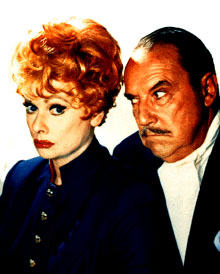
…Kind of like Mr. Mooney from the Lucy Show.

Anyway, Ludwig decides he’ll follow his dead father’s advice and replace the creature’s damaged brain with a good one. The creature, meanwhile, wants the brain of a little girl he’s befriended. And Igor wants for his own brain to be placed in the creature’s body. Through some trickery, Igor gets his wish, and his brain ends up controlling the monster. What’s more, somehow the monster now talks with Igor’s voice. But in the end, the creature is killed in a conflagration. Of course, given that the monster was presumably killed in Universal’s last three movies, we shouldn’t count him out too quickly.

The Monster: Boris Karloff declined to play the creature in this movie, partly because he was starring in a successful run of Arsenic and Old Lace on the stage, but also perhaps because he felt the role had run its course. So in his place we have Lon Chaney, Jr, who had just finished starring in Universal’s The Werewolf. The son of the silent movie actor Lon Chaney Sr., Chaney Jr. played a number of Universal’s monster films, including The Mummy and Dracula.

Chaney is a far cry from Karloff. For starters, he’s much heavier, a fact which is evident even through the makeup. (Makeup artist Jack Pierce again applied the same trademarked image that he’d done for Karloff. And this was the first time Pierce would be acknowledged in the movie credits.)

The Ghost of Frankenstein - Movies on Google Play
No Karloff.

Chaney is also much less expressive. Karloff didn’t speak in two of his three Frankenstein movies, but at least he grunted and growled and whimpered and changed his facial expressions. Chaney does not do any of this. Sadly, it’s this less personable monster, with outstretched arms and granite expression, that has come to define the creature in the public imagination.

The Atmosphere: This was the cheapest of Universal’s Frankenstein movies so far. But it’s still atmospheric. It’s filmed in black and white, with heavy shadows, an oppressive sky, stone dungeons, and gnarled trees.

Halloween Havoc!: GHOST OF FRANKENSTEIN (Universal 1942) – cracked rear  viewer

Overall Comments: Ghost of Frankenstein didn’t do as well at the box office as its predecessors had, perhaps because of the smaller budget or due to Karloff’s absence. Or, some say, it’s because audiences in 1942 were experiencing enough death and evil coming from the war in Europe, and preferred lighter fare.

So, with a Frankenstein franchise that is getting long in the tooth, and with the true star of the series–Boris Karloff–refusing to participate, you’d think it would be a good time for Universal bring the Frankenstein procession to a close. But you’d be wrong. For in a desperation move, Universal decided to pair Frankenstein and Wolfman in a single movie! Tomorrow we’ll review the unlikely Frankenstein Meets the Wolfman. You can watch it on YouTube.

Frankenstein movies

Young Frankenstein (1974)

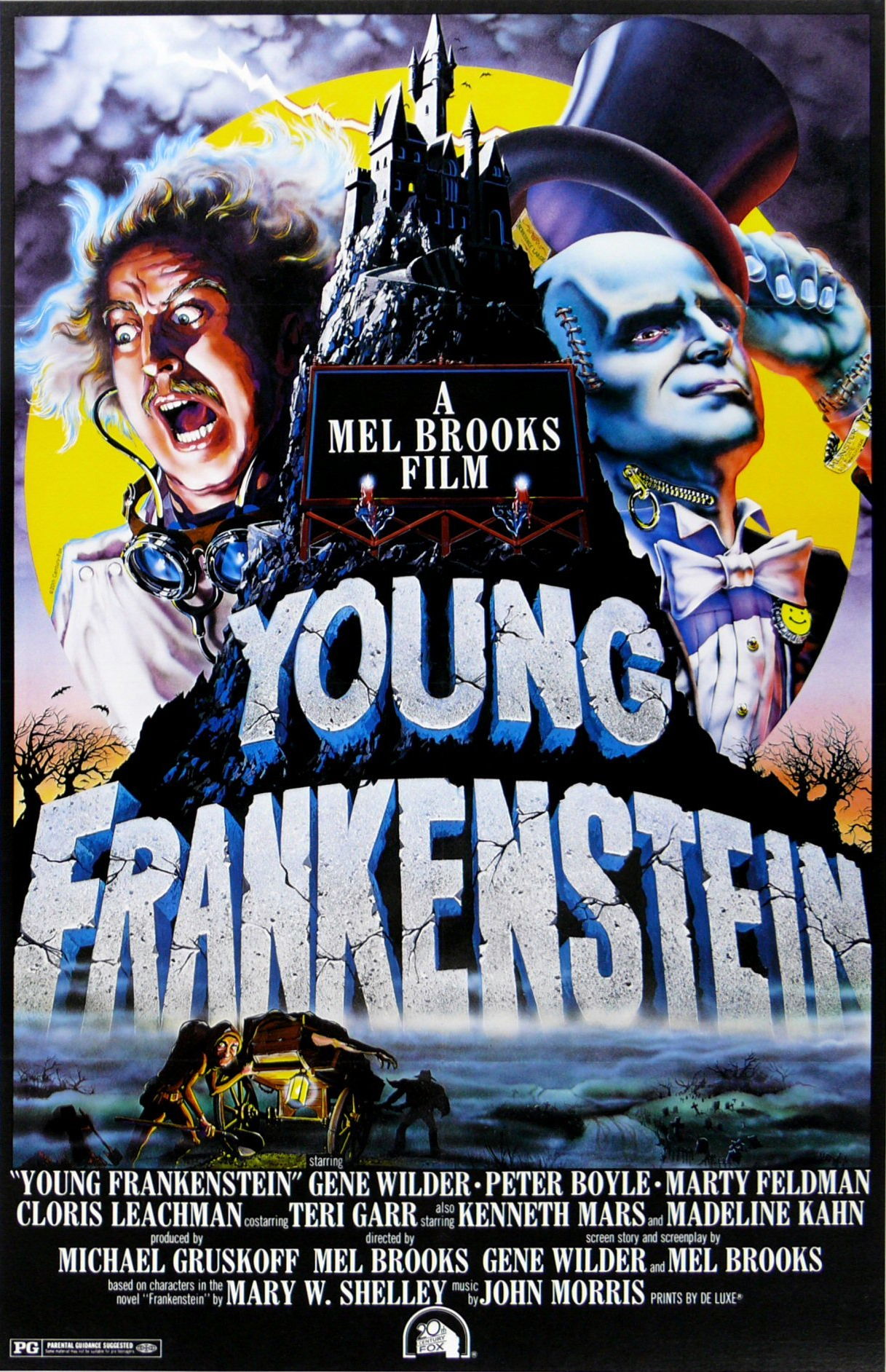
In 1974, some 43 years after Universal released its first Frankenstein film, Mel Brooks released a movie that gently, even reverently, spoofed it and its sequels. (Shocking reality check: 1974 is closer to 1931 than it is to 2021!) Young Frankenstein is, quite frankly, a masterpiece. It manages to evoke all the main aspects of the Karloff movies, riffs on most of the beloved scenes from those earlier movies, and reminds us why we love them so much. (Because we do, don’t we??)

Young Frankenstein (1974) - IMDb

The Plot. Young Frankenstein is a pastiche of key scenes and themes from Universal’s Frankenstein (1931), Bride of Frankenstein (1935), and Son of Frankenstein (1939). Set in the modern day (well, modernish), Gene Wilder plays Frederick Frankenstein, the grandson of the man who created the original monster. Frederick, a successful surgeon, has just inherited his grandfather’s castle in Transylvania, where he arrives by train.(Note that the essential elements of this plot set-up are borrowed directly from Son of Frankenstein, including even Gene Wilder’s mustache, which mimics that of Basil Rathbone in Son.)

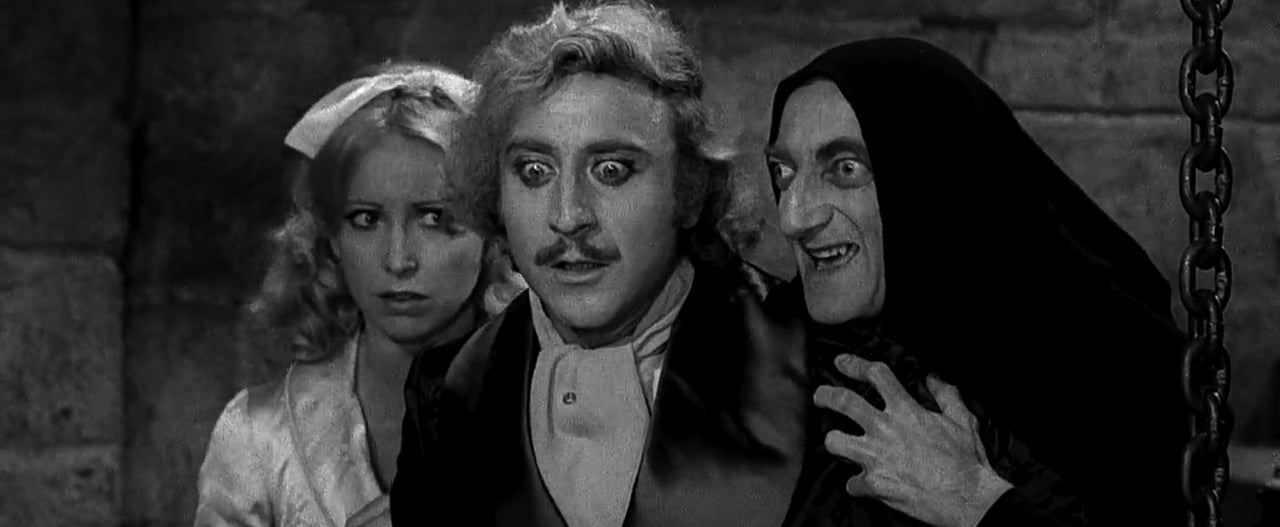
With his assistants Igor (Marty Feldman) and a very delectable Inga (Teri Garr), Frederick is ineluctably is drawn to continue his grandfather’s experiments, and before long he creates a monster that subsequently escapes and wreaks havoc in the village. Although there are a number of typical Mel Brooks plot twists, the main elements of the earlier movies are all there: The basic creation sequence, the laboratory, the bad blood between Igor and the creature, the angry villagers, the little girl with the flowers, the blind hermit, the wooden-armed police inspector, Dr. Frankenstein’s wife, and on and on.

Young Frankenstein Featured
Teri Garr, Gene Wilder, and Marty Feldman.

The Monster. Frankenstein’s creature is played by Peter Boyle, who’s generally made up as Karloff appeared in the Universal movies. Like Karloff’s monster, Boyle’s creature doesn’t speak (except at the very end of the movie, as a gag), and has to express himself with his eyes, face, and gestures. Boyle is masterful at this, in much the same way Karloff had been. Boyle’s version of the monster is somewhat less scary than Karloff’s. With a balding head and a bewildered face, Boyle’s creature is in some ways the straight man of the movie.

From the Archives: On the set of 'Young Frankenstein' - Los Angeles Times
Peter Boyle

The Atmosphere. Clearly Mel Brooks had set out to capture the look and feel of those old Universal pictures, and just as clearly he succeeded. Overcoming resistance from the studio, Brooks had the movie filmed in black and white, just as those 1930s films had been. Much of the story takes place in Frankenstein castle, replete with cobwebs, dark corners, and secret passageways. We see a graveyard (very similar to the one in the opening of 1931’s Frankenstein), and a village like the ones that appeared in the Universal films. There is fog, lightning storms, horses (“Blucher!”), moonlit nights, and wolves. It seems that nothing was left out.

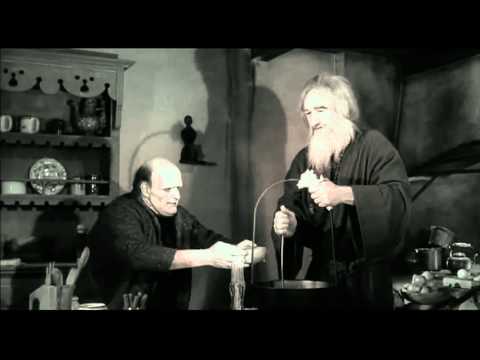
WebM Test II - Blind Priest Scene
That’s Gene Hackman as the blind hermit.

Indeed, Young Frankenstein even features the same laboratory equipment from the 1931 original. I don’t mean it just looks the same; I mean, Mel Brooks got his hands on the very same props. Evidently all the equipment had been stored in the garage of Ken Strickfaden — the Universal props guy who’d designed it in 1931. Strickfaden was getting on in years by 1974, but he was game for the project.

Young Frankenstein (1974)

General Comments. If you’ve seen the three Karloff Frankensteins, you owe it to yourself to watch this paean to them. You’ll appreciate the in-jokes, and in some ways you might even appreciate those old movies more as a result of this send-up.

But if you can’t find the time to watch the whole movie, at least watch this clip.

Tomorrow: Things go downhill a bit. We’ll go back to the Universal films, with their first post-Karloff Frankenstein movie: Ghost of Frankenstein (1942). You can watch it on YouTube, but I’m not sure it’s worth the $3.99 it’ll cost you.

Frankenstein movies

Son of Frankenstein (1939)

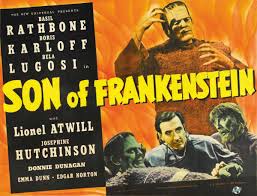
Today we reiew Universal’s third Frankenstein movie, which is the last one in which Boris Karloff plays the creature. Many consider it to be the best of the three. Perhaps that’s because cinematography was developing rapidly throughout the 1930s, and quality of the film, cameras, sound, and sets was considerably improved. Perhaps its because the actor playing Baron Frankenstein (Basil Rathbone) was a better actor than Colin Clive, who played the Baron in the other two movies. Or maybe it’s just because Universal was hitting its stride with the Frankenstein story. In any event, this film is a must for the completist, if for no other reason than because it’s the main source material for Young Frankenstein (which we’ll get to in due time).

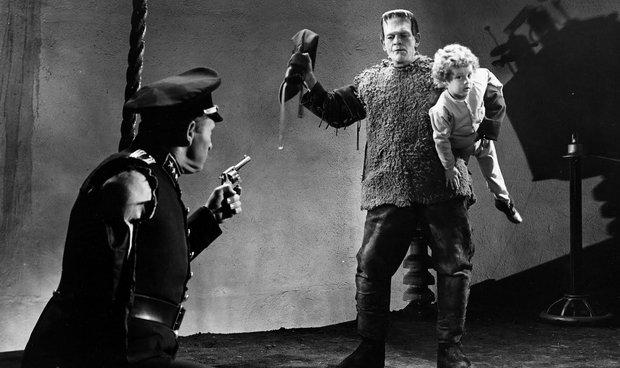
The Plot: Wolf Frankenstein (the son of Henry Frankenstein, who’d created the monster in the first film) has come to live in his ancestral home in the burg of Frankenstein (presumably somewhere in Germany). The townsfolk are unhappy about this, as they remember the havoc created by Henry and his monster. Wolf has arrived with his wife and his son (played by a precocious 4-year-old Donnie Donagan, with an anachronistic Texas accent. Donagan, who soon left show biz and went on to become a career, decorated Marine, appears to be the only surviving actor associated with the early Frankenstein films. If you have evidence to the contrary, please let me know!)

Anyway, Wolf discovers Ygor (or Igor, if you prefer), who has been living in Dr. Frankenstein’s abandoned laboratory and tending to the Monster, who somehow has survived the castle explosion at the end of Bride, but now is sickly and in some sort of a coma. Wolf decides to help the creature, in the hope that it will then be available for study and the advancement of science. Of course, things don’t work out that way…

Nothing is Written: Son of Frankenstein
Donnie Donagan, in the grips of something less menacing than the Viet Cong soldier who later would stab him.

After the usual mayhem, Wolf realizes he has to terminate the experiment, and the creature is dispatched into a pit of boiling sulfur. Surely that will kill the creature once and for all, right? (Spoiler alert: Probably not.)

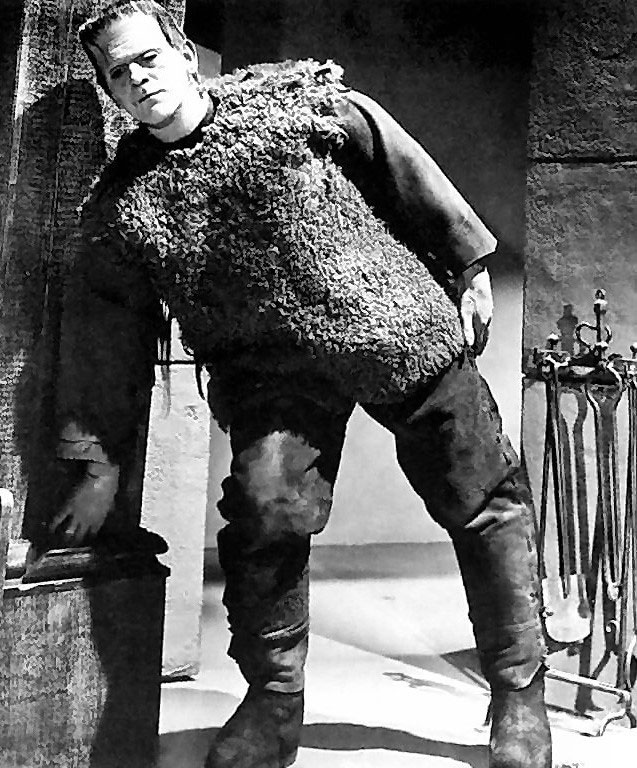
The Monster: Played once again by Boris Karloff. You’ll recall that he developed the ability to speak in Bride of Frankenstein, but for some reason he no longer speaks in this installment. He’s also got a mohair suit (but no electric boots; you know I read it in a magazine).

Eerie Essentials: Son of Frankenstein (1939) - Morbidly Beautiful
Hey Kids, Shake it loose together…

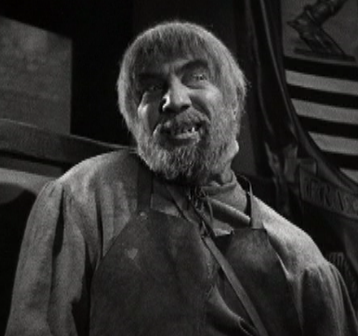
Karloff’s performance is one of this film’s major attractions, but he doesn’t actually get a huge amount of screen time. Clearly the real stars of this film are Basil Rathbone (Wolf Frankenstein), Bela Lugosi (Ygor), and Lionel Atwill (Inspector Krogh). What? Didn’t I mention that Bela Lugosi (of Dracula fame) plays Ygor? It’s actually a very impressive performance. In fact, it’s probably Lugosi’s best role after Dracula. (You’ll recall that Lugosi originally turned down the role as Frankenstein’s monster in the 1931 classic, and eventually came to regret that decision. It’s nice that he could finally get into one of Universal’s Frankenstein movies.)

Classic Film and TV Café: Is "Son of Frankenstein" the Best of Universal's  Series?
Lugosi, lacking a vampire’s dental care.

The Atmosphere: It’s said that this movie was originally planned to be filmed in color, but ultimately it was decided that black and white would provide the better atmosphere. This movie feels like a German expressionist film, with huge sets built at odd angles, deep shadows, the otherworldly laboratory of Baron Frankenstein, and Wolf’s growing detachment from reality.

The Son of Frankenstein | Scifist
Paging Dr. Caligari….
The ruined laboratory

This has the ideal, classic monster-movie atmosphere: an ancient castle, bleak landscapes, lightning storms, steaming sulphur pits, secret passageways, science-fiction-inspired laboratory equipment, and an all-star cast (Karloff, Lugosi, Rathbone). So much of this film has become monster-movie cliches, but at the time is was fresh indeed. For the modern viewer it has a comfort-food quality, offering familiarity and old-fashioned formulas while not placing much demand on our brains or palates.

General Comments: I really like this movie. True, I can’t see Basil Rathbone without thinking of Sherlock Holmes, and Donnie Donagan is a little too precocious for my tastes. But Karloff does a masterful job again as the monster, and Bela Lugosi is downright scary as the crazed outcast with a broken neck who somehow is able to control the monster. I also want to give special recognition to Lionel Atwill, who plays a police inspector that’s reminiscent of Claude Rains’ French police captain in Casablanca. Both characters have a duty to stop the lead character (Baron Frankenstein and Rick Blaine), but they both also find themselves befriending those lead characters. Atwill’s police inspector is the hinge of the whole plot, and he plays it convincingly and with flair.

The Son of Frankenstein | Scifist
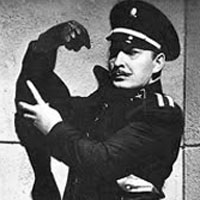
Inspector Krogh, The Man with the Wooden Arm (apologies to Frank Sinatra).

So I urge you to check out The Son of Frankenstein. And do so before you watch tomorrow’s entry, which is….

Tomorrow: Mel Brooks takes all three of the Karloff/Universal Frankenstein movies and creates a spoof that’s become a classic in its own right. You can watch Young Frankenstein on Amazon Prime Video, if you have that service. (It doesn’t seem to be available on YouTube.)