Editor’s note: Given limited travel opportunities these days, I decided each Thursday to post travel stories I’d written prior to starting this blog. The following is from November 2018. I hope you might vicariously enjoy this trip while we’re all hunkering down at home.
For many years, my friend Vic and I have been talking about driving out to Lake Havasu, on the border between California and Arizona, to see London Bridge. As you may know, London Bridge was moved from London to Lake Havasu in the 1960s, and it’s always struck us as a “you-have-to-see-it-to-believe-it” kind of phenomenon. But, despite the best of intentions, the trip never materialized. Until now.
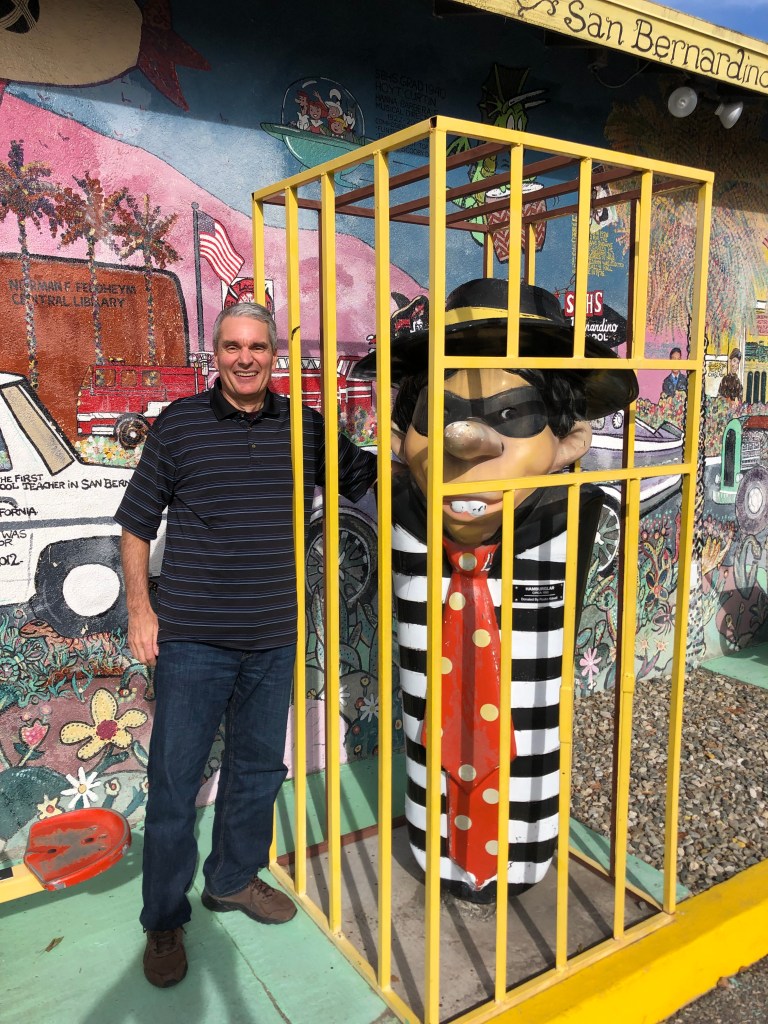
So it was that last Tuesday morning I found myself at Ontario airport, picking up Vic who’d just arrived from Sacramento. A couple of illegal U-turns later, we were on our way to…….the site of the first McDonald’s restaurant, which is in San Bernardino.
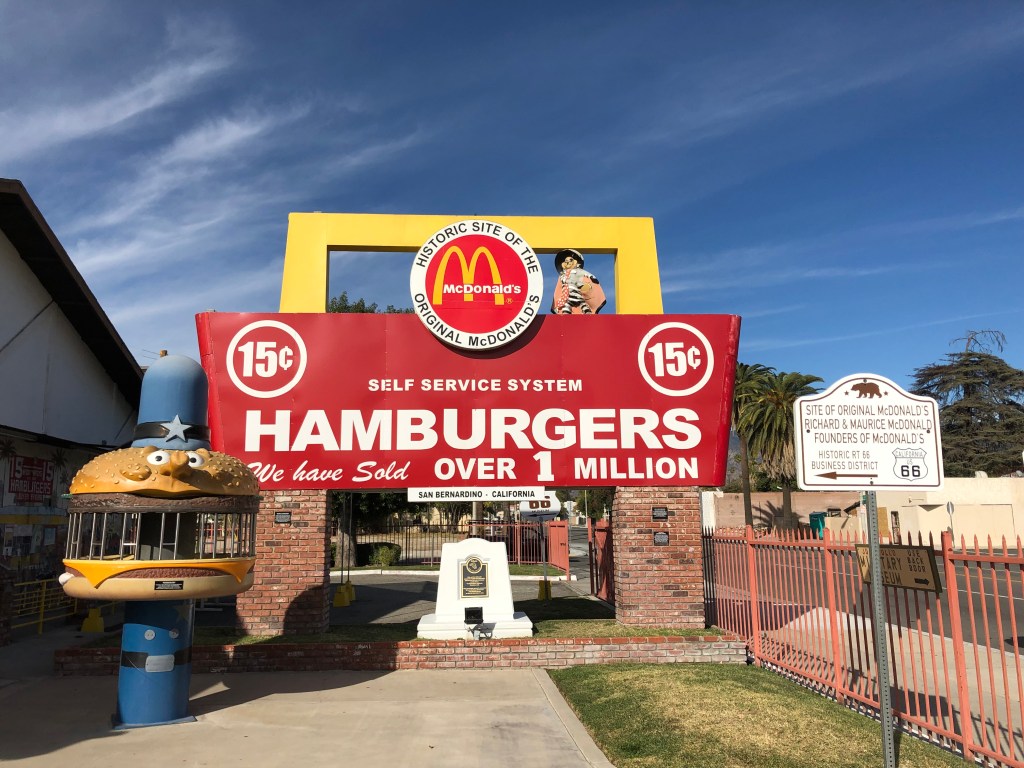
It would probably help to explain that Vic shares my interest in unsung history. And while McDonald’s is hardly unsung, this particular site is something that the McDonald’s Corporation would rather be forgotten. For it was on this site in 1948 that the McDonald’s brothers built the first McDonald’s restaurant. But when Ray Kroc bought the chain from the brothers in 1961, he was infuriated to learn that the sale did not include the original San Bernardino store. He made the brothers remove the Golden Arches from that building, and change its name from McDonald’s to “Big M.” A decade later, the building was torn down, but the sign was saved, and remains to this day.
Now, along comes a fellow named Albert Okura, who owns the Juan Pollo Rotisserie Chicken chain. (I’d never heard of it either.) He learns that this old McDonald’s property (with the original sign, and a new office building) is up for sale, so he buys it and moves the Juan Pollo headquarters there. But, supposedly because he “believes it is his responsibility to preserve the early history of the most successfulfast food restaurant chain in the world,” he devotes half of the office building to an unofficial McDonald’s history museum. Vic and I spent an hour checking out the old McDonald’s paraphernalia, as well as thousands of Happy Meal toys.
A little later, as we were driving across the Mojave Desert, we stopped at the “ghost town” of Calico. I use quotation marks because, while Calico was once a prosperous mining town that became all but deserted after silver prices dropped, it’s now a county park. In fact, to enter the “town” you have to stop at the entrance and pay $8 a head to the County parks ranger, who was asleep on a stool. (Evidently visitors are as scarce as residents in this ghost town.)
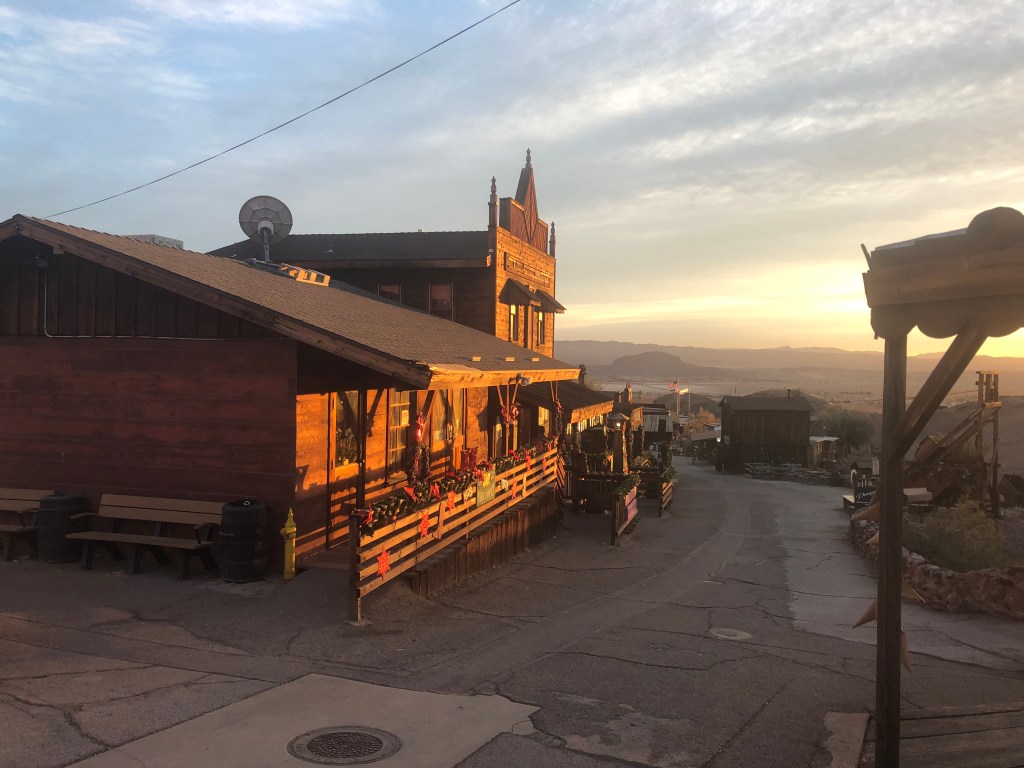
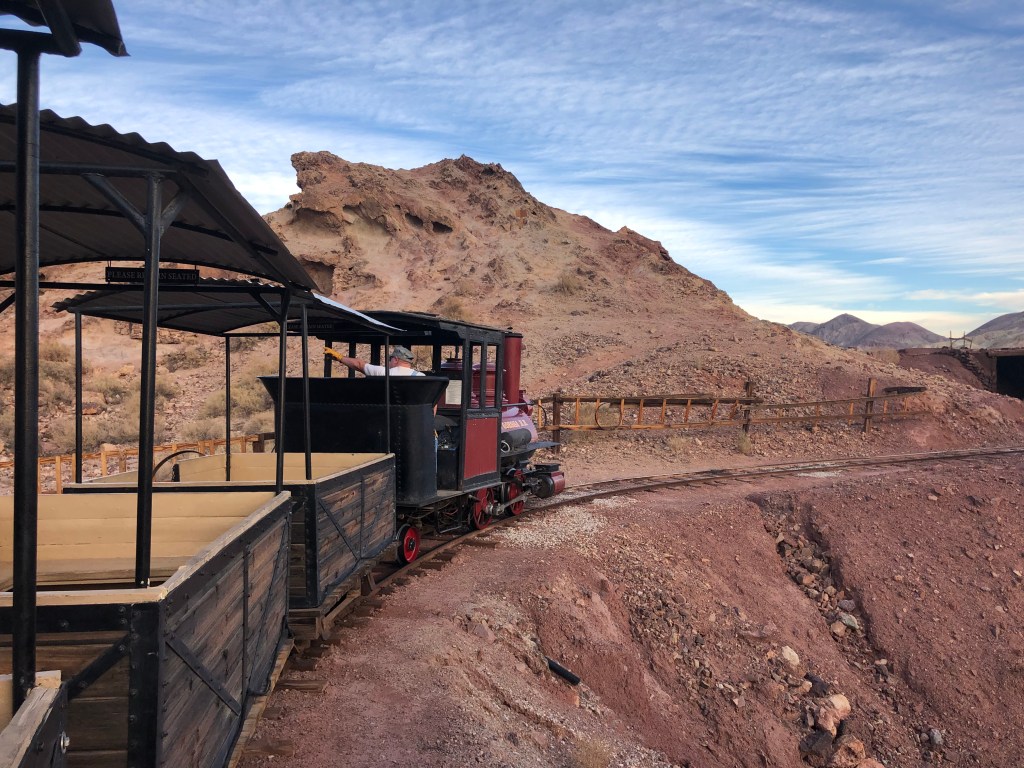
Calico is an uneasy mix of legitimate historic structures, kitchy craft stores, and hucksterism. Indulging in the latter category, we took the train ride (as the only two passengers) and visited the “mystery shack,” where water supposedly runs uphill.
Eventually, we made our way to Lake Havasu City, Arizona, where we got dinner and rested up for the next day’s assault on London Bridge. The story of how London Bridge ended up in the Mojave desert is fascinating. It’s all due to the efforts of Robert McCullough, an entrepreneur who was born in Missouri and eventually made his way to Lake Havasu, where he developed, tested, and manufactured boat motors. As his manufacturing facilities grew, he bought much of the surrounding land and founded Lake Havasu City. But he needed some kind of gimmick to draw people to this barren land. As he pondered this, he learned that the City of London was auctioning off the London Bridge, which had been built in 1831 but was gradually sinking inch-by-inch into the Thames. So, in 1967, McCullough’s bid of $2.5 million was accepted, and he became the proud owner of London Bridge. The structure was carefully disassembled stone by stone, shipped through the Panama Canal, and unloaded at Long Beach, CA, where it was then trucked inland 300 miles to Lake Havasu City. The bridge was re-assembled on the desert floor. Finally, a channel was dug to bring the Lake’s water under the bridge. The bridge was reopened in 1971.
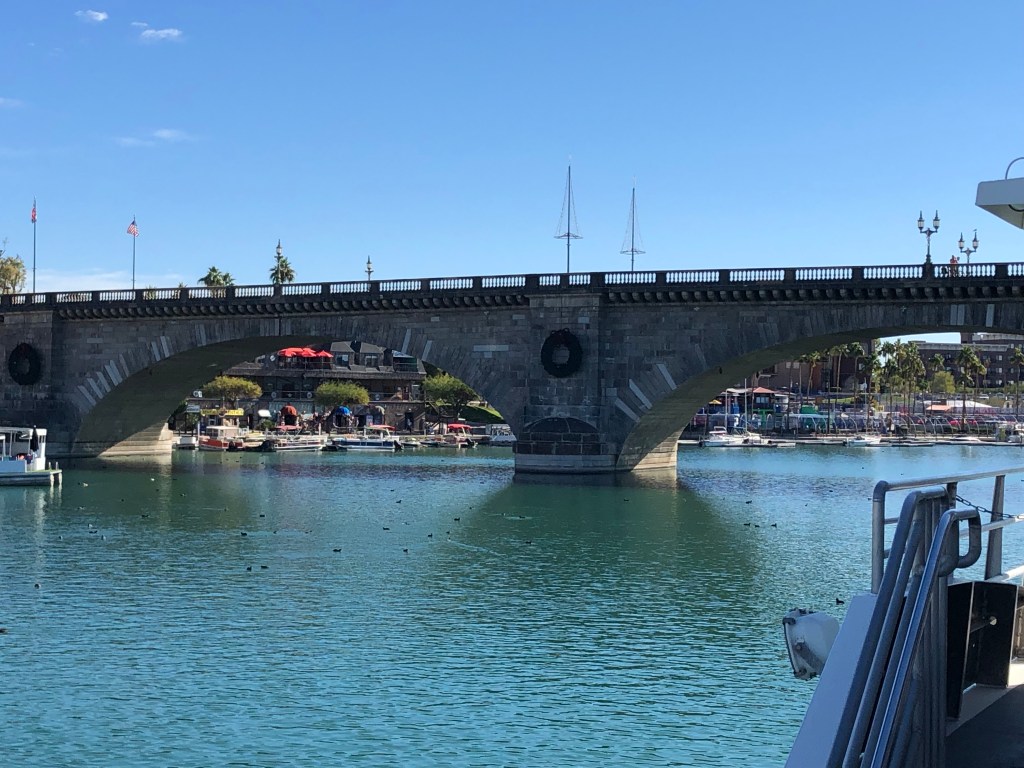
It’s hard to express why I’m so intrigued by McCullough’s effort. Sure, it was a crazy idea. The very logistics of moving a bridge 5,300 miles are daunting enough. And to spend a good chunk of one’s personal fortune on it seems foolhardy, especially when the end result is a relatively useless structure in an unpopulated desert town. But I suppose it’s because of those things, rather than in spite of them, that I admire McCullough. Too often we let logic get in the way of our dreams. In a very small way, that’s why it took Vic and me so long to take this trip!
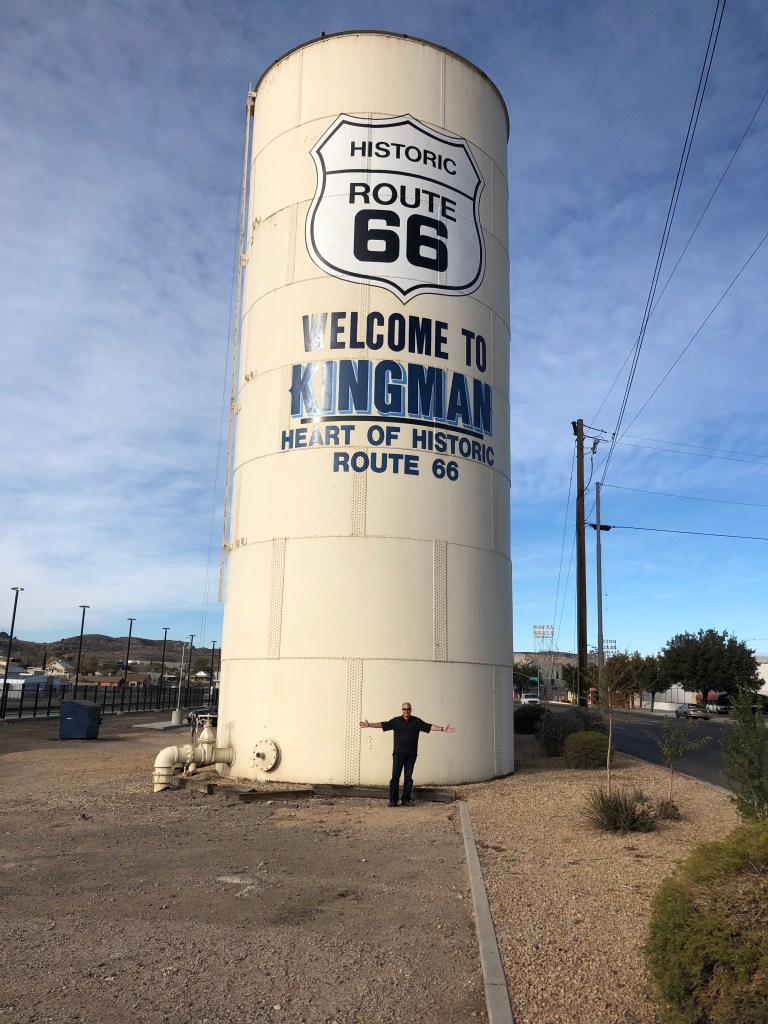
With the main objective of our trip now complete, we began our return drive along several stretches of historic Route 66. We headed up to Kingman, AZ (pop: 28,000), which is called out by name in Nat King Cole’s “Route 66.”
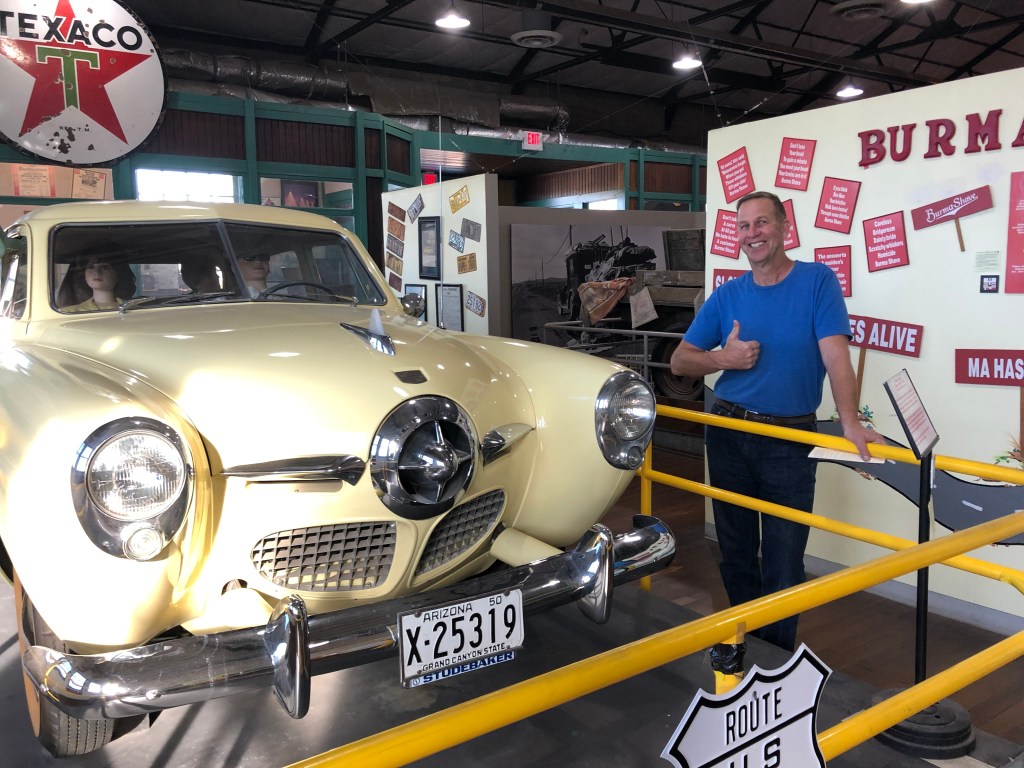
We visited Kingman’s Route 66 museum (which included a sweet Studebaker Commander), and explored some of the historic sites along the Mother Road.
The next day we headed west on Interstate 40 (which replaced Route 66 in this region in 1984). But whenever a stretch of the historic highway was available, we left the interstate and motored along the historic pavement. Each time we transitioned off the interstate, I could feel my grip on the steering wheel relax. My eyes would open a little wider, and I’d feel more at one with the passing countryside.
One item that caught my heightened attention on Route 66 was a Chinese lion, cast out of cement, sitting about 20 feet off the road, all alone.
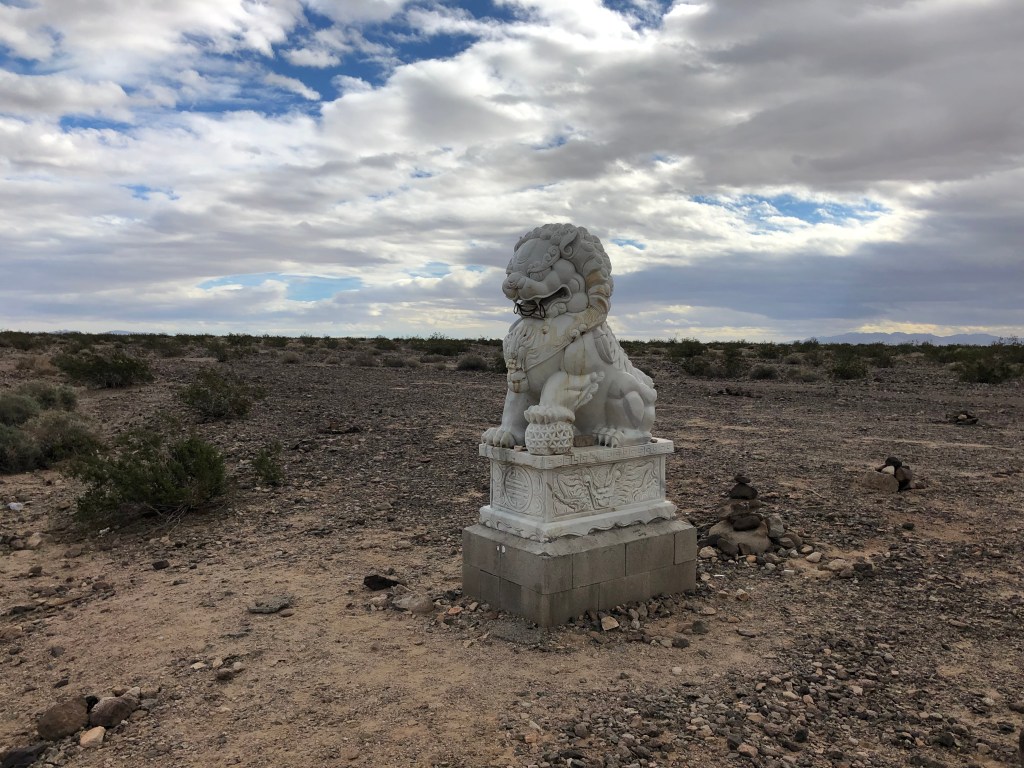
A waterproof journal was sitting on the pedestal, with an invitation to record our thoughts. There were many earlier entries, about half of which clearly got into the Zen of the thing, while the other half expressed puzzlement. I wrote something that was somewhere in between those sentiments. But I confess that a world with mysterious lions along the roadside is better than a world without such oddities.
A short time later we came upon the town of Amboy (pop: 4). Amboy was first settled in 1858, and became a boomtown when Route 66 opened up in the 1920s. In the 1930s, Roy’s Motel and Cafe were built by Roy Crowl. The complex included a gas station and a store, and the addition of a large sign in 1959 make Roy’s an especially popular, even iconic, spot along Route 66.
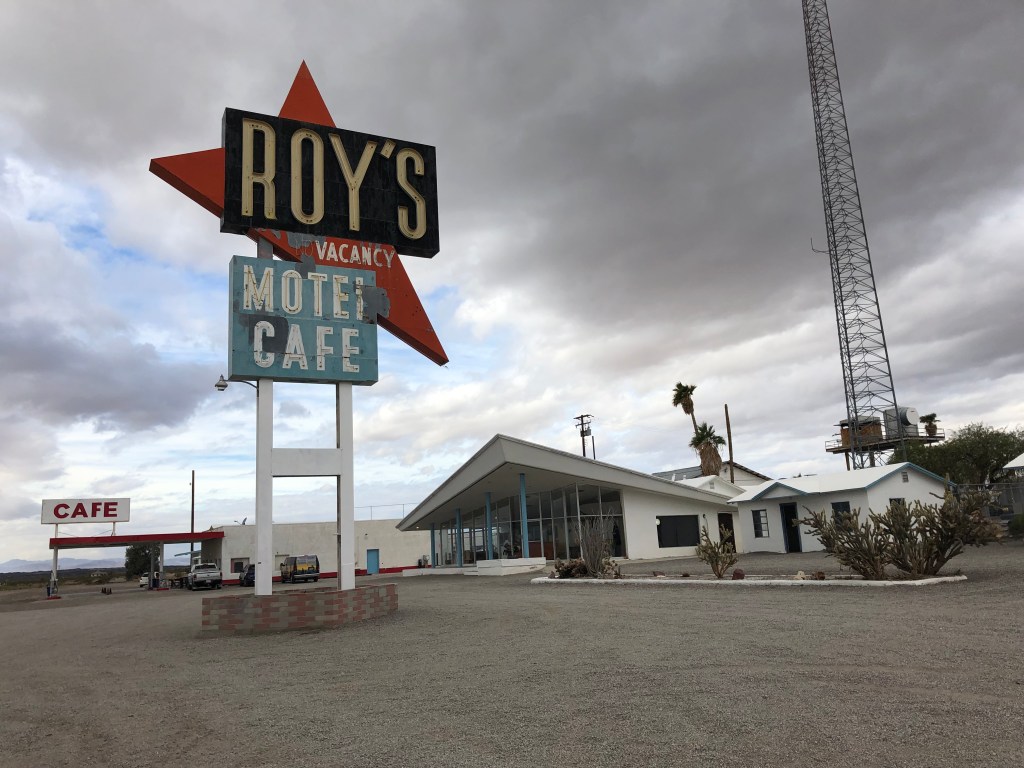
Like the many other businesses along the route, Roy’s (and Amboy) fell on hard times when the interstate replaced Route 66. Roy’s went through several ownership changes, Eventually, the motel, gas station, and cafe closed, and the property fell into disrepair. Then, in 2005, a history buff and Route 66 preservationist purchased the town of Amboy with the intention of re-opening Roy’s and creating a Route 66 museum. I can attest that Roy’s is indeed now open for business, selling gas and supplies to the (scarce) passers-by. We saw active construction on the motel cabins, which look like they should be open for visitors sometime next year. And who is this savior of Amboy and Roy’s, who puts his money and time into saving a piece of history for the rest of us? Coincidentally, it’s Albert Okura — the same guy who created theMcDonald’s museum we’d stopped at 2 days earlier. And, like Robert McCullough, Okura isn’t afraid to purchase an entire town in the effort to fulfill his dreams.
So, as we headed home, Vic and I tipped our hats to Albert Okura, Robert McCullough, and all the others who work to make our world a little less jejune and a little more worthy of a road trip like this one.
 Chasing Phantoms