You may recall that last year I took an interest in the old Orbit gas stations that have somehow survived from the 1960s. My most recent Orbit-related post concerned an abandoned station near Lake Tahoe.
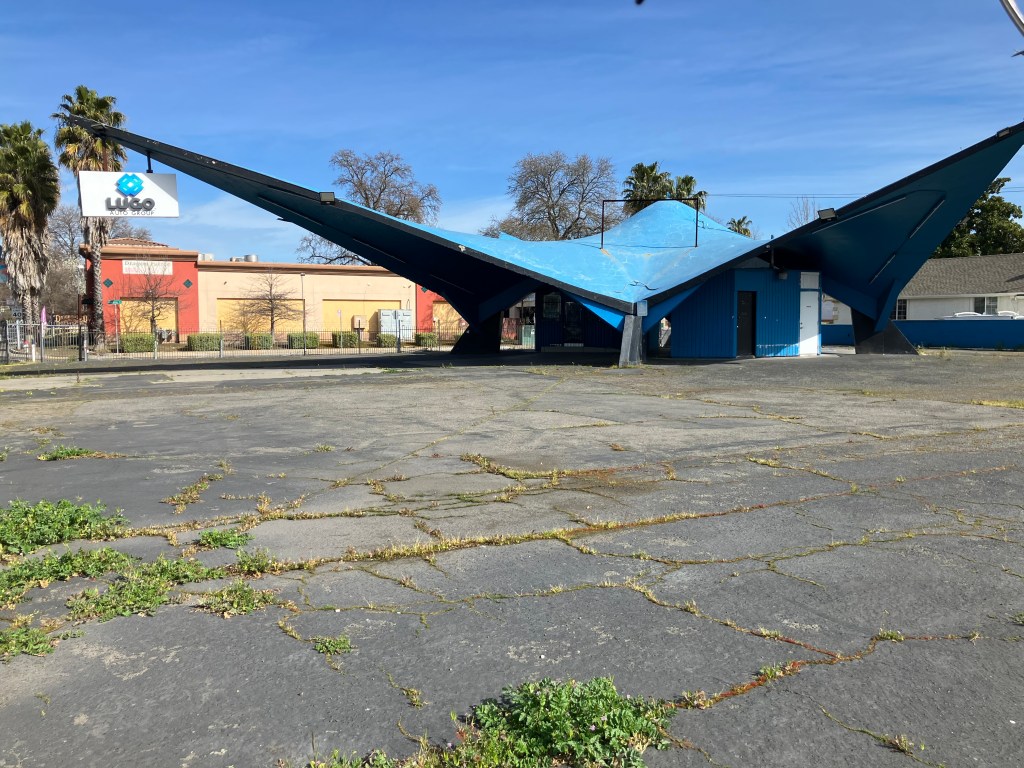
I mention all this because yesterday loyal reader Victor R. shared with us a news item about an old Orbit gas station in north Sacramento. It seems this Orbit station was built in 1963, and ceased operation as a gas station a scant 7 years later. Since that time it’s served various functions, most recently as a used car lot. But last year the car lot closed, and the building has sat vacant behind a fence topped with razor wire.
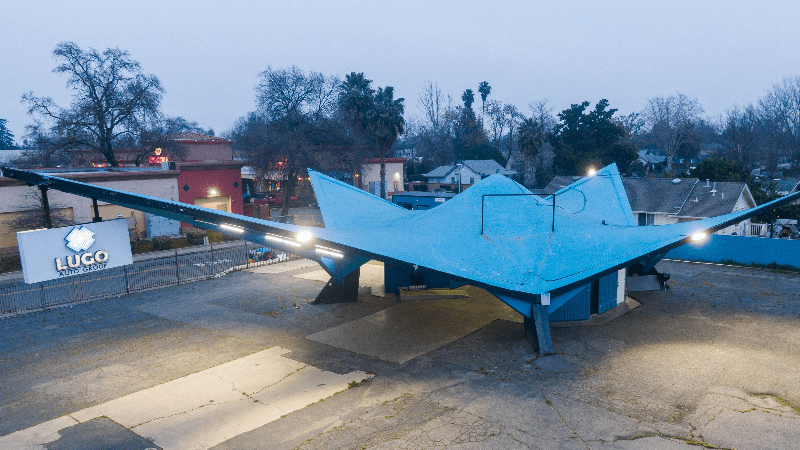
Vic shared a KCRA story about how the Sacramento Preservation Commission voted to recommend that the City Council place the station on the local historic register. Frustratingly, the news item only showed an aerial shot of the gas station. So I decided to head out to North Sacramento and get some ground-level photos for you, dear reader.
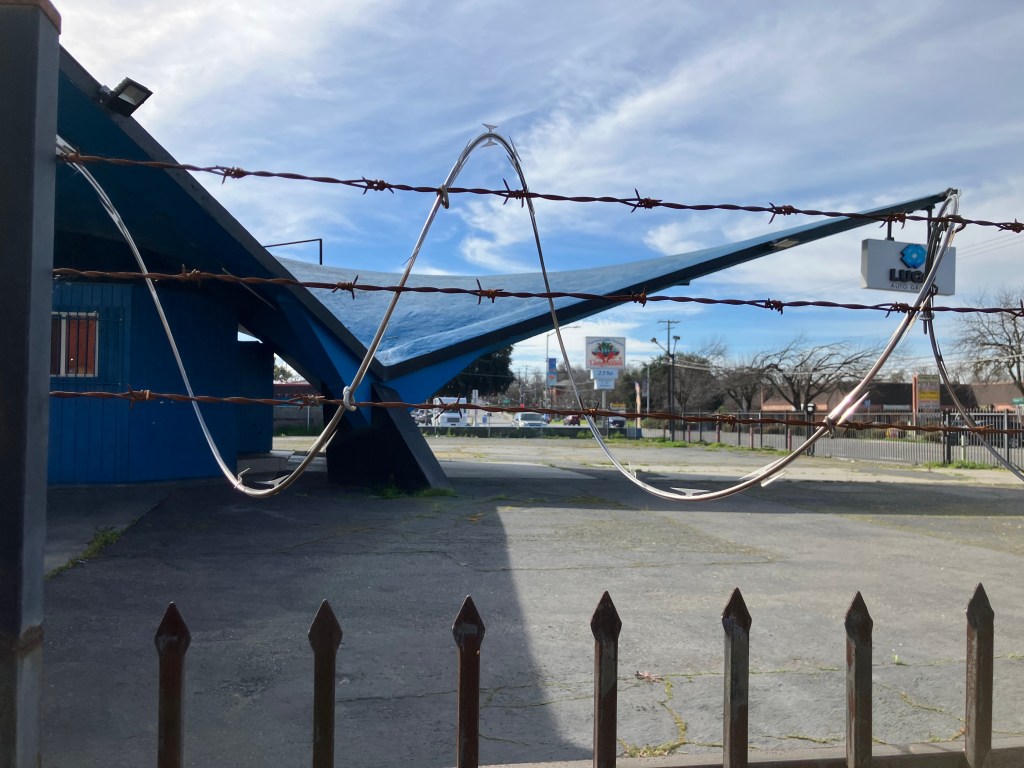
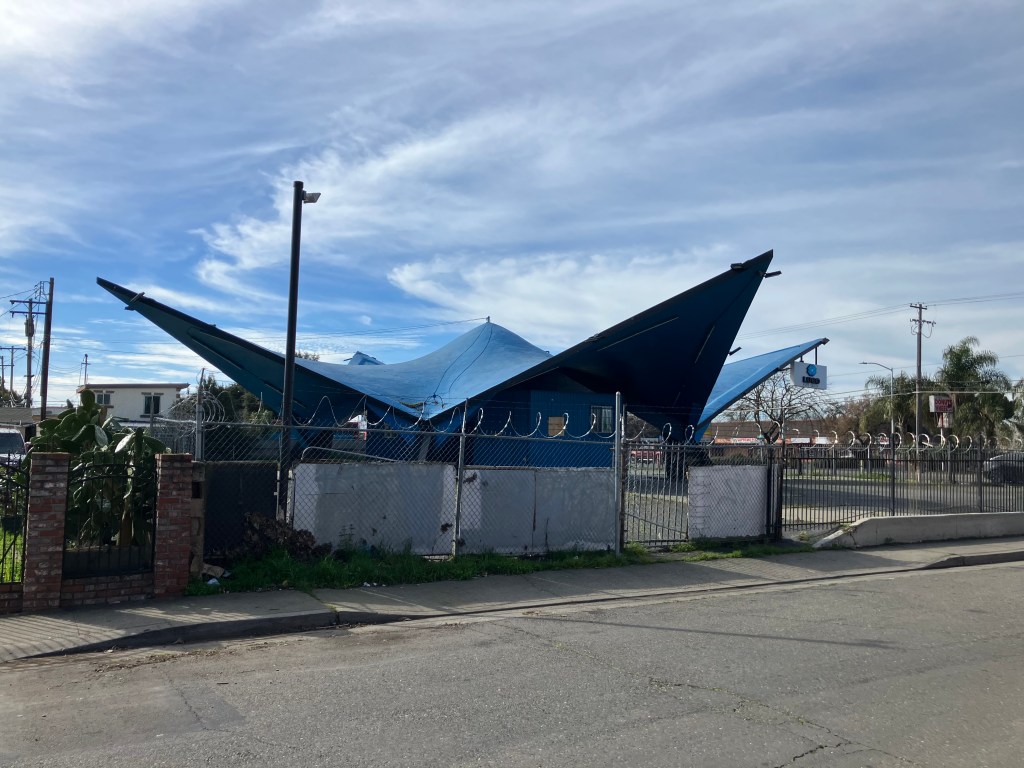
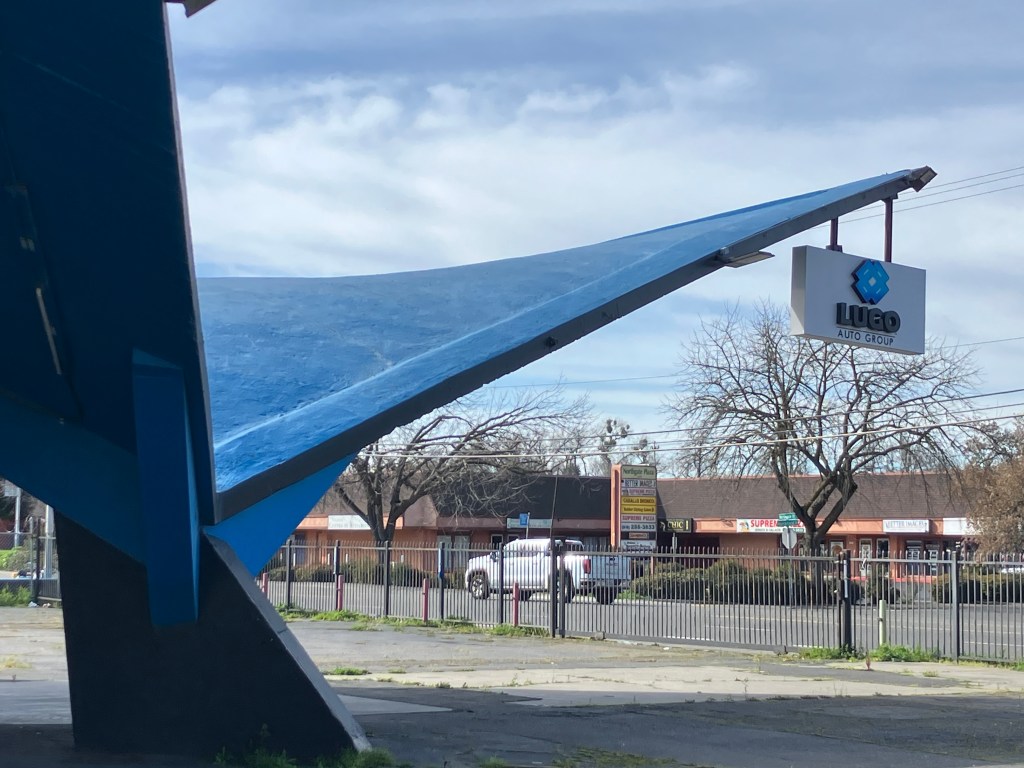
Even stripped of its gas pumps and signage, the structure is unmistakably an Orbit gas station. Here’s a photo I took by poking my camera through a gap in the surrounding fence:
But viewed from the street, the fence makes for an ugly tableau.
Still, the local residents spoke enthusiastically in favor of preserving the structure. “It’s got its own personality for sure; it’s got character,” stated one resident. “To have this go away would be a disservice to our community,” said another. A third noted “It reminds me of a flying saucer,” which, to be honest, it clearly does not. But there is something alien about it.
I think the point, though, is that residents in the area like the odd structure. Notably, while I visited today, it was clear that the neighborhood (which is dubbed “Gardenland,” not for any greenery, but because of its proximity to the Garden Highway) is struggling. Northgate Boulevard, on which this gas station sits, is lined with a depressing array of struggling fast-food eateries, grungy liquor stores, and predatory check-cashing businesses. I can see how a quirky retro-futuristic building might bring some much-needed whimsy and optimism to the area, particularly if it were repurposed as a community center or maybe a hip coffee shop.
Wouldn’t it be great if the sign were changed to “Jetsons Java”?
So I’d encourage my Sacramento-based readers to let your Councilmember know that you support having this building designated a local historical landmark. Meanwhile, please send me any sightings of other Orbit stations.
Obelisk Corner
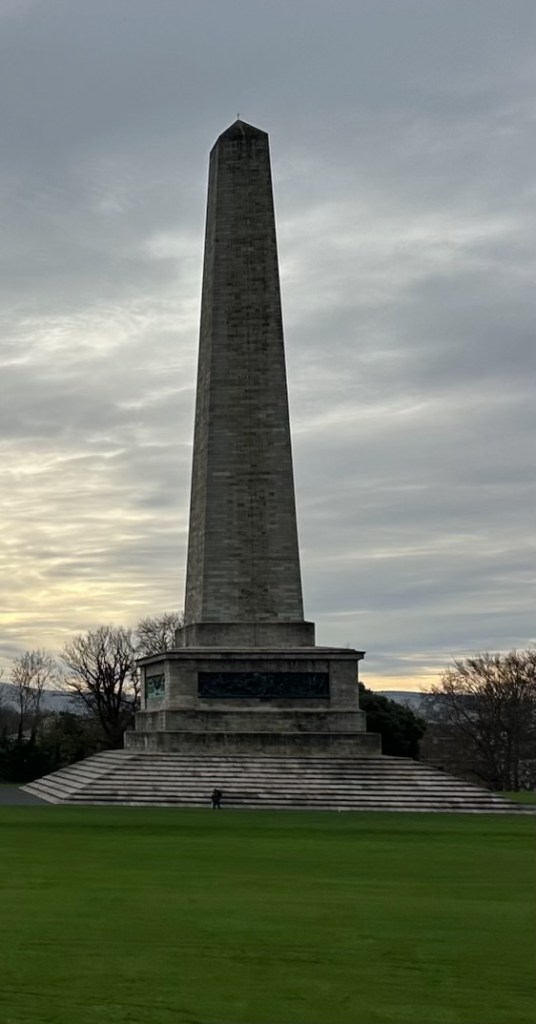
Faithful Reader Ron P. shared this photo of the Wellington Testimonial (which is evidently a fancy way of saying “monument”) in Phoenix Park, in Dublin (Ireland).
(New readers may want to check this post to understand this blog’s fixation with obelisks. It’s not what you think!) Anway, the Wellington Testimonial was erected (so to speak) in 1861, and it’s 203 feet tall, making it the tallest obelisk in all of Europe. As a point of reference, the Washington Monument is 555 feet tall, which I think handily proves the superiority of America.
The other day I was driving along the freeway, observing the passing phalanx of big, blocky buildings behind the trees and sound walls that flank the freeway. These buildings all seem to have been conceived by a kindergartener for whom the words “office building” and “box” are synonymous, and then value-engineered to the apotheosis of vapidity–nondescript, slab-sided edifices with bands of tinted windows and, at a top corner, a single word in an unembellished font: “Kaiser,” “Allstate,” “Lennar.” We live in an age of soulless and tedious architecture.
And then, a little later, I spotted this in Sacramento:
Don’t scratch your cornea on that pointed roof!
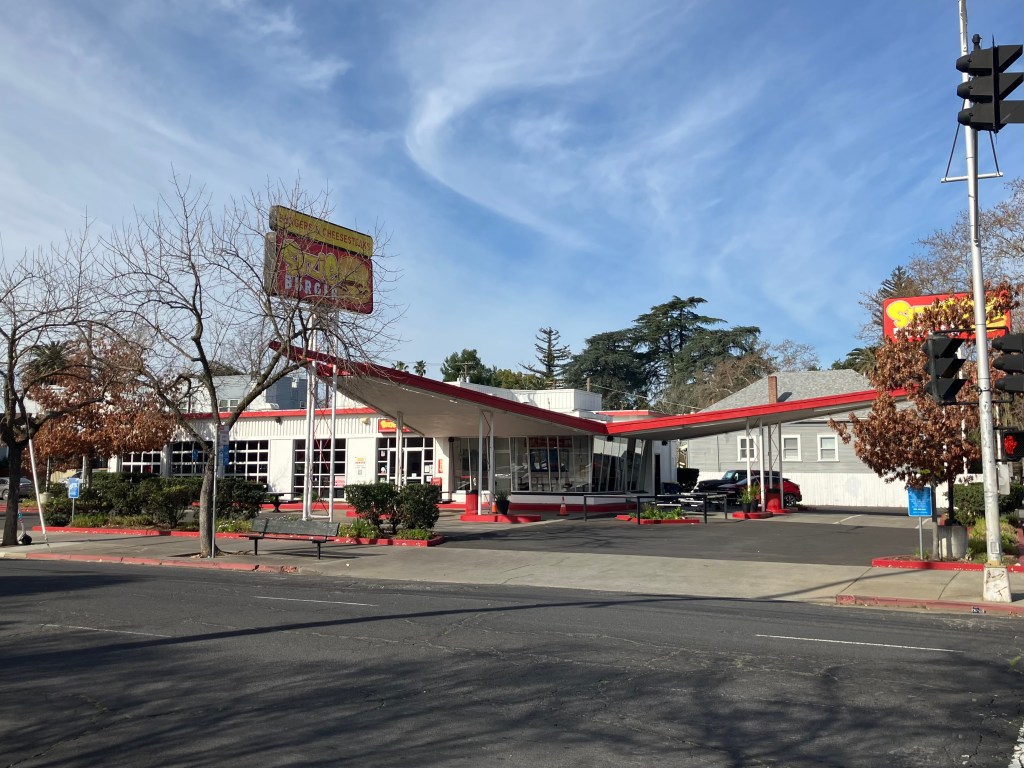
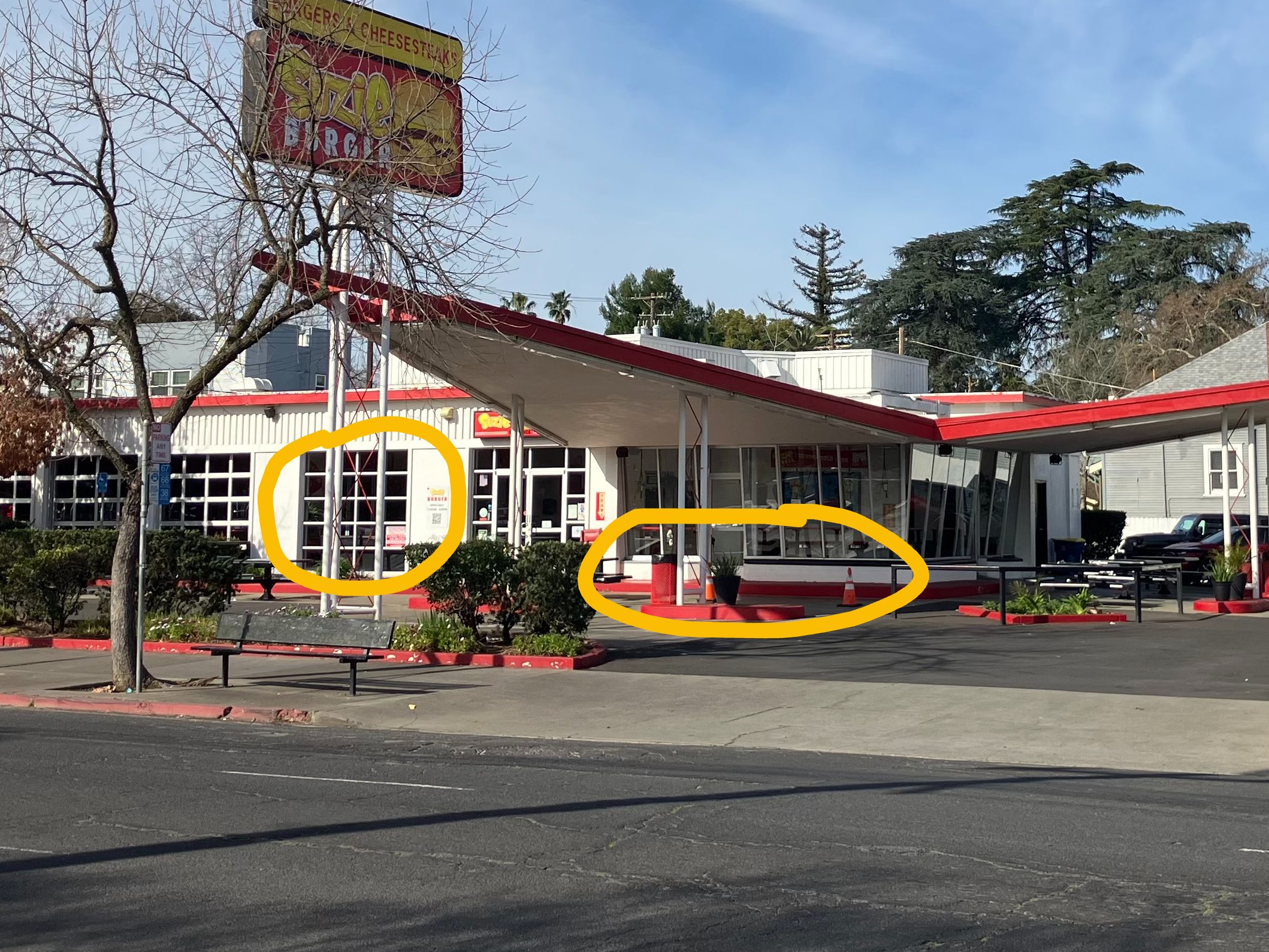
Now this building has style and soul! I realize that’s not a great photo; it was difficult finding the right angle. But it’s an old Orbit gas station, now repurposed as a hamburger joint called Suzie Burger.
That this was once a gas station is obvious. Note the islands where the gas pumps once stood, and the enormous mullioned windows that used to be roll-up doors in front of the service bays.
These Times They Are A-changin’ indeed.
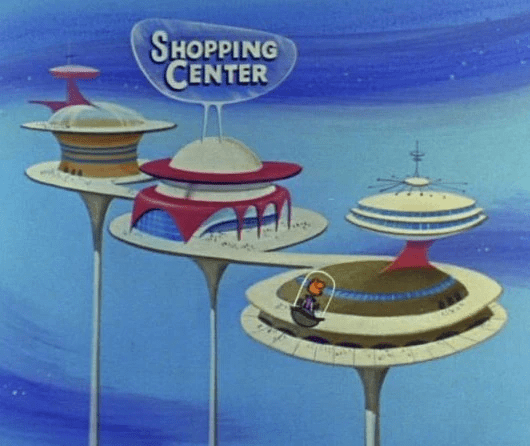
Orbit gas stations used to be all around the Sacramento area, first showing up around 1963. They represented the future, or at least what people during the age of black-and-white TV and AM radio thought the future would look like. It’s got a very Jetsons vibe, all upswept and angular and exaggerated.
Jane’s addiction.
According to this website, Orbit’s distinctive four-point architecture was the brainchild of some guy named Ed Ward. There were about a dozen of them at their peak. Now, it seems that most have been torn down in the intervening 60-odd years. And yet the good people at Suzie Burger recognized that Orbit’s retro look would be a great calling card for their old-school burger joint.
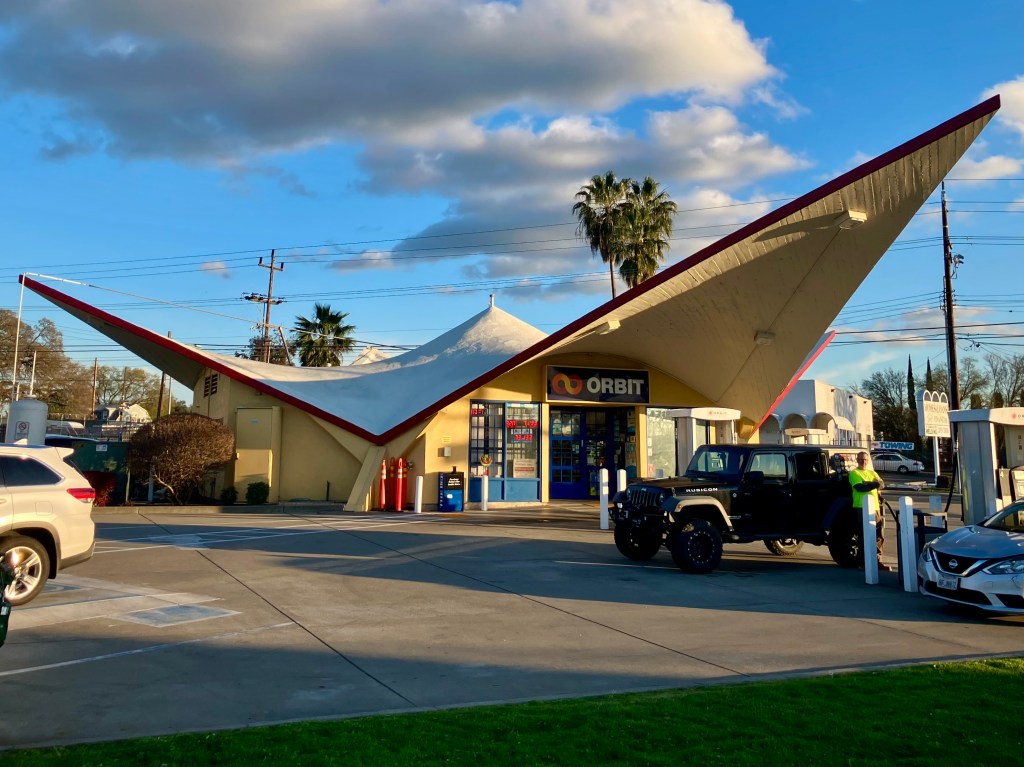
I remembered that when I lived in Sacramento (pop: 525K) in the 1980s, there was still a handful of Orbit gas stations in operation. In fact, I regularly gassed up the Studebaker at an Orbit station near my apartment in Carmichael. What had happened to it? Had it been torn down? Or had it been converted to some other use? I decided to take a drive out there to find out. And what to my wond’ring eyes should appear but this:
“It’s alive!”
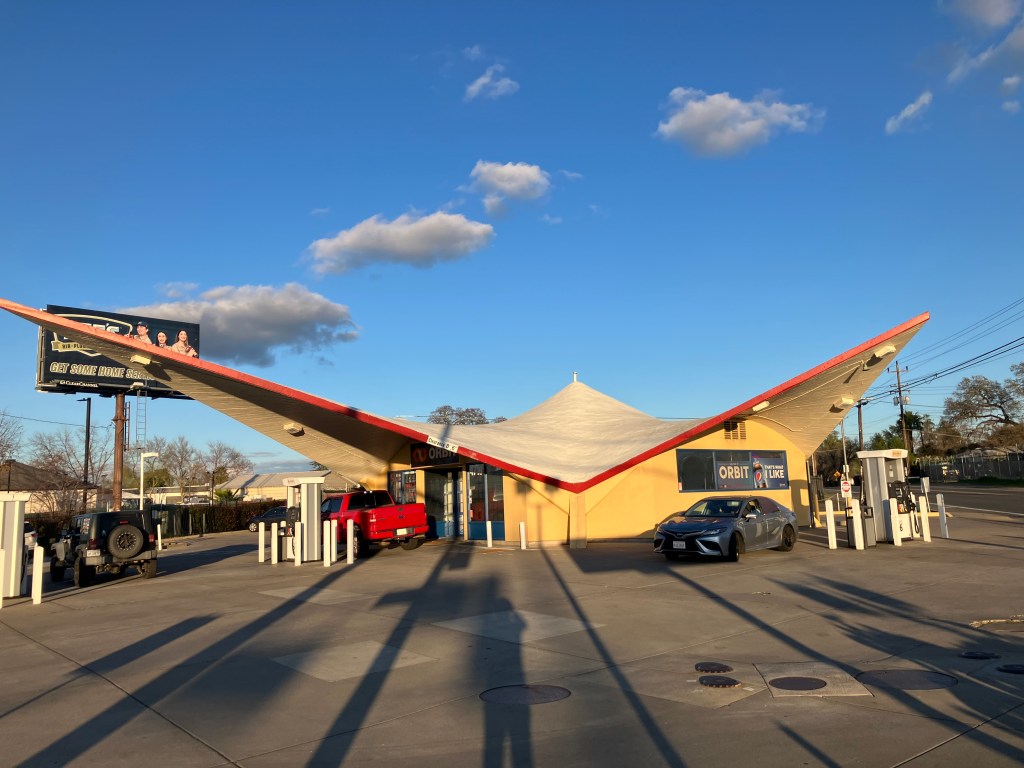
Not only had it not been torn down, but it was still operating as a gas station. It even still bears the Orbit name!
So take that, you big, ugly, featureless office buildings! Even at age 62, this Orbit is still going strong. Next time you find yourself in Sacramento make sure you gas up at 4716 Auburn Blvd and support the preservation of Googie architecture!
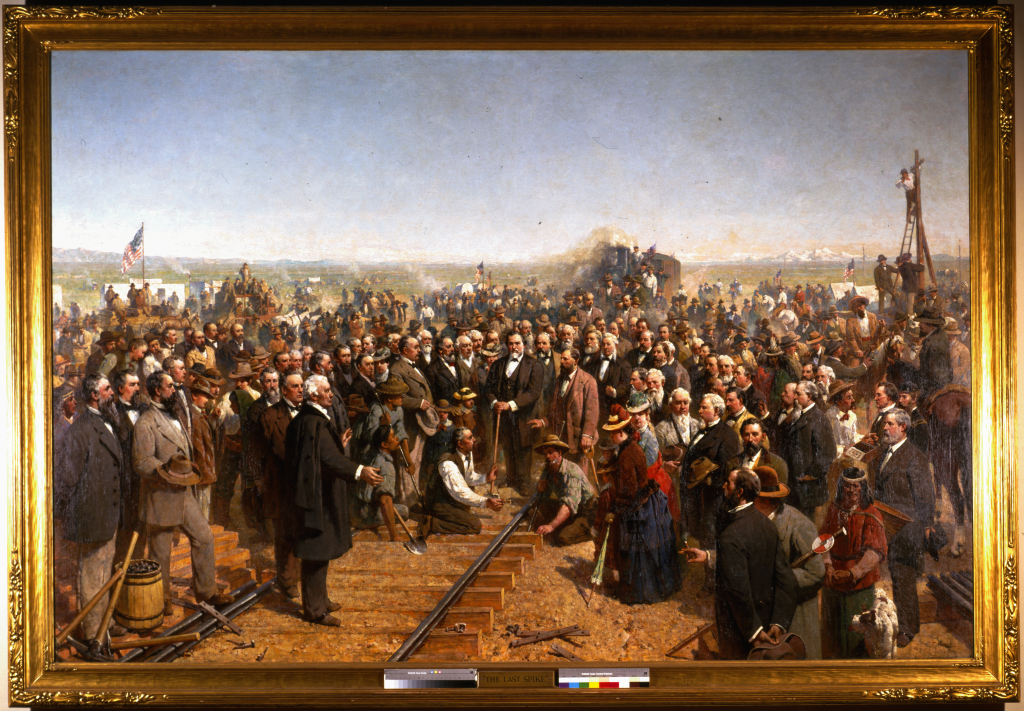
In the 1860s, the Central Pacific Railroad began laying tracks from Sacramento that would cross the Sierra Nevada mountain range and eventually connect with tracks that the Union Pacific was laying westward from Omaha. The two railroads were joined at Promontory Point, Utah on May 10, 1869. The country’s first transcontinental railroad was complete.
“The Driving of the Last Spike,” by Thomas Hill (1881). This painting, which isn’t entirely historically accurate, hangs in the California State Railroad Museum in Sacramento.
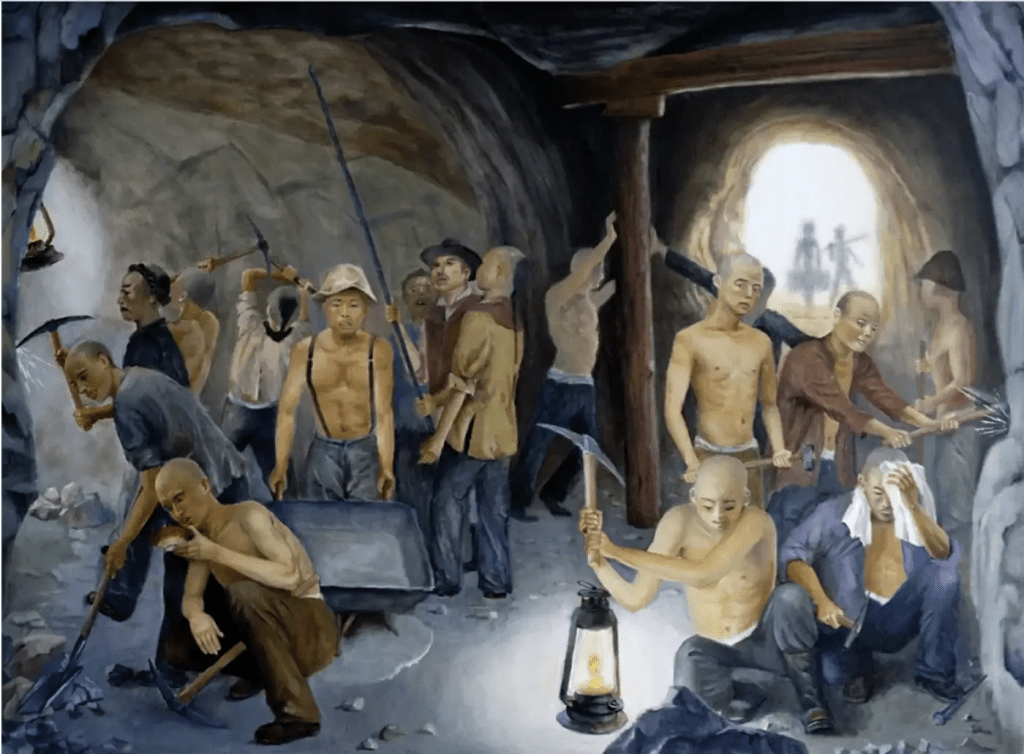
Much of the new railroad was hurriedly and haphazardly put down in a relatively straight shot across the Great Plains. But the much more difficult, dangerous, and impressive work involved cutting a roadbed across the Sierras. Fifteen tunnels would have to be dug through solid granite, using hand tools and blasting powder. Daily progress was measured in mere inches. In addition to the tunnels, various cuts, fills, and bridges were constructed to keep the roadbed at a manageably gradual incline. And because of the heavy snowfall in the Sierras, about 40 miles of snowsheds were built to protect tracks in the areas given to especially heavy snow and avalanches.
No picnic.
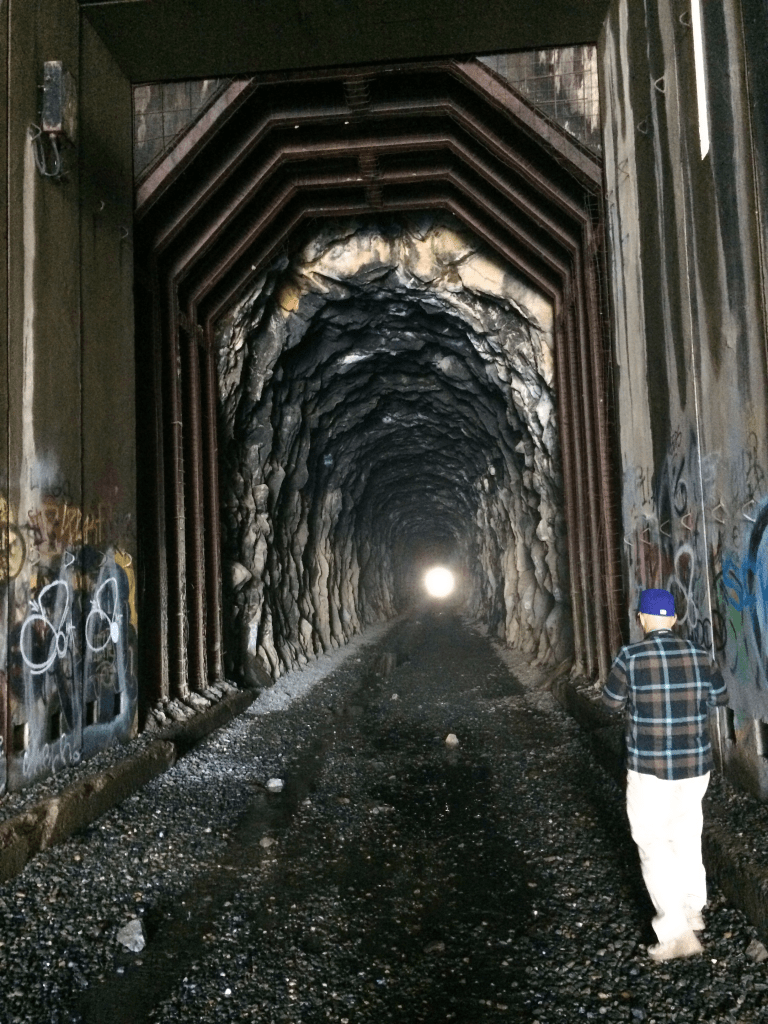
Today, over 150 years later, most of the original route is still in daily operation. (Some small improvements to the route have been made over the years, most notably the abandonment of the 1,687-foot long Summit Tunnel at Donner Pass. My friend Bill and I were able to walk through that abandoned tunnel a few years ago.)
Bill, literally walking in the footsteps of Chinese railroad workers.
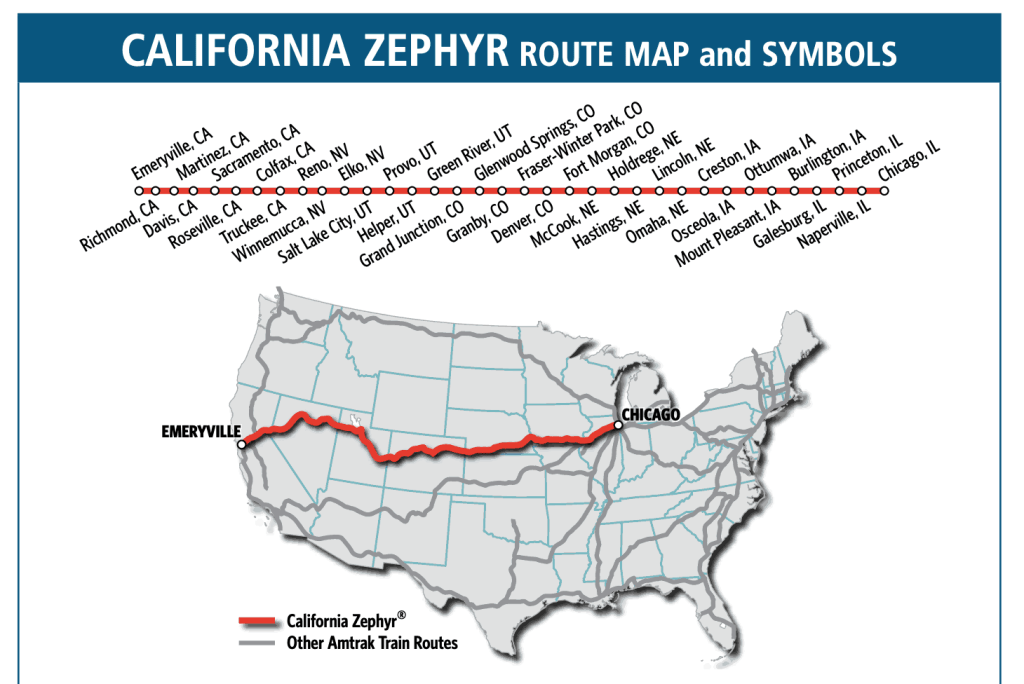
Amtrak (the country’s only remaining interstate passenger railroad) runs a daily train called The California Zephyr between Chicago and San Francisco, and naturally it travels the historic route over the Sierras. Now, you can catch glimpses of the railroad and its tunnels and snowsheds from your car window on Interstate 80, which roughly parallels the railroad. (I recommend the book Sierra Crossing by Thomas Howard, which describes the history of various routes over the Sierra Nevada.) But by car you just can’t appreciate the engineering marvel that is the Sierra route as well as you can by riding the rails themselves.
And so it was that, a few years back, my son (Ian) and I flew out to Chicago and boarded the California Zephyr. We were excited to experience the Sierra passage from the window of our compartment. But alas, Amtrak (which notoriously and habitually runs late) reached the Sierras not at midday as scheduled, but rather in the middle of the night as we slept.
Yesterday Ian and I tried again. This time we are boarding at the historic Sacramento station and heading east. We’re only taking the Zephyr as far as Reno, because the whole point of this trip is to finally experience the Sierra crossing in daylight.
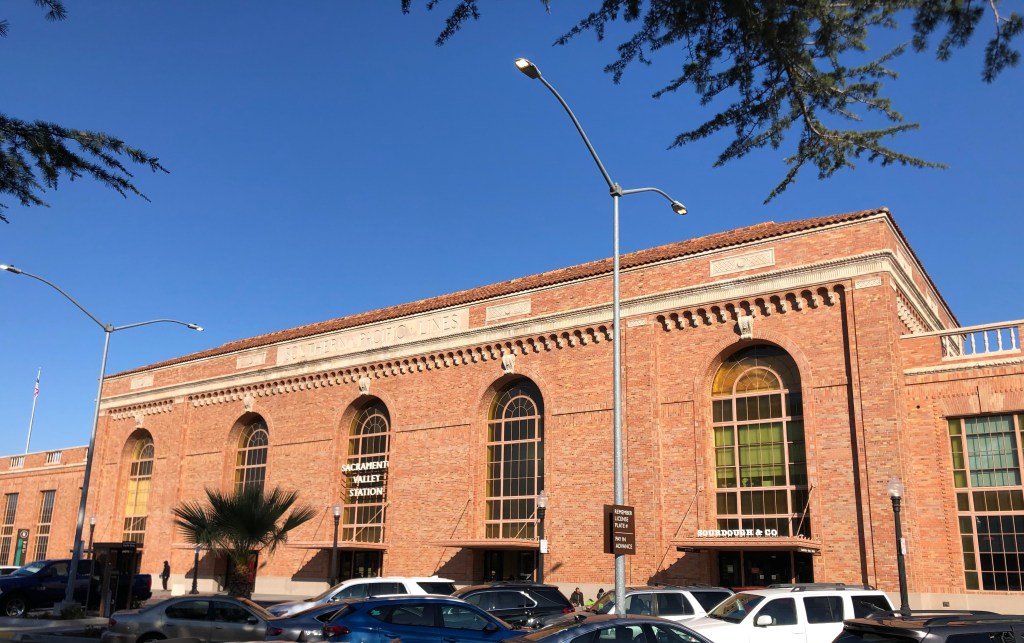
The historic Sacramento Station, built by the Southern Pacific in 1926.
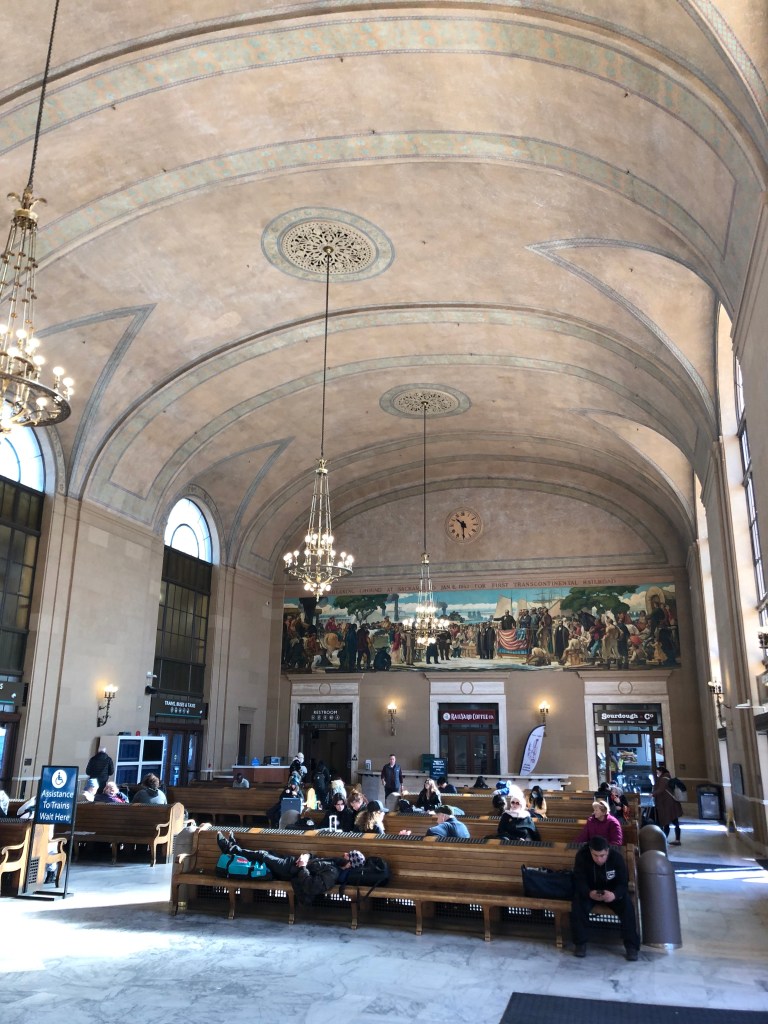
Interior of the station, in all its Renaissance Revival glory.
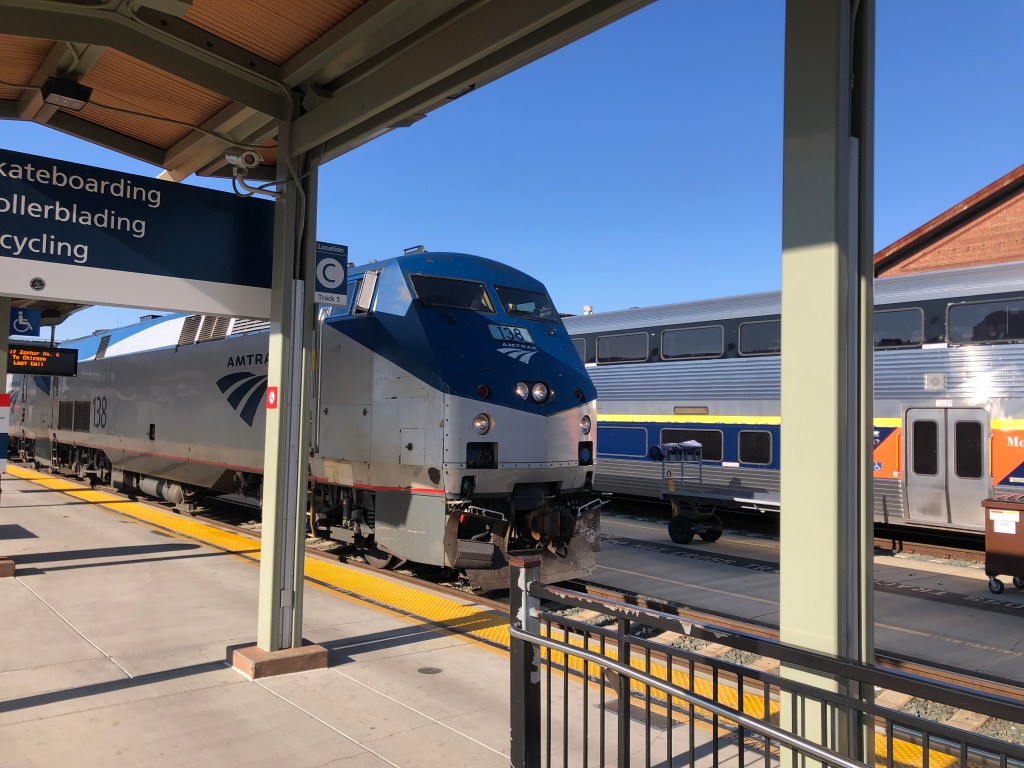
The California Zephyr arrived on time!
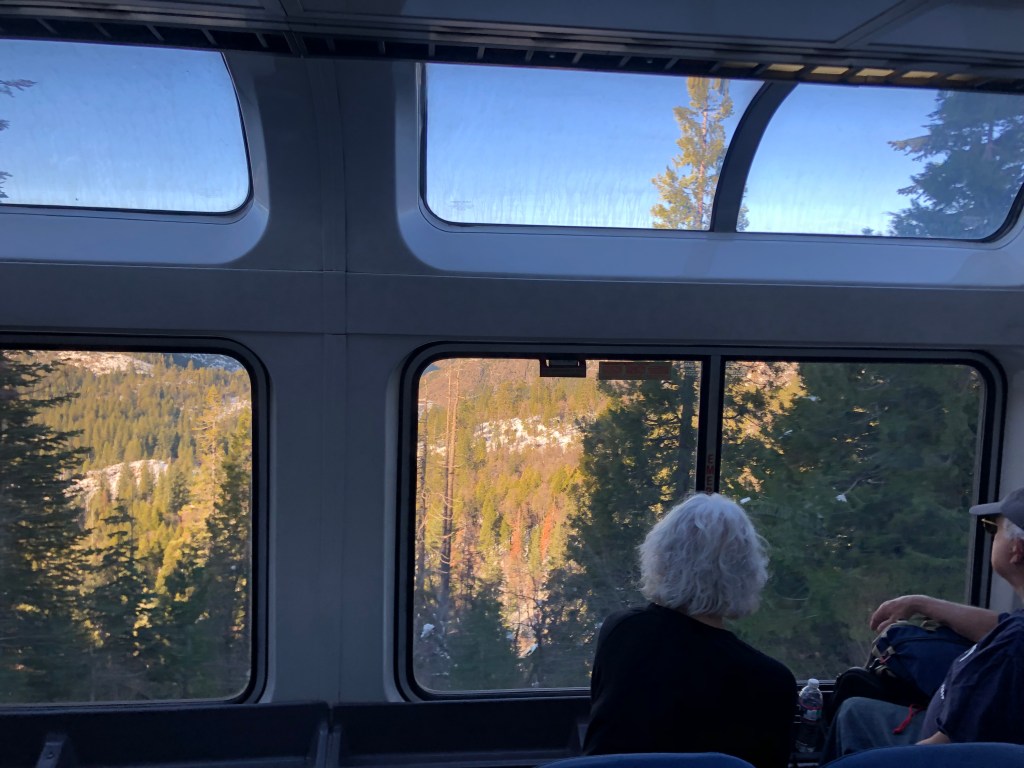
As the train started rolling we settled into our seats and began watching out the window at rather sketchy parts of Sacramento, Citrus Heights, and Roseville. We decided this might be a little more tolerable if we had beer, so we repaired to the club car. Fortified with our beers and some microwaved food, the scenery began to improve. Upstairs from the snack bar is a friendly and casual observation area, with nice big vista-dome windows and comfy chairs and tables. This is where we spent most of the trip.
Everyone loves the Vista Dome.
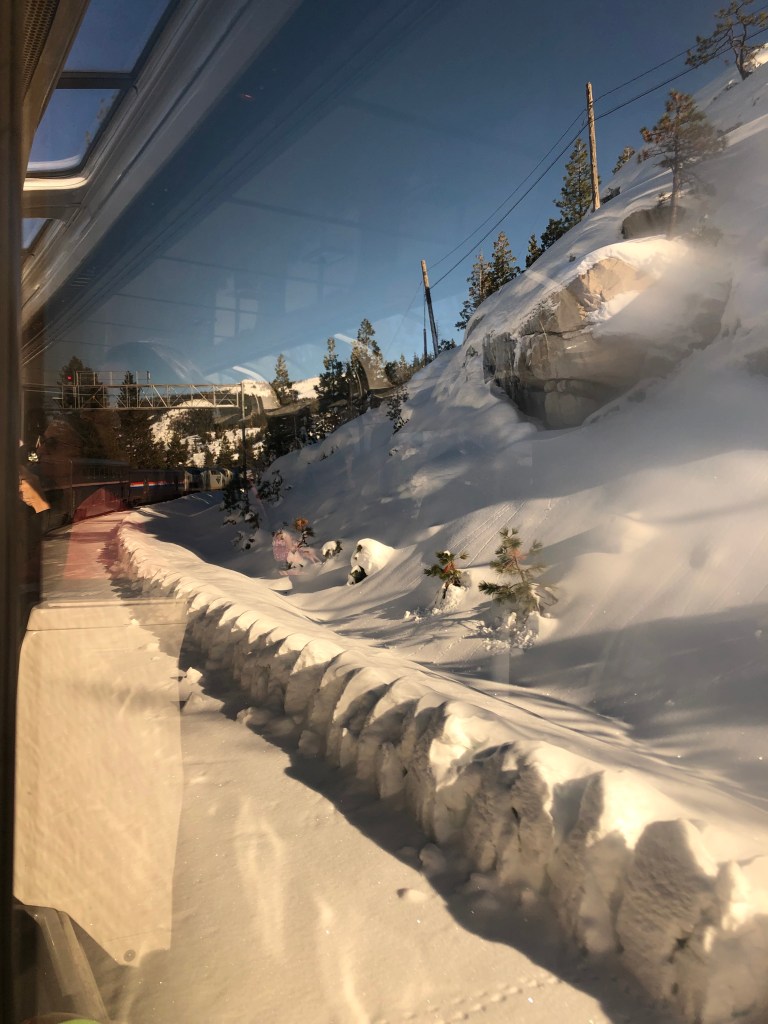
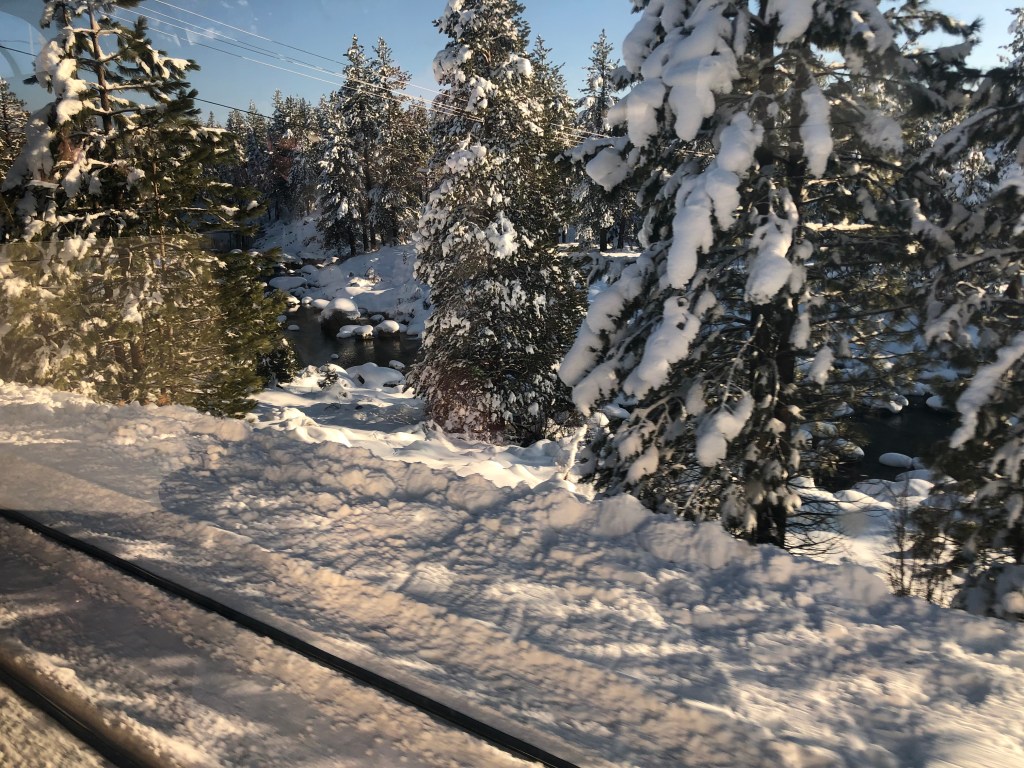
After a bit we started to climb into the foothills, and soon we encountered snow. Our climb over the Sierra had begun!
There’s something very relaxing about watching scenery through the window of a railroad car. The train moves steadily and smoothly, and the car is warm and comfortable. The passengers adopt an attitude like they’re in their own living rooms. Young parents entertain their kids, college students take pictures and send text messages, an older couple plays cards. One friendly guy was gushing to his seatmate about how he prefers train travel to the stress and hassle of flying. A few people were napping. Many just watched out the windows. It’s a remarkably relaxed way to travel, where you wear no seatbelt, you have freedom to move from room to room, and someone else up at the front of the train is in charge of getting you where you need to go.
Of course, I had my own specific interest in this particular route. I kept trying to imagine how the Central Pacific work crews managed to build this railroad over the Sierras using 1860s technology. They worked in subfreezing temperatures and massive snow drifts battling avalanches, gravity, and relentless granite walls. And yet they completed the job in just a few years. It’s hard to imagine CalTrans, even with all its modern equipment, ever matching that record.
After a few hours we reached Donner Pass at about 7,000 feet. The snow was at its thickest here, but it was pretty scanty by historic standards. A snowplow had passed through about a week earlier. Fortunately, brother-in-law Scott found a video of that very event: The plowing of Donner Pass around December 10.
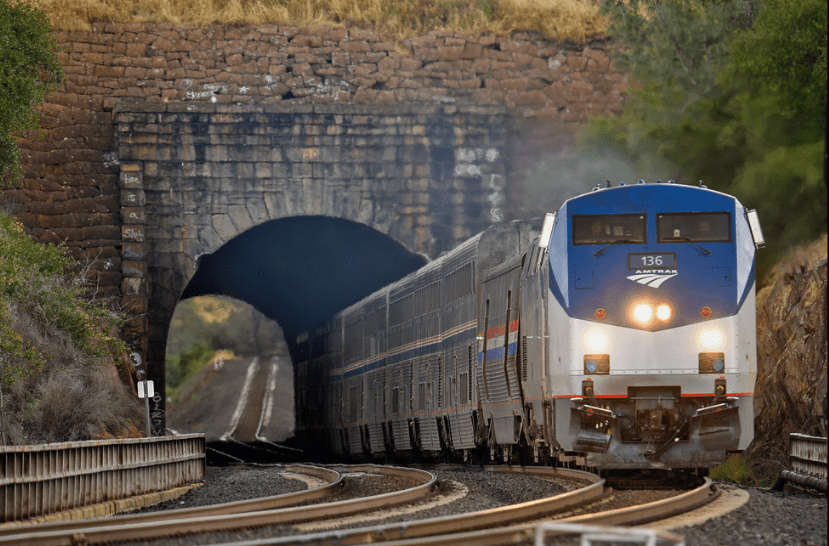
The other thing I really like about going over the Sierra by train is the visual access to California’s remote and relatively untouched lands. In the more urbanized parts of the state where most of us live, very little evidence of our history remains. Historic buildings are torn down as soon as they are deemed “outdated.” Those that do remain are often rebuilt with modern materials or modified for ADA access. But here in the Sierra it’s not unusual to see 150-year-old relics still standing proud–Like many of those original tunnels that we passed through.
I did not take this photo, since I was onboard the train! Photo taken by Tom Taylor, who does excellent railroad photography.
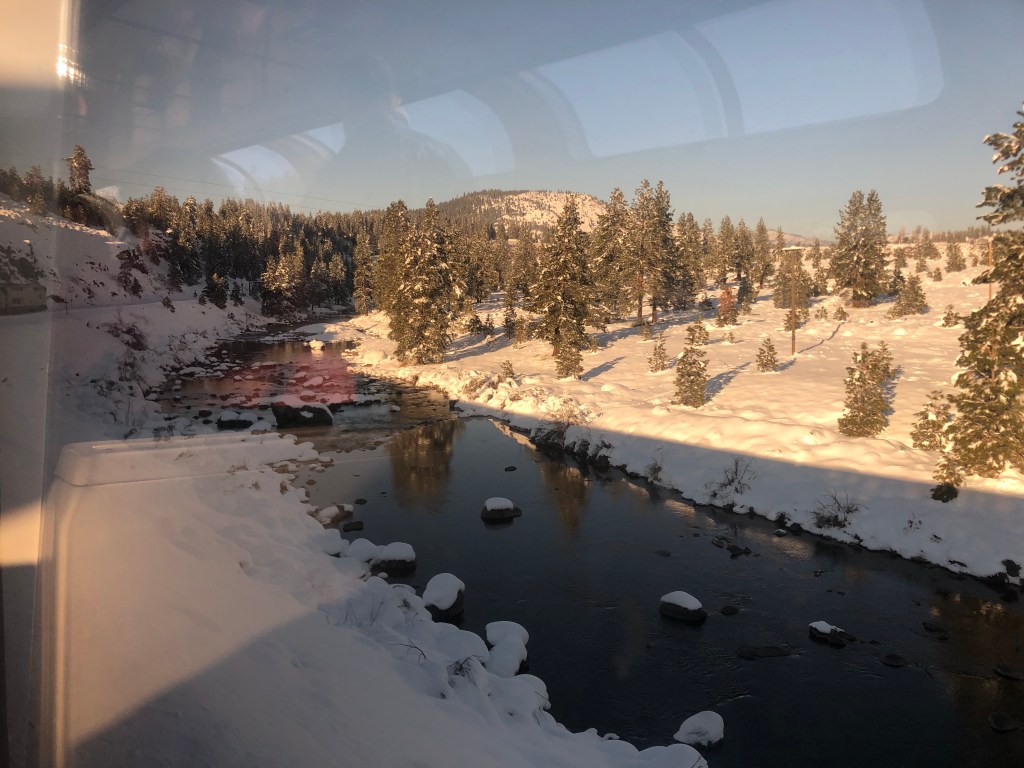
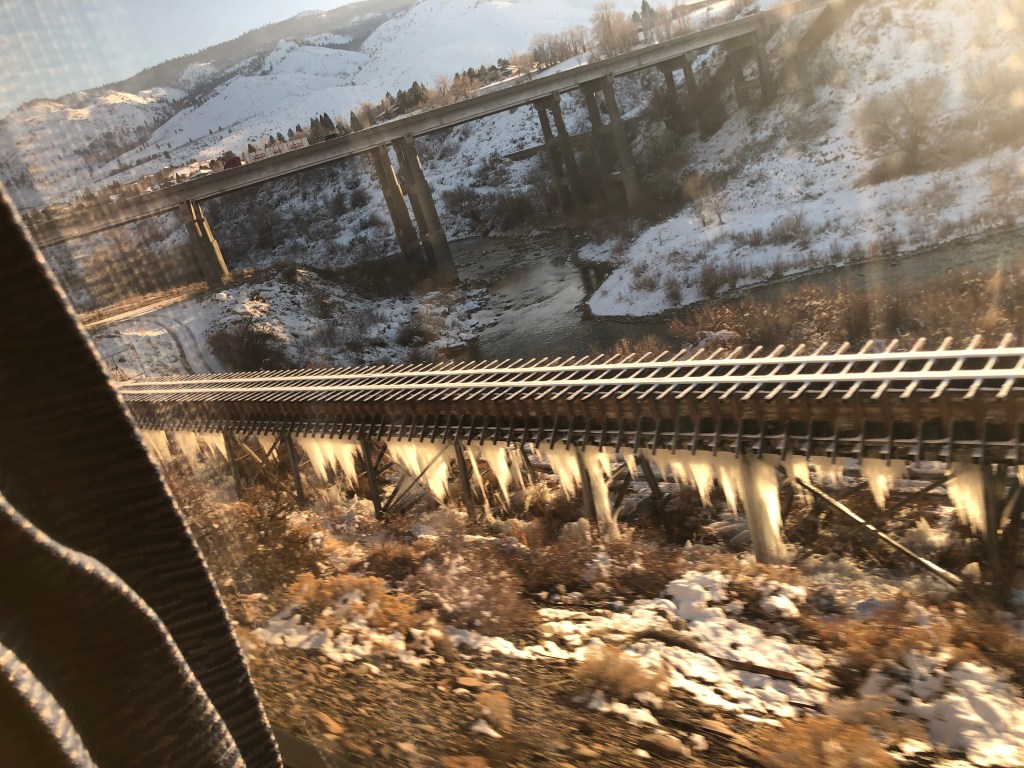
Another relic from a century ago is a collection of wooden flumes conducting water along the Truckee River. The water powers several century-old hydroelectric plants that are still in operation today.
The Truckee River.
The flume is the railroad-track-like structure at the lower third of the photo. Note the icicles hanging beneath. Evidently the wooden flumes aren’t watertight.
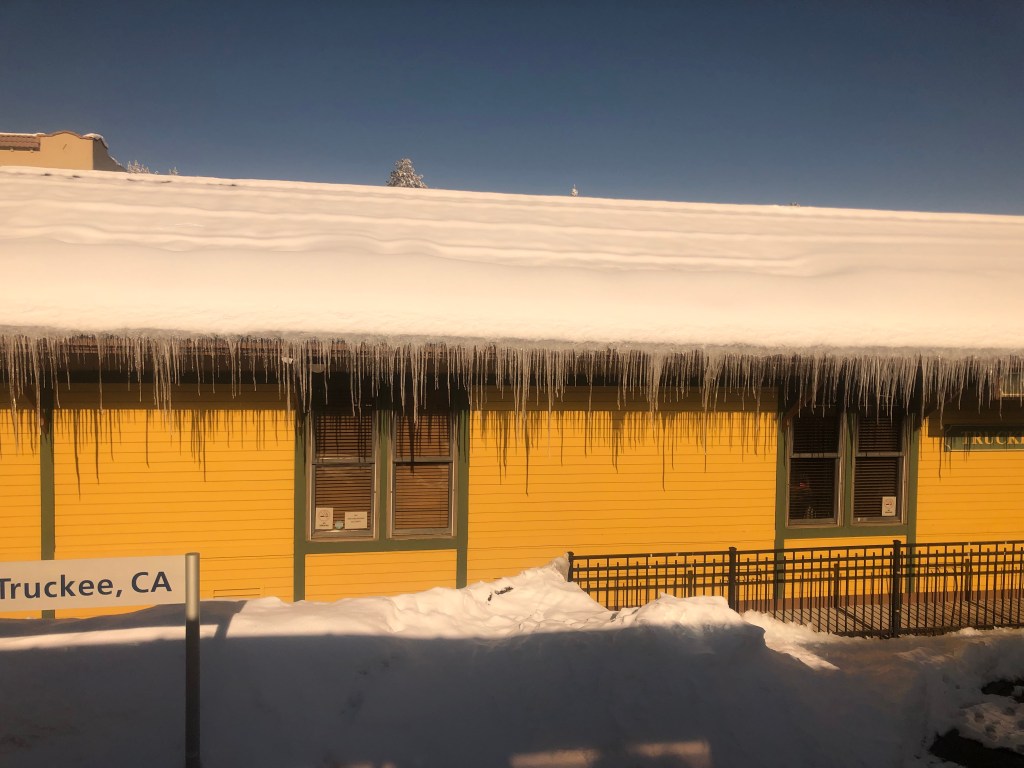
Speaking of Truckee, the town still has its old Southern Pacific station from 1900. It’s remarkably well preserved, and according to “The Great American Stations” website, “Renovations and modernization in 1985 altered the historic fabric only slightly.”
Careful standing under those eaves!
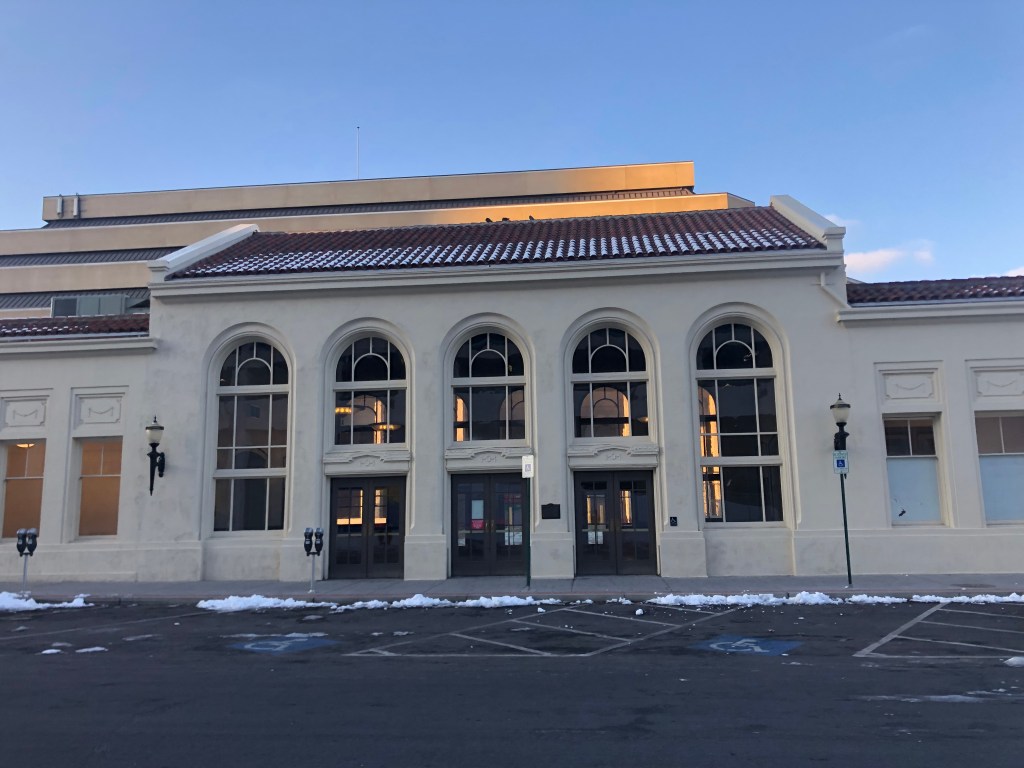
Eventually we got over the Sierras and dropped into Reno, NV (pop: 270,000). Reno’s current Amtrak station was grafted onto the city’s 1926 Southern Pacific depot in 2005. That same project lowered the railroad tracks into a 2-mile long ditch (a two-track-wide concrete canyon), in order to eliminate 11 grade crossings at street level. We got off the train down in this concrete canyon, enter a waiting room, and then climb stairs to the street level.
The Reno station at street level. (This is the original Southern Pacific portion of the structure; the Amtrak section is to the left.)
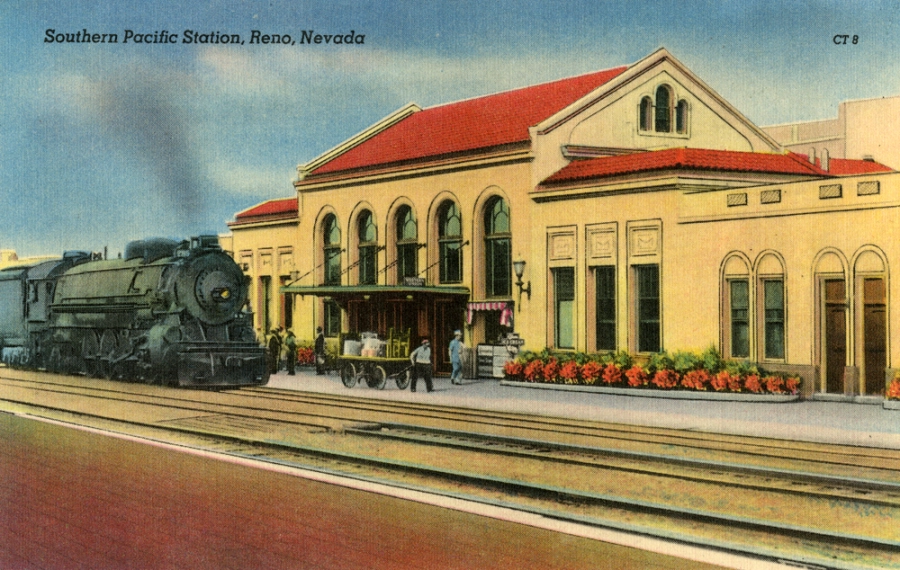
Reno’s Southern Pacific station in the steam era.
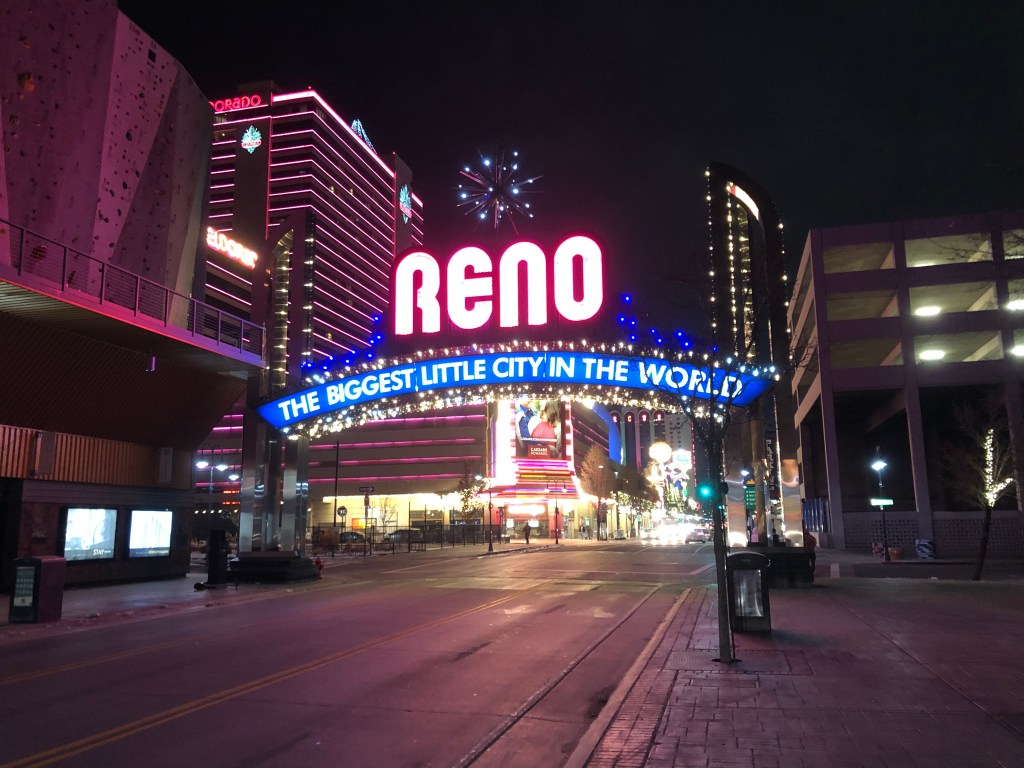
So, that’s about it for our Amtrak adventure over the Sierra. (We returned today, but obviously covered the exact same ground.) But it’s worth noting that we spent some time walking around Reno last night…
…and naturally I was able to squeeze in a Brew of the Day. So, without further ado, I present:
THEBREW OF THE DAY
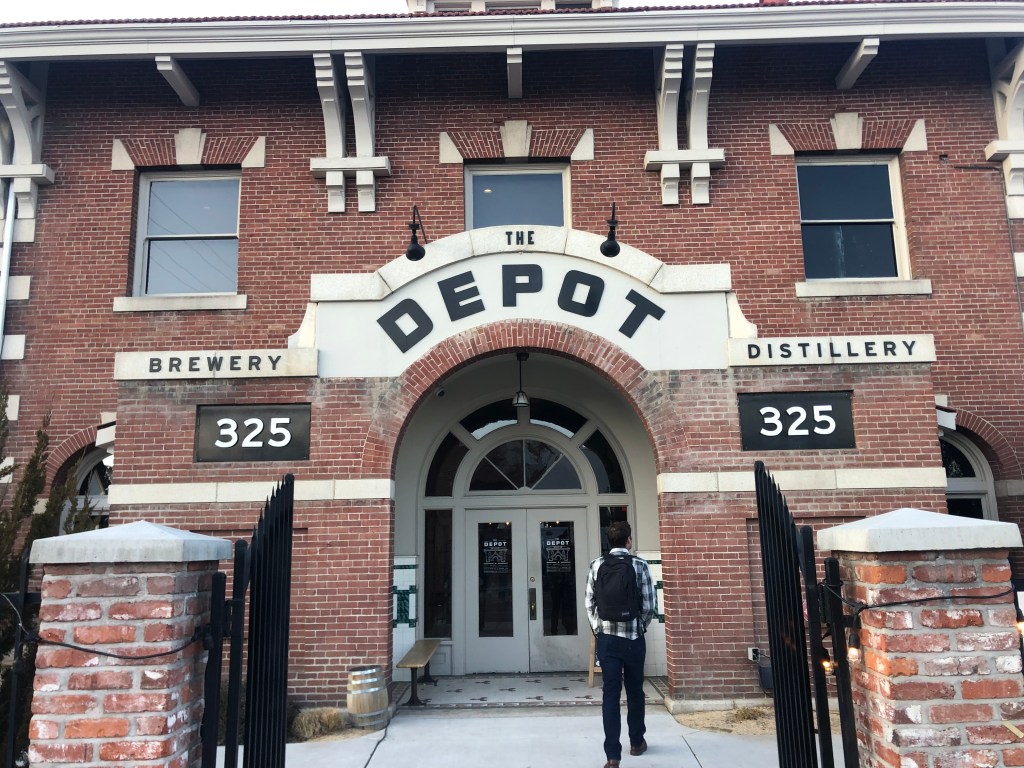
Just a few blocks from the Reno station is a brew pub named The Depot. Appropriately, it’s housed in the old Nevada-California-Oregon Railroad depot, which was built in 1910.
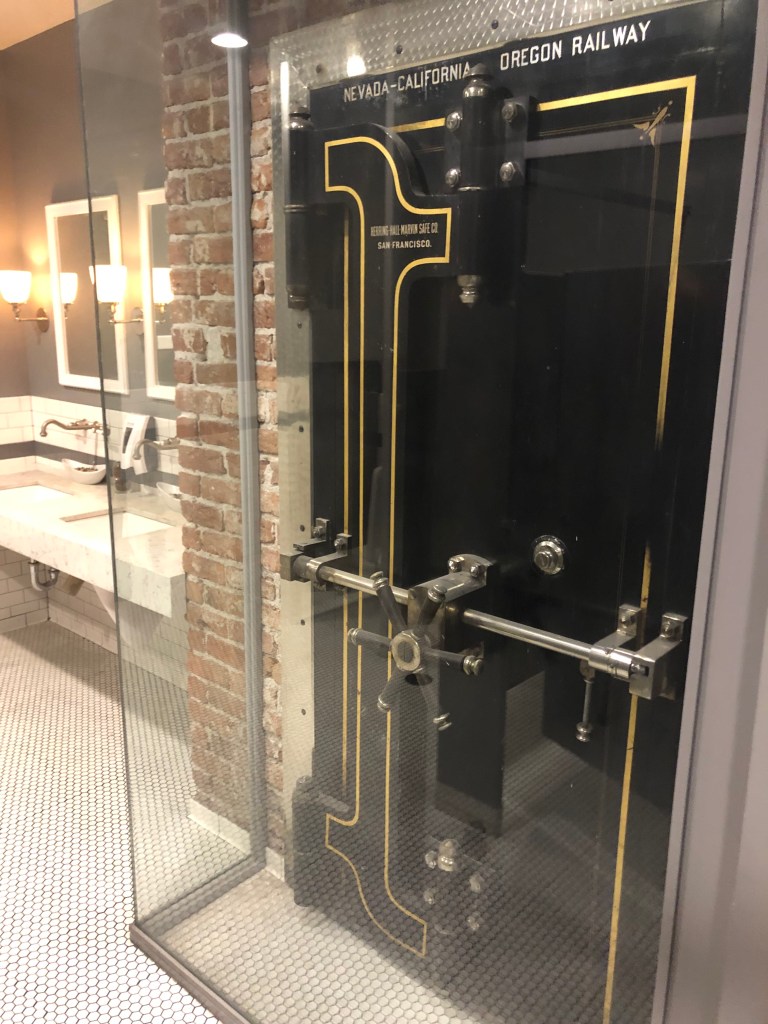
It’s a cool old building, remarkably preserved, with an impressive bar and attractive decor. There are neat old and anachronistic features everywhere, including the railroad’s ancient walk-in safe standing in the Men’s room.
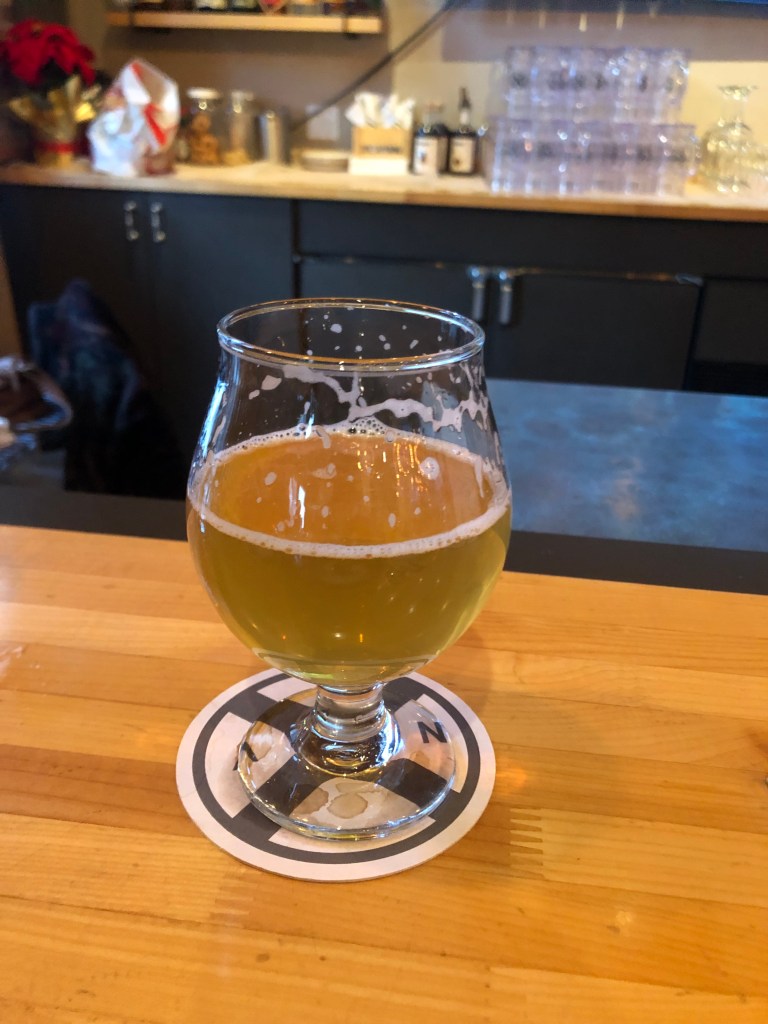
Feeling good about our find, we set ourselves down at the bar and studied the extensive beer menu. After much consideration I ordered something called a “Yankee and Kraut.” Let me quote how the menu describes it: “German beechwood smoked malt and Bavarian pretzel smoked sour ale.” (5.9% ABV.) I was intrigued. I’d literally never heard of anything like it. But I like Bavarian pretzels, and I like smokey drinks like Scotch or Mezcal or a smoked porter. What could go wrong?
Yankee and Kraut
The first sip I took definitely had a smokey profile, but it was fleeting and became immediately overwhelmed by a sour, vinegary assault on my tastebuds. This wasn’t a fun or playful sour like you get from sour gummy worms or Lemonheads. This was reminiscent of swimming pool acid. What’s more, the acidic, sour taste kept increasing with each new sip. And then, just when I thought it couldn’t get any worse, a “finish” reminiscent of off-brand window cleaner washed over my tongue and singed my sinuses. Meanwhile, there was not the slightest hint of “Bavarian pretzel” anywhere–not even the requisite salt or mustard, which would have been a welcome distraction for this beer. I cannot in good conscience give this anything higher than zero points. (The Mac ‘n’ Cheese Bites were awesome, though.)
 Chasing Phantoms