Editor’s note: Given limited travel opportunities these days, I decided to post some travel stories I’d written prior to starting this blog. The following is from August 2019. I hope you might vicariously enjoy this trip while we’re all hunkering down at home.
Yesterday was a beautiful, warm, sunny day here in the so-called “Southland,” and more importantly, it was not a Monday, Tuesday, or Wednesday. Stick with me on this for a minute.
There’s an old restaurant high up in the San Gabriel Mountains. Named Newcomb’s Ranch, its lineage dates back to 1888, when a mountain man named Louie Newcomb built a cabin and became one of the first forest rangers in the new San Gabriel Timber Reserve. Louie ended up selling his land in 1929, and by 1939 the new owners had built a restaurant just a few hundred yards from Louie’s original cabin. Over the years this restaurant (largely rebuilt after a fire some 45 years ago) became a popular stop for motorcyclists. It sits about halfway along the winding, 66-mile, two-lane “Angeles Crest Highway,” which crosses the San Gabriel Mountains and was built by prison labor in the 1930s and 1940s.
I first stumbled across Newcomb’s Ranch a few years back while taking a day trip along the Angeles Crest Highway. Now, no one who knows me would ever use the term “biker” to describe me. But I was strangely attracted to the biker hangout as a way to prove that, yes, I can fit in with that crowd. I mean, I own a bike, right? But it was late in the day, and I didn’t have time to stop. So I made a mental note to return some day. A few weeks later I made the trip up the ACH again, with the intention of stopping for lunch at Newcomb’s. But I found the doors locked, and a couple of swarthy-looking bikers eating bag lunches on a picnic table in front of the place. “Are they closed?” I asked the bikers. The more sentient of the two looked up at me and said “Yep.” When it was obvious that I was looking for a little more information, he volunteered that the place is closed Monday through Wednesday. I was there on a Wednesday.
So Thursday of this week I set out for a third assault on Newcomb’s Ranch. I was enjoying the ride through the mountains when I abruptly encountered a “road closed” sign. It turns out the ACH experienced a landslide a few months back, and CalTrans is still at work clearing it and installing new retaining structures. Here’s a picture (from the web) of the goings-on:

A “detour” sign pointed toward a side road (though it contained no information as to length or destination). I tried it. Before long I was crossing the Big Tujunga Narrows Bridge, which is an impressive structure over 400 feet long from 1941. Here are a couple of my photos:
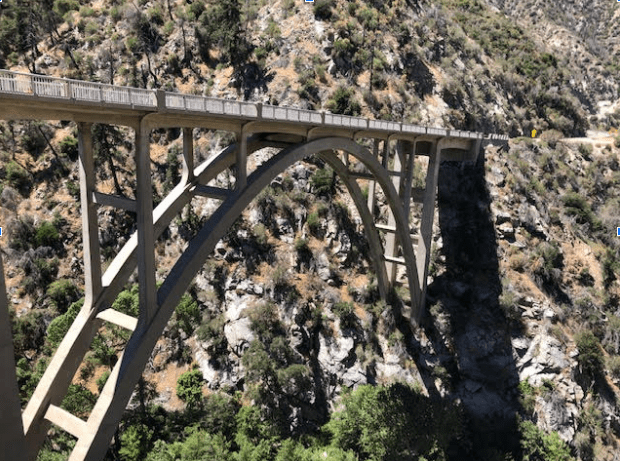
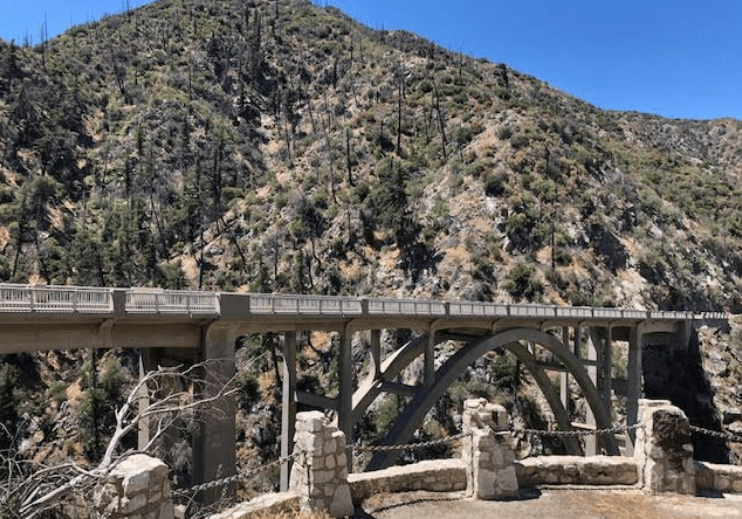
The second photo shows what appears to be an old overlook site in the foreground. The area was fenced off, but it was easy to get past the barrier. I got the sense that it was considered unsafe, and thus the public was discouraged from going out to this area. It felt like an old Conservation Corps project, or maybe a WPA project. But there was no plaque, and I couldn’t find any information about it online. I’d welcome any intel that readers might be able to share.
Eventually the detour routed me back to the ACH, some ways past the landslide, I presume. A few more miles and I came upon the fabled Newcomb’s Ranch. But wait: there were no signs of life through the windows of the building. And weren’t those the same two bikers I’d met weeks before, sitting out on a picnic bench? I walked up to these now-familiar figures, and asked if the place was closed. “Yep.” (I should have learned my lesson the first time.) I protested that “It’s Thursday!” One of the guys just shrugged, and said “sometimes something comes up. I think they might have lost their power.” I told them that I’d made a trip out here just to get a burger, so they pointed me down the road to a place called Sky High. How far is it, I asked. “About 30 miles.” That would take me just about to the end of the ACH, so heck, I decided to make the trip.
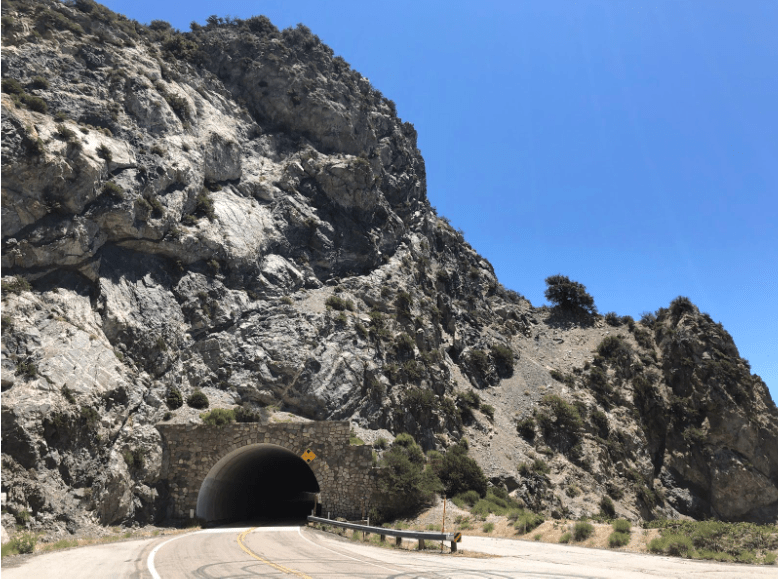
I didn’t encounter much traffic on the ride. Mainly just a few other guys on motorcycles. The road twisted over and even through the mountains. Here’s one of the tunnels, that I thought was picturesque:
I was becoming famished. What with the detour, and with the unexpected additional mileage to the Sky High restaurant, it was now almost 2 pm. But I stopped once again for another of the rare structures along this desolate road. It looked like an old lodge of some kind, with a stone tower and a bronze plaque bearing a poem from 1925. Here’s a picture of the tower. (Sadly, I didn’t get a picture of the lodge.)
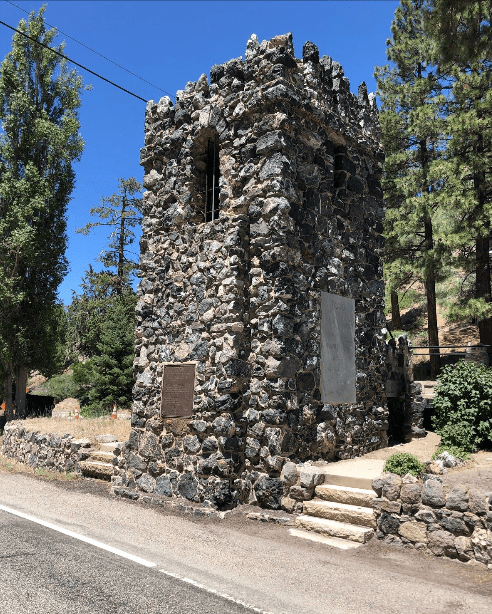
The structures were immediately on the side of the road, and they were completely deserted. Other than the poem (“In the Pines,” by WIlliam Bristol) and the engraved names of the LA County Supervisors from early in the last century, there was no information as to what the heck I was looking at. Further research would explain that these are the remnants of the Big Pines Recreation Camp — a retreat owned by the County of Los Angeles to provide recreational opportunities like boating, hiking, and horseback riding on 5,600 acres of property in the San Gabriel Mountains. The camp was opened in the 1920s. Here’s a historic photo I found:

You can see that my mysterious stone tower had been part of an entry arch for the camp. The lodge-like building I saw evidently had been the recreation hall. At some point later in the century the facility came to be too much for the county to maintain, so it was turned over to the US Forest Service. I’m told that the recreation hall is now a ranger station, but there were no signs of life when I was there.
WIth hunger gnawing at my stomach, I got back on my bike and continued eastward on the ACH. Shortly I saw a sign for “Burgers and Pizza” at a place called “Sky High Disc Golf.” This must be the place. I turned onto a narrow, steep road for about a mile, and arrived at an old two-story building that seemed to serve as a ski lodge in the winter. Now, in mid-summer, the vast parking lot was deserted. I went up the stairs and found the door to be open. I was met by an older woman who’d evidently had a hard life, standing behind a lunch counter looking bored. I was the only person in the place that wasn’t paid to be there, and I wouldn’t be surprised if I was her only paying customer for the entire day. She asked me what I wanted, and I (perhaps foolishly) asked her what she’d recommend. “Well, the chili cheese dog isn’t bad.” With a recommendation like that, how could I resist? Soon I was tucking into a slightly warmed generic hotdog on a soggy bun covered with shredded American cheese and some questionable chili. This was my quarry for the day.
After my repast, I got back on the Triumph and headed down the hill to rejoin the ACH. But then I figured I’d take a different route to head home, so I jumped onto the Big Pines Highway, which looped a little further north than the route I’d come. Most of the day’s travel was entirely rural, with almost no signs of habitation. Imagine my surprise, then, when I came across this sign which seems to promise some kind of real civilization:
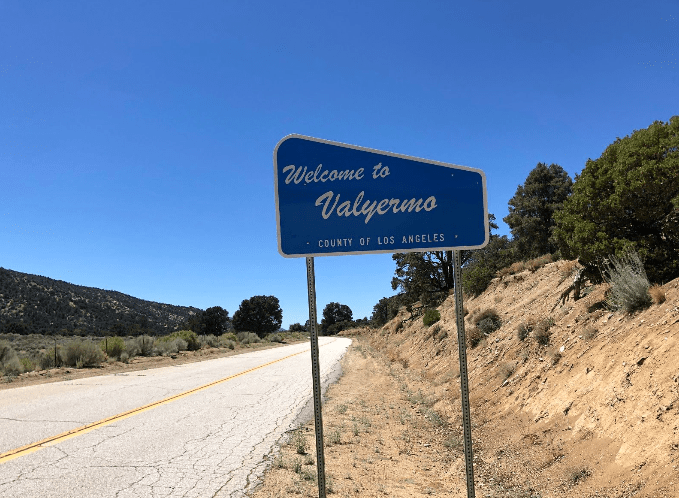
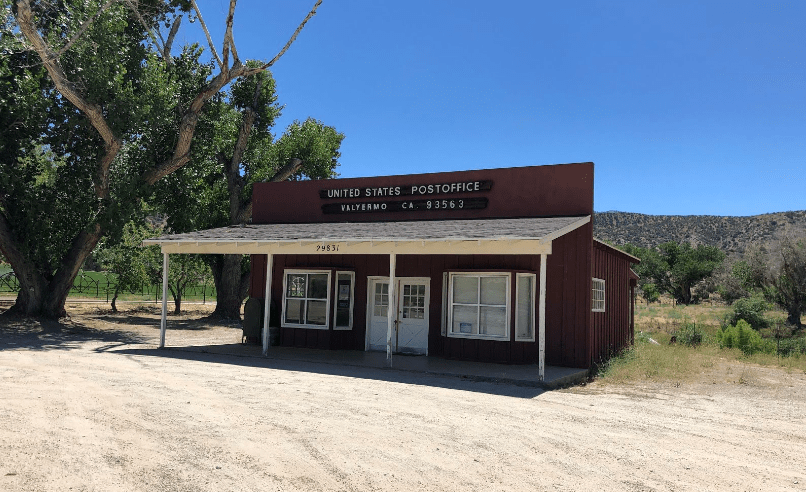
Alas, Valyermo appears to have little to recommend it, other than some scrub brush and a couple of buildings. One of those buildings, surprisingly, is a sturdy post office. It was closed however. On a Thursday afternoon. I can’t imagine they get a lot of business.
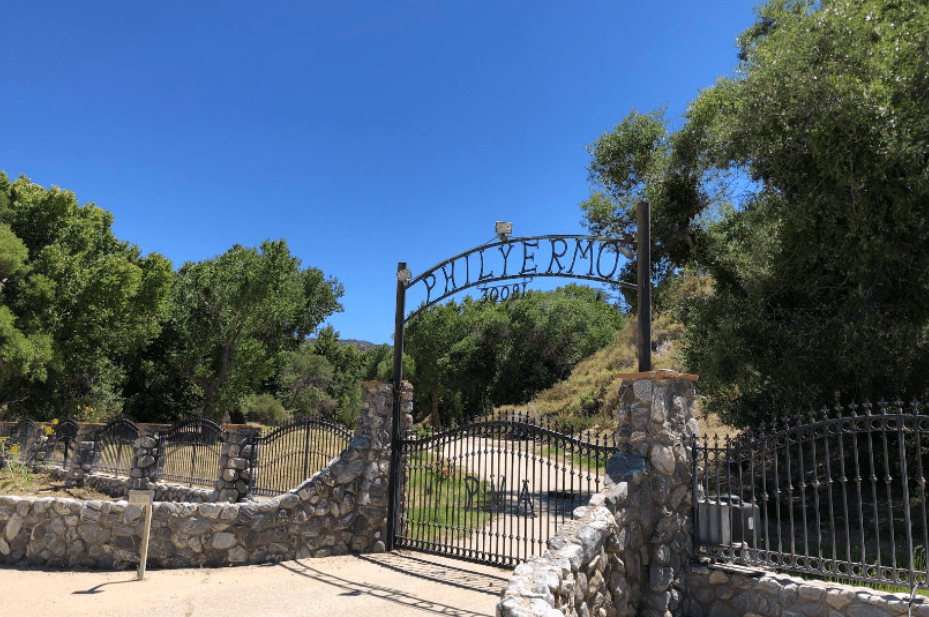
The other notable site was this entrance to an 800-acre ranch, which had originally been owned by Bob Wian (the guy behind the eponymous “Bob’s Big Boy” hamburger chain). Bob died over 25 years ago, but his ranch, I’m told, is now owned by a guy named “Phil,” who renamed the place by inserting his surname into the first syllable of Valyermo. I guess it’s his version of Trump Tower.
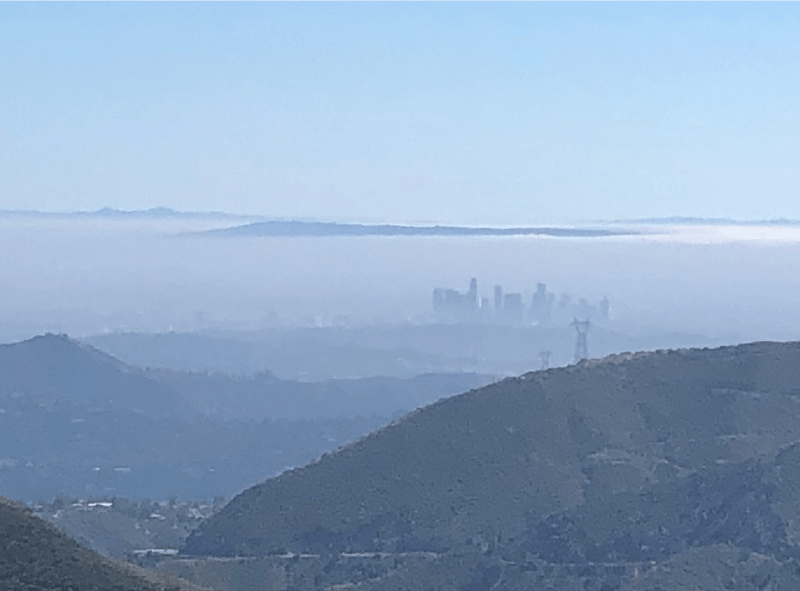
Continuing on, I found myself leaving the mountains and heading towards Palmdale, on the floor of the Mojave Desert. Here’s a photo looking down on the desert from when I was still higher in the mountains:
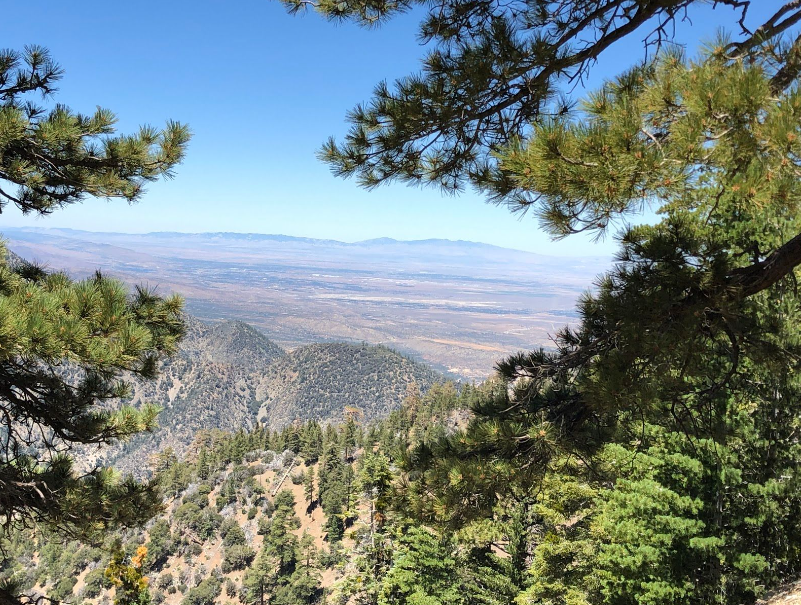
It’s striking how effectively the San Gabriel mountains separate the burning desert heat from the (relatively) cool ocean air of Los Angeles. And yet, cutting through this inhospitable, arid land is an aqueduct. This time it’s the California Aqueduct, bringing water from the Sacramento Delta down to Los Angeles. You have to wonder how much of the water evaporates before it enters the county.
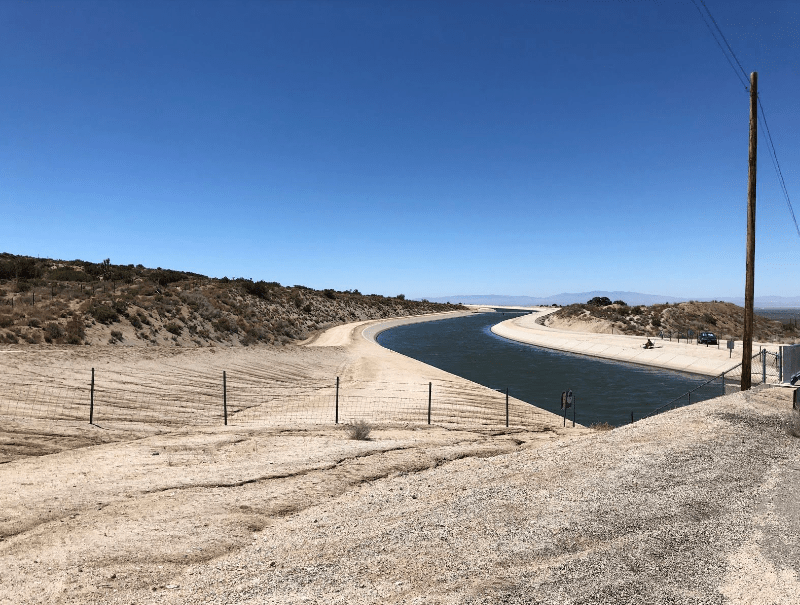
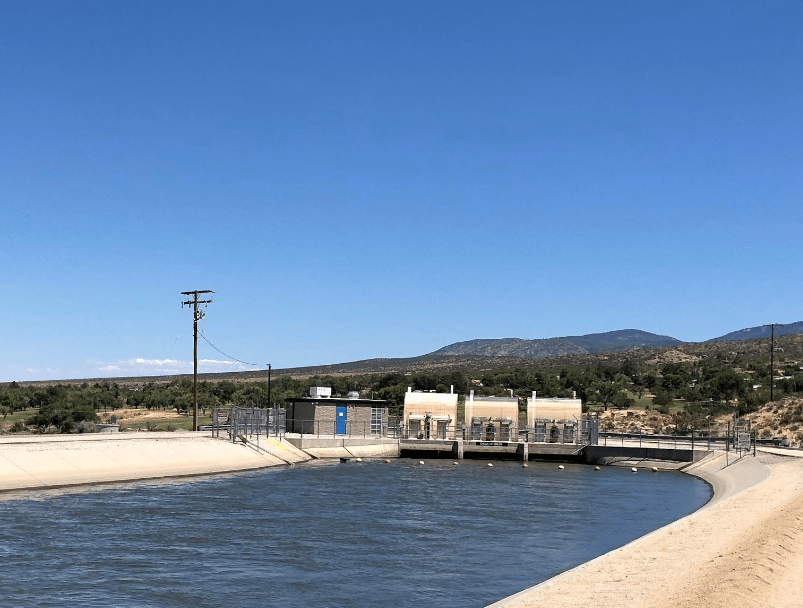
Shockingly, even in this post-9/11 era, one is able to walk directly onto the banks of the aqueduct and, say, fish. (I saw a sunburned fellow in a lawn chair doing just that.) I amused myself by checking out the gate infrastructure:
When I got to an oasis of civilization near Palmdale, just before heading back south toward LA, I encountered something I hadn’t seen for about 30 years: real Golden Arches.
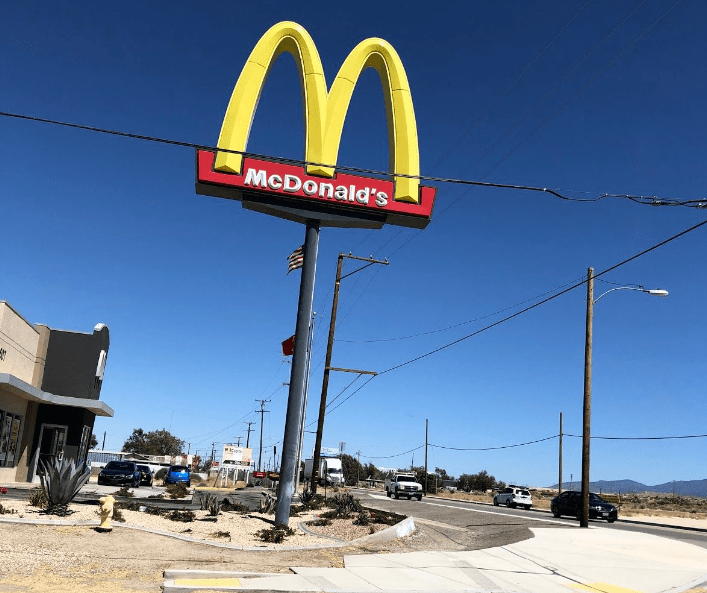
And, come to think of it, it might have been preferable to get my lunch at that old McDonald’s in the middle of the Mojave, rather than at Sky High Disc Golf in the mountains. But no matter. I learned a little more about the Los Angeles region. And it seems like every trip seems to bring more examples of aqueducts, dams, and other water-related facilities. It’s striking that this metropolis of 10 million people relies on so much far-flung infrastructure. From up here in the mountains, you get a whole new perspective on the town.

 Chasing Phantoms
Steve:
I remember this blog post, mostly because of the two laconic bikers (“yep’).
You are really a fan of old highway bridges, aren’t you? I remember how fond you are of those arched bridges, like the Bixby Creek Bridge on Highway One near Big Sur. Man, those were the days of engineering accomplishment. I just re-read the Wikipedia entry about how Purcell and Panhorst, the two state highway engineers thought long and hard about the design: https://en.wikipedia.org/wiki/Bixby_Creek_Bridge#Bridge_design
Their work deserve admiration, just as you admired the Big Tujunga Narrows Bridge, built about a decade later.
Interestingly, the state highway engineers who worked on the Big Tujunga Narrows Bridge benefitted not only from their earlier experience with building bridges like the one over Bixby Creek, but by the late 1930s, there were a number of respected civil engineers who had left Nazi Germany in time. Like the physicists who came to Cal Tech, several professors of civil engineering were also attracted to Southern California and quietly helped solve complex design problems like the one posed by Big Tujunga Narrows.
There were several mis-steps in the early phases of construction because no one had yet figured out how to design (and fabricate) proper concrete arches that would hold up until the roadway “deck” could be installed over their tops. Luckily Professor Ernst Klaus Scholl had an adjunct teaching gig at Cal Tech, having earned his degrees and taught at the Technical University of Darmstad before fleeing Germany in 1935. He showed the state engineers the proper way to design arch supports which – – – as you showed in the photo – – – really worked.
For all the talk about immigrants coming into California, the xenophobes forget that we owe a debt to the likes of Dr. Scholl and his arch supports. His work is a fabrication worth remembering.
Stay healthy. Be well. – Peter
>
LikeLike
I was taking the bait on this one, until the “Dr. Scholl’s arch supports” line at the end…..
LikeLike