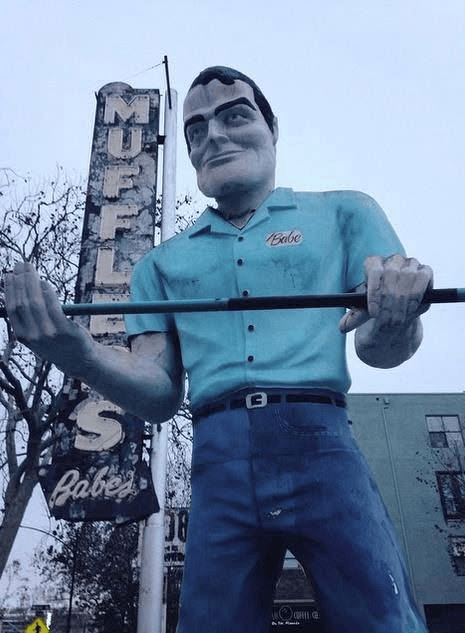
Back in the 1960s, when I was just a sprout, there was a muffler shop in San Jose called Babe’s Mufflers, and facing the street they had a 20-foot-tall fiberglass figure holding a muffler. I always thought the guy’s expression looked a little too determined, like he was about to clobber an unsuspecting passerby with the muffler. I also felt his hand positions on the muffler were unnatural; one was facing up, and the other was facing down. That his shirt pocket was embroidered with “Babe” didn’t help. Anyway, I thought this was just a unique, if unsettling, piece of advertising art.
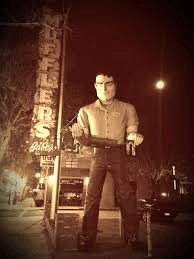
It turns out “Babe”is a reference to Roland “Babe” Royer, who owned the place. He died in 2011. But Babe’s Muffler lives on. What’s more, the iconic fiberglass figure still stands in front, holding a muffler. (Sometimes, when the San Jose Sharks hockey team is playing an important game, the muffler gets swapped out for a hockey stick. I’m not making this up.) Indeed, the giant figure is now an official San Jose landmark.
On my travels over the years I’ve encountered a number of similar fiberglass figures. Some look identical to Babe (but advertise other businesses), and some look a little different. Most have the same odd hand positions.
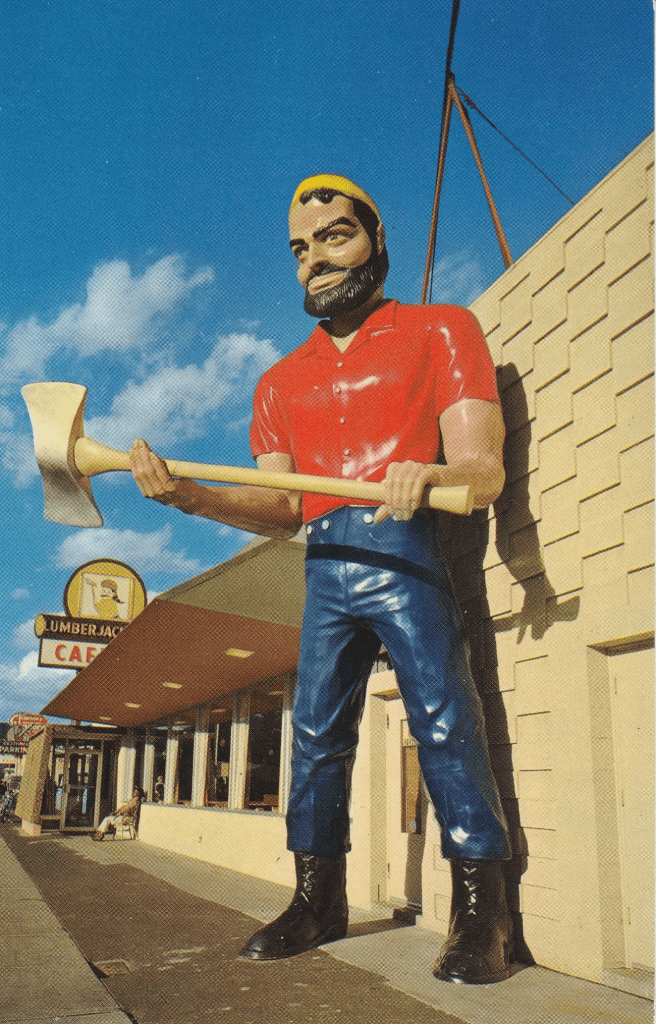
It turns out these “muffler men” (as they are usually dubbed) were made in the 1960s by a company in Venice, CA called International Fiberglass. They’re the same company that made all those brontosauruses (brontosauri?) that you see in front of Sinclair gas stations. Apparently their first muffler man was actually a Paul Bunyan figure to advertise the Lumberjack Cafe on Route 66. In this case the hand positions actually made sense, as the figure was holding an axe.
International Fiberglass would end up making thousands of these fiberglass figures, with a handful of variations (different faces, different attire, etc.) They could be spotted along the highways all across the country. Later, when establishments would go out of business, the new owners would often repurpose the muffler men.
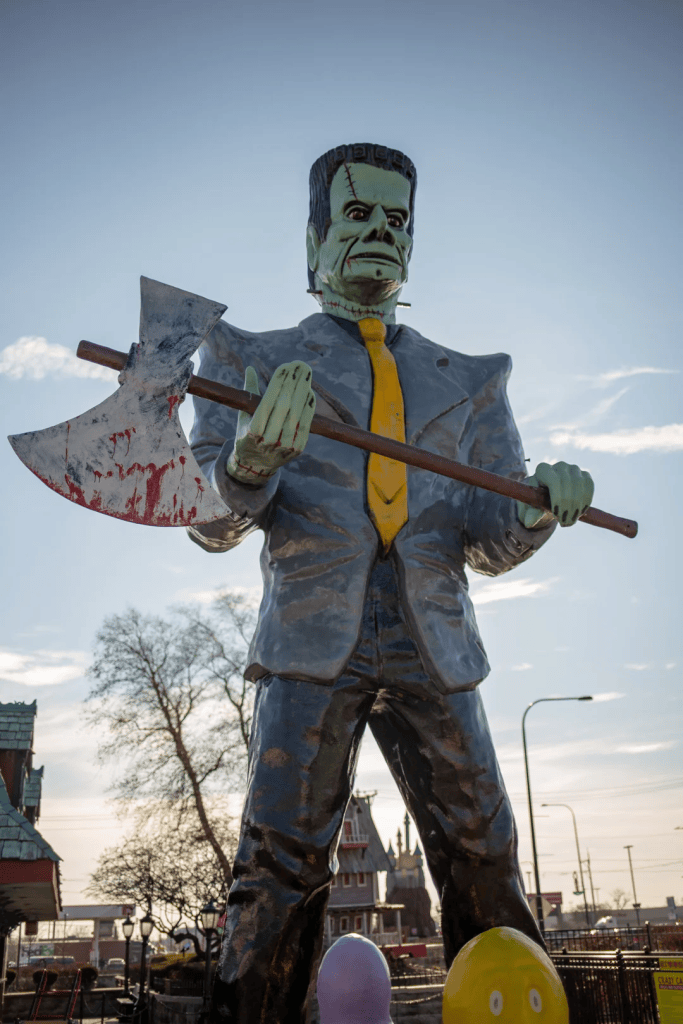
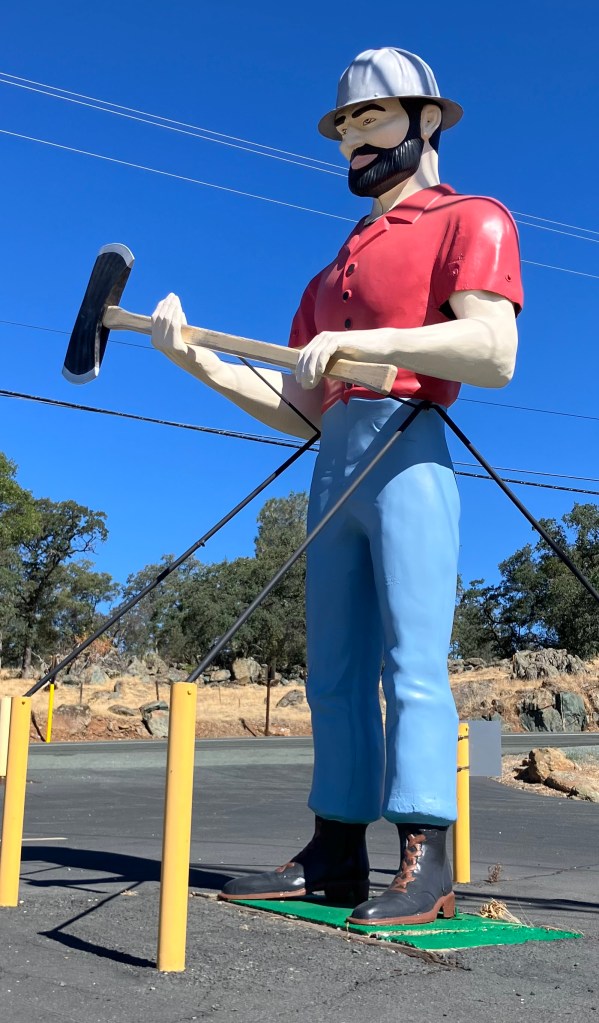
Anyway, I was reminded of all this the other day, when I arrived in the town of Jackson (pop: 5,000), in order to collect dead animal parts at Swingles Meat Company (nickname: A Carnivore’s Playground). On the side of Highway 88 I spotted a muffler man in front of a fitness center called Warriors Lodge. He predates the Warriors Lodge, having stood in this spot (and perhaps other parts of town) advertising other businesses, including a thrift store. He doesn’t quite look like that original Paul Bunyan muffler man, but he looks pretty close, with the telltale hand positions.
If you know any of this guy’s back story, please let me know. Better yet, why don’t you join the Muffler Man Challenge? All you have to do is send me a picture of a muffler man that discover in your own travels, and give me a little information about it (location, associated business, back story, whatever). Bonus points if you can find one that’s not listed on the Muffler Man Wikipedia page. The one I spotted in Jackson is not listed on the page, and I’m guessing there are many more out there.
Poe Corner
(Not to be confused with The House on Pooh Corner)
I was recently interviewed about my Poe-related writing by the hosts of Poe Unplugged. Check it out, if you dare:


Hi, Steve, I left my comments for “The Muffler Man Cometh” on Chasing Phantoms, and more comments about your interview by Carmen and Jeanie on that platform. All three of you were so articulate. Such a pleasurable way to spend part of my afternoon. Intrigued by your question about what might be the single thread that unites us around Poe, I asked Copilot. Here is the answer I received. What do you think of the response? My Question: What could be one common thread that unites people’s love of Edgar Allan Poe and his literary oeuvre? Copilot’s Response: A single thread that reliably runs through people’s love of Edgar Allan Poe is the pleasure of confronting darkness in a controlled, imaginative space. That’s the concise answer. Here’s the deeper view that shows why this thread holds so tightly across readers, eras, and tastes. 🕯️ The core: Safe proximity to the unsettling
Poe gives readers a way to touch fear, grief, madness, and the uncanny without being consumed by them. His stories and poems create emotional intensity, but they also provide structure—meter, rhyme, gothic atmosphere, detective logic—that acts like a railing on a staircase. You descend, but you don’t fall.
This “safe descent” is the unifying experience. It’s why people who otherwise have very different literary preferences still find themselves drawn to him.
🧠 Why this thread works across his entire oeuvre – Psychological exploration — Poe externalizes inner turmoil. Even readers who don’t share the narrator’s obsessions recognize the thrill of peering into a mind under pressure.
All of these feed the same central thread: Poe lets people explore darkness without being lost in it.
🔮 A non‑obvious insight
Poe’s appeal isn’t just that he’s “dark.” It’s that he’s dark in a way that feels strangely intimate. His narrators confess. His poems mourn. His stories whisper. Readers feel addressed, implicated, invited. The darkness feels personal, not theatrical.
That intimacy is the hook.
A question that will sharpen your next step Which aspect of Poe’s darkness resonates most with you—the psychological, the emotional, or the atmospheric?
Steve, thanks again for your insights within Chasing Phantoms and the interview!Sherrill
LikeLike