Breweries · bridges · Cars · Gas stations · movie theaters · Road trips · trains

Cowboy Country

In all my jaunts along the various blue highways criss-crossing the map, it never ceases to amaze me how varied this country is. Just over the past week I’ve gone from coastal New England, through the green hills of the Berkshires, into lighthouses on the Great Lakes, through the rust belt of South Bend and Chicago, between the manicured fields of Iowa farms, and under the leaden skies of the Great Plains.

In all honesty, there hasn’t been a single segment that I haven’t enjoyed, that I haven’t experienced beauty, that I haven’t met wonderful people. And yet, today’s segment was characterized by lots of long, straight stretches at freeway speeds across the plains of Nebraska. Faithful reader Brian W. had encouraged me to “enjoy the unique look and solitude” of western Nebraska. And I did. The sheer scale of its open space forces one to relax, and the solitude is conducive to contemplation.
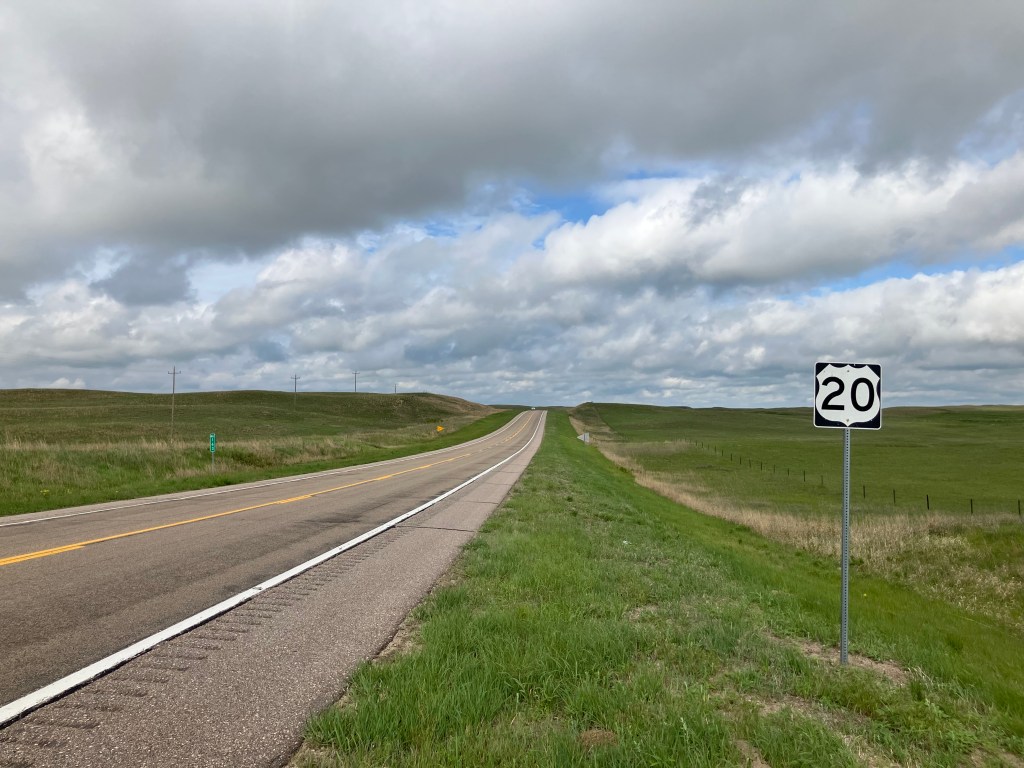
Cheap therapy.

US 20 is the only major east-west route in the northern half of Nebraska. (Interstate 80 runs along the lowest third, through Lincoln and Omaha. For this reason, there has historically been a good amount of services along US 20. I encountered a surprising number of old garages and gas stations that have been preserved or restored to their vintage look. I peeked in the garages and saw walls lined with fan belts, racks of oil, piles of tires, and other evidence that these places still do business.
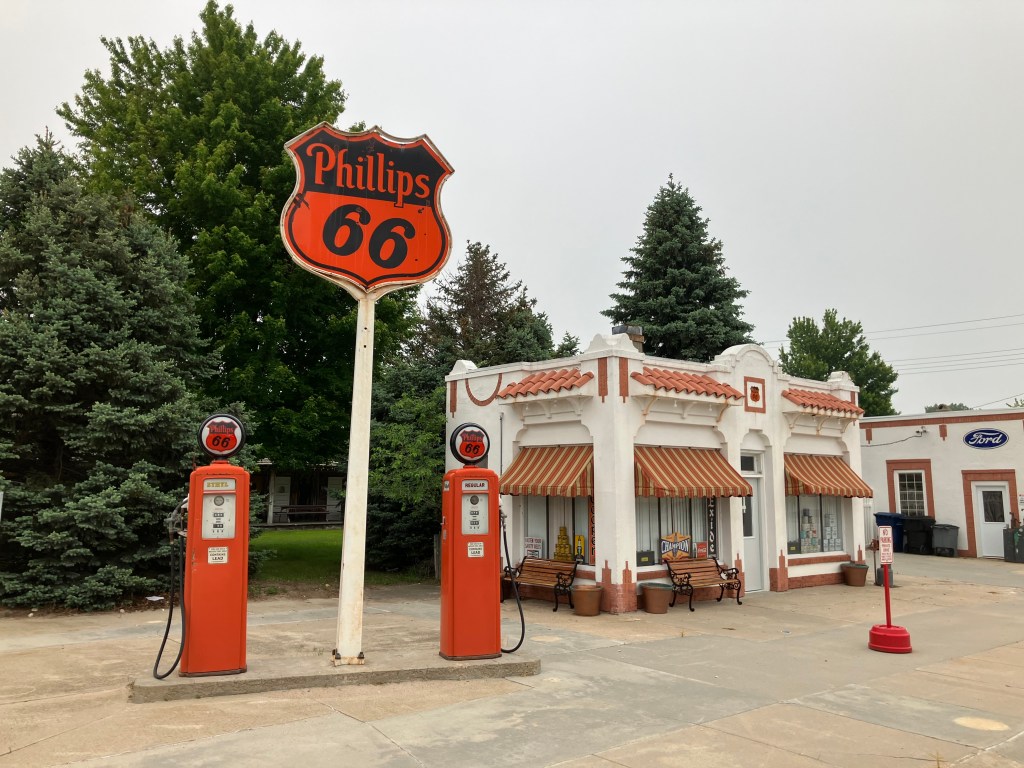
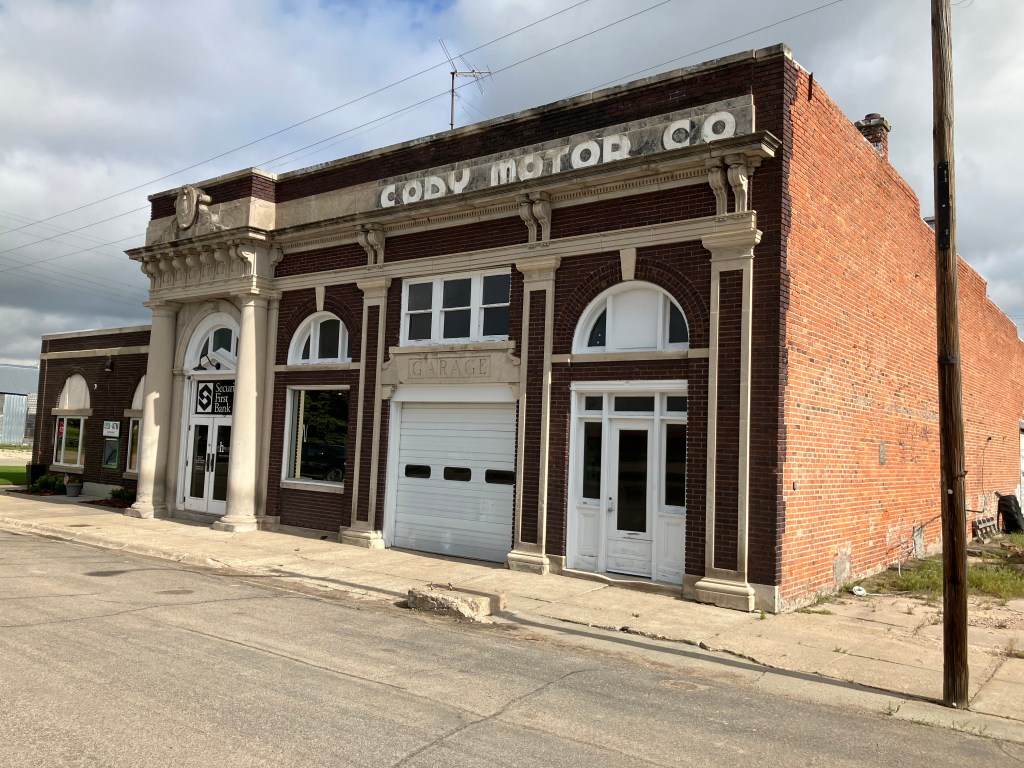
But what I appreciate more than the restored buildings are the historic roadside attractions that have just kept going, year after year, with just enough maintenance to stay in the game. That seems to be more the rule out in this part of the country. I’m sure part of the reason is that the local economy can’t support the wholesale replacement of infrastructure unless there’s a good reason. And there’s not enough population to entice national chain stores to locate their businesses here. The result is a “time warp” situation in many of these towns. Here are a few examples:

“Big John’s” had been a local burger chain in the 1960s that never caught on. This is evidently the only remaining sign–some sixty years old. The current business is an independent cafe in Ainsworth, Nebraska (pop: 1,600).
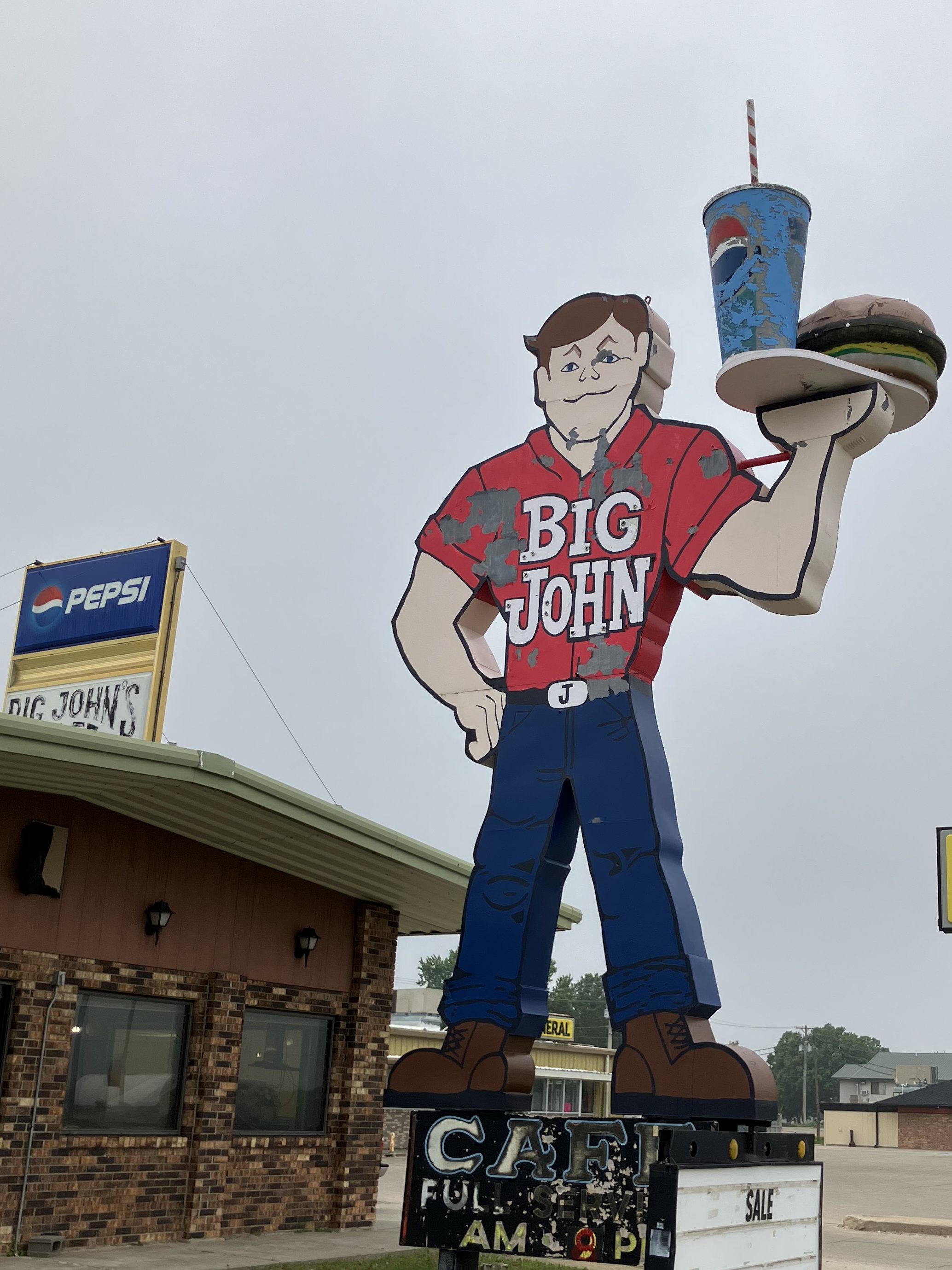
Big John doesn’t look amused.

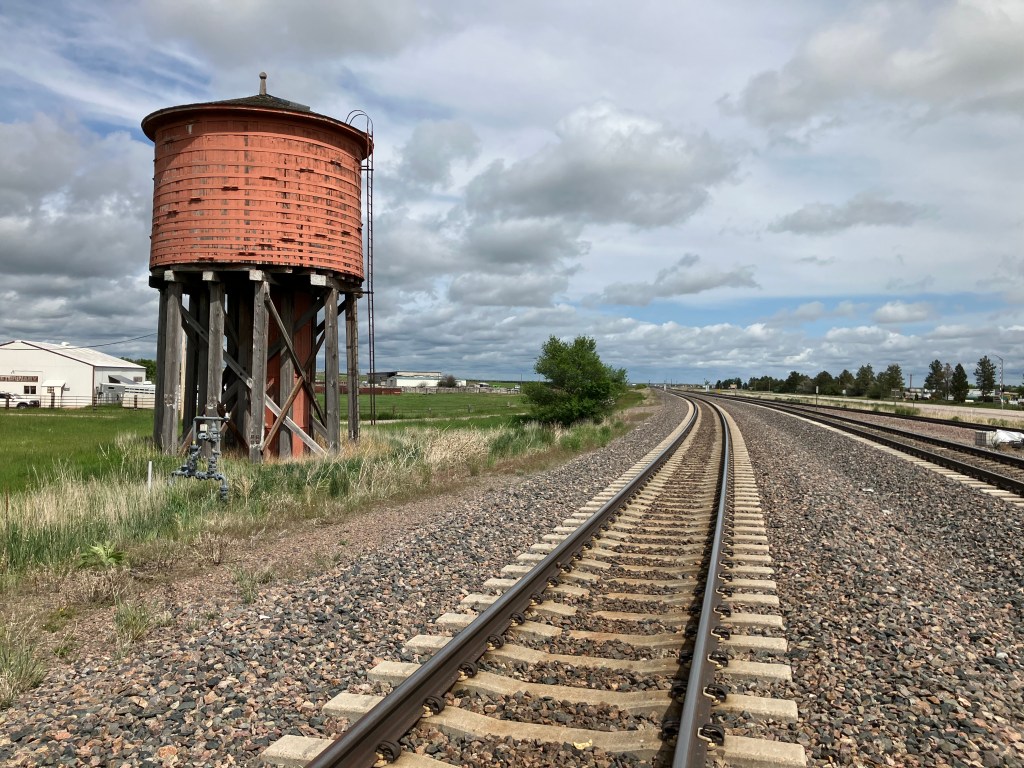
In the town of Lusk, Wyoming (pop: 1,500) a redwood water tower still stands next to the railroad tracks. It dates to 1886, and used to provide water to the steam locomotives. They moved it once, in 1919, in line with changes in the railroad. The Tower is now something of an icon for the town, but it’s authentic and as you can see in the photo, the whole scene could be from a century ago.
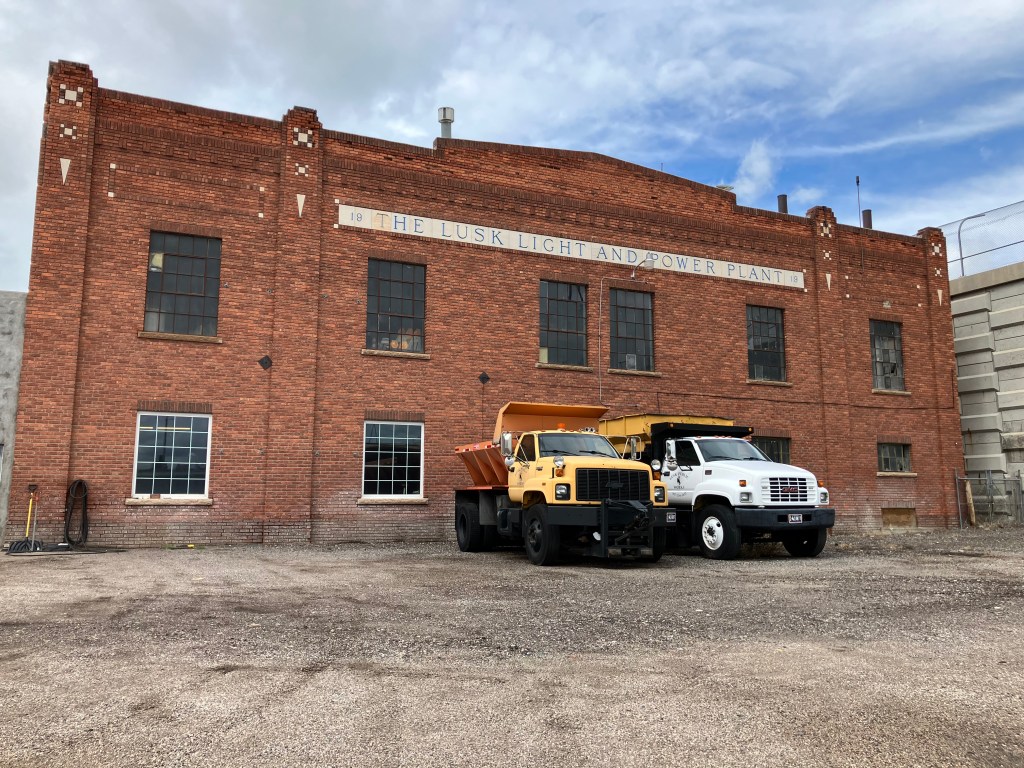
The Lusk Light and Power Plant also looks to be a historical relic, but I couldn’t find any information on it
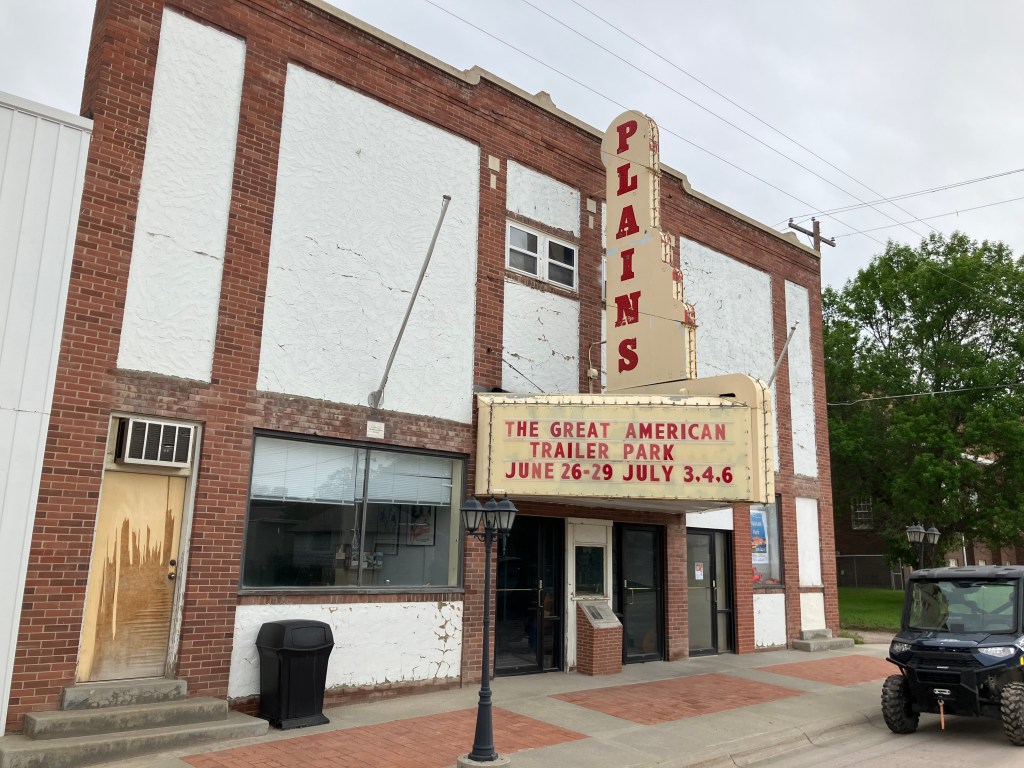
The Plains theater in Rushville, Nebraska (pop: 784) dates back to 1914. It’s gone through a number of different iterations, including a movie theater and a church. Today it is a live theater venue.
But let’s get back to US 20 itself. For the first 250 miles of today’s drive, the Cowboy Trail (that I mentioned in yesterday’s blog) runs alongside the highway. You’ll recall that the Cowboy Trail used to be a railroad line that’s been replaced with a hiking/biking path. I was surprised that I didn’t see a single person on the trail, but it’s still pretty new and maybe word hasn’t gotten around. But it’s interesting to see how all the old railroad bridges have been replaced with pedestrian bridges.
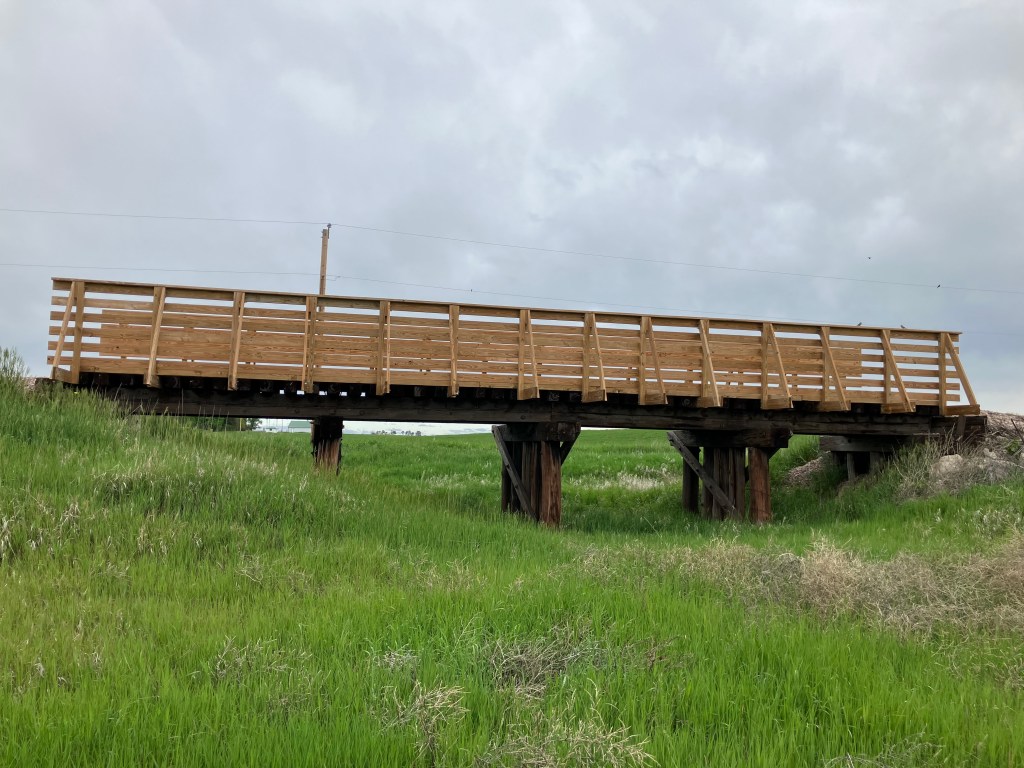
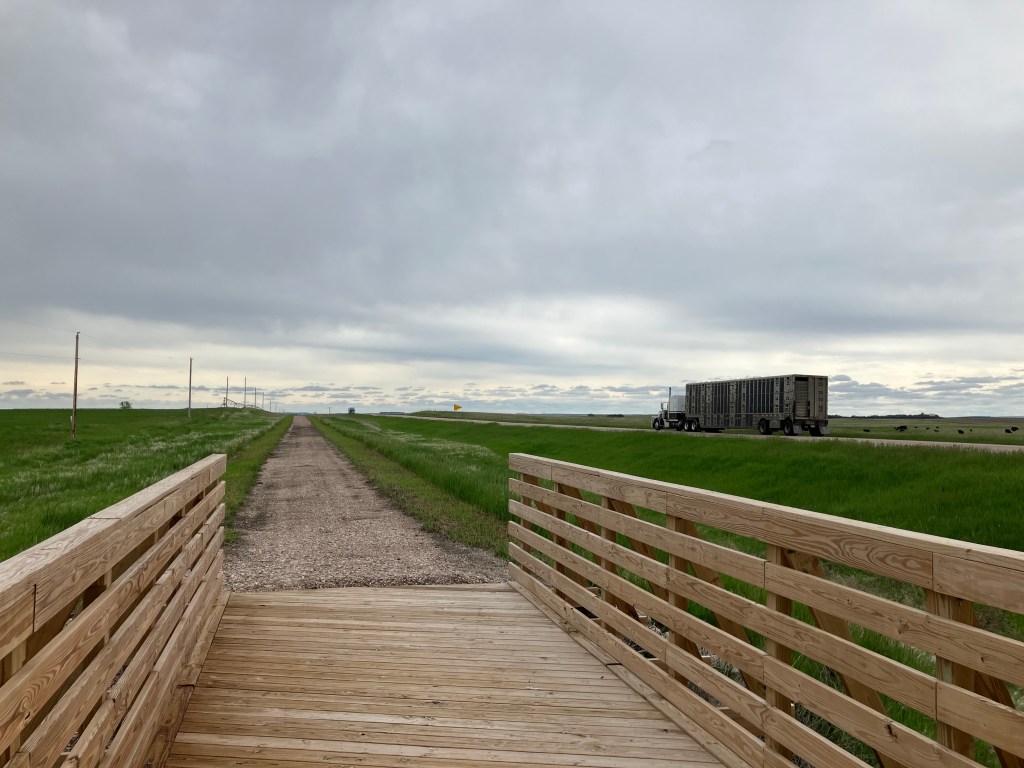
The lower pilings are left over from the railroad; the new wood slats on the upper sides were added for the Cowboy Trail.
The old railroad roadbed has been covered with crushed granite.

The reassuring monotony of the plains and the cloudy sky, with the Cowboy Trail close by at my right, had something of a lulling effect that required periodic infusions of coffee. But suddenly, in the mid-afternoon, I spotted some sharp buttes rising from the plains. These were most welcome after The Unbearable Flatness of Being that characterized most of the day’s drive.
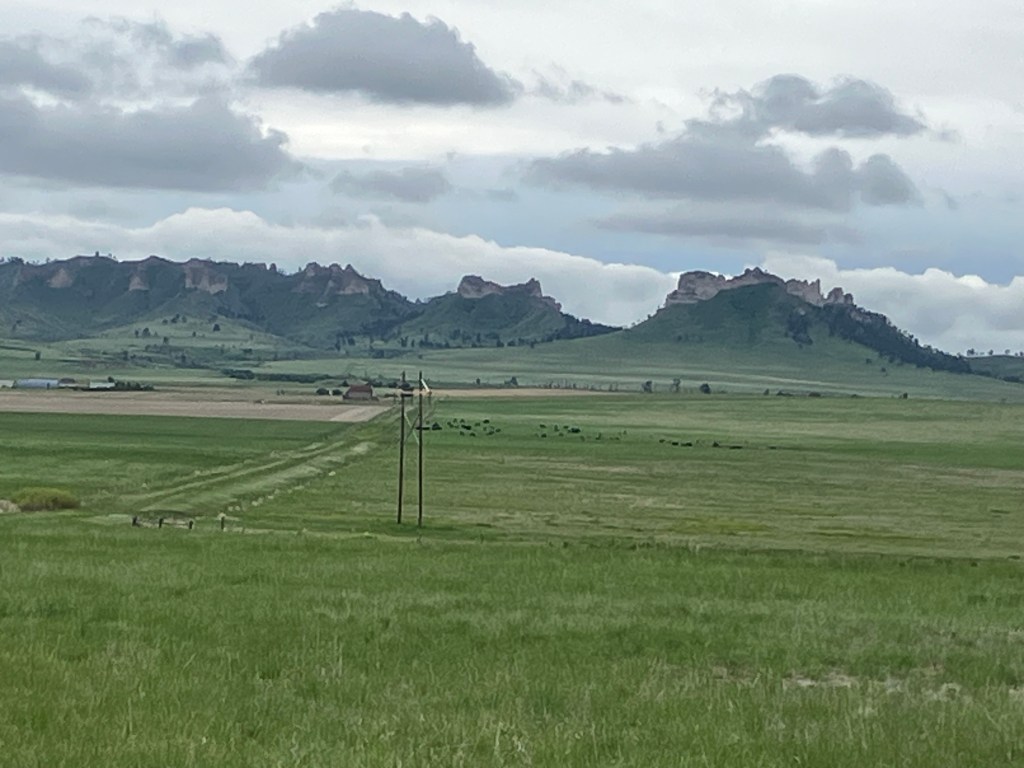
Where did you come from?

I stopped at the nearby town of Crawford, Nebraska (pop: 1,000) to see if I could learn more about the buttes. My first stop was to get a refreshing beverage from a young entrepreneur named Case.
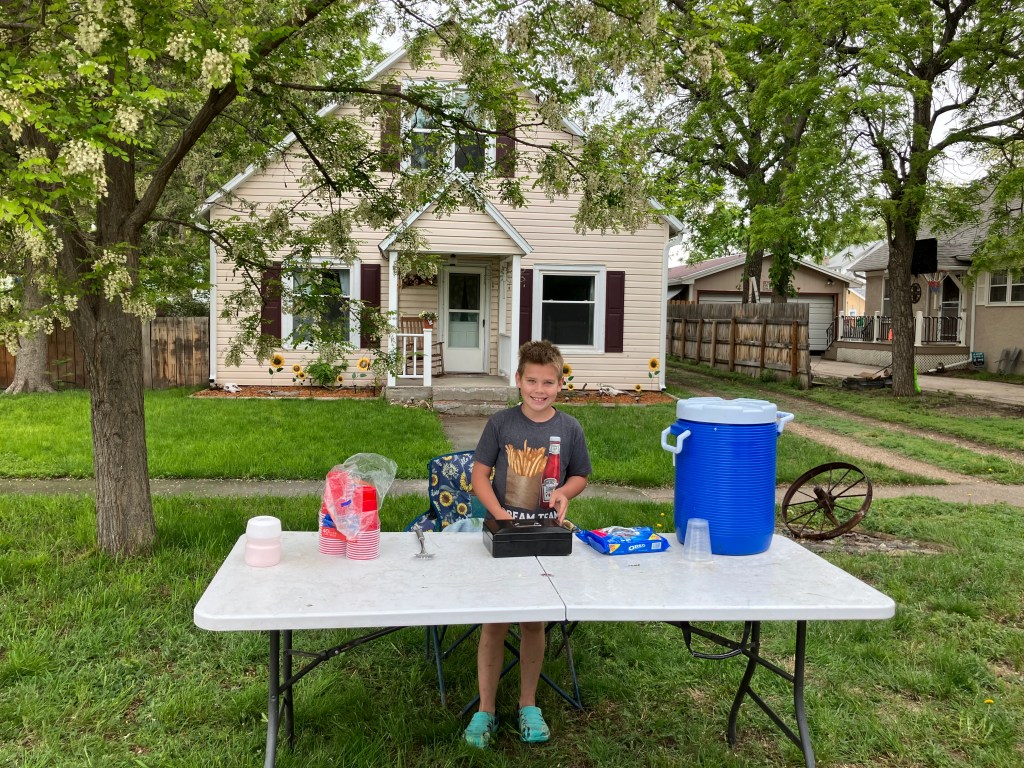
No BOTD, sadly.

Then, in the center of town, I found the local tourist bureau/museum. The door was open wide, and as I entered I was greeted by a docent named Cathy. She didn’t have a lot to say about the buttes, but she did encourage me to visit Fort Robinson, just a couple of miles up the road. Her father had been stationed there once upon a time, and a couple of family heirlooms are in the lodge.
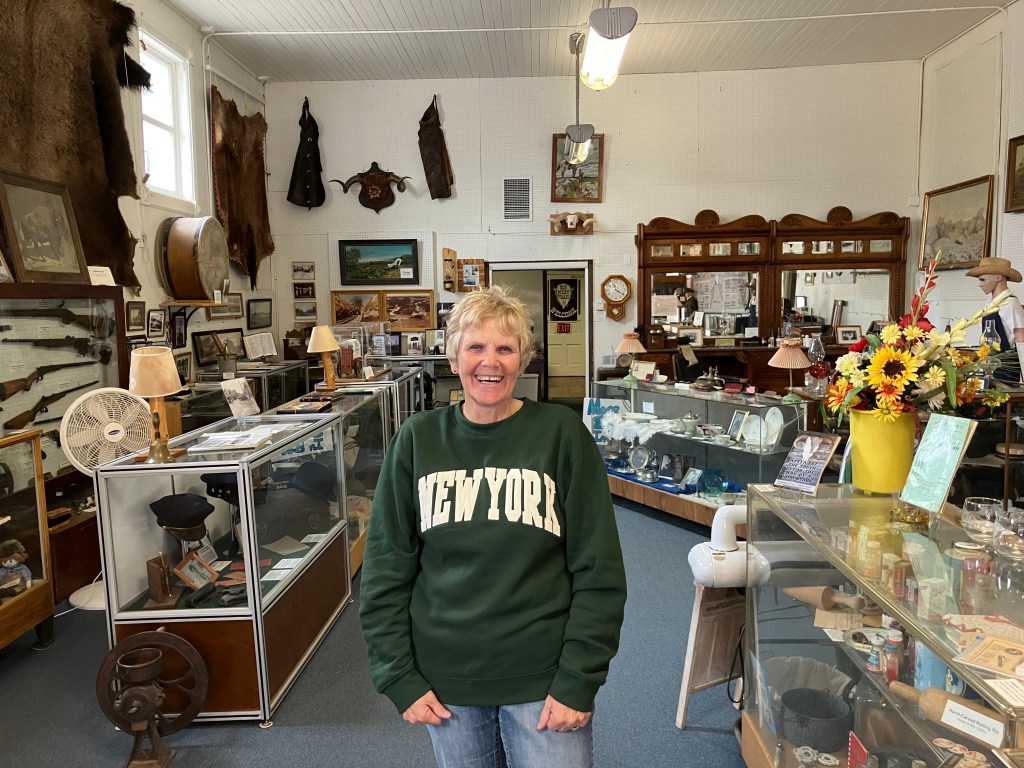
Cathy is retired and volunteers at several places in town.

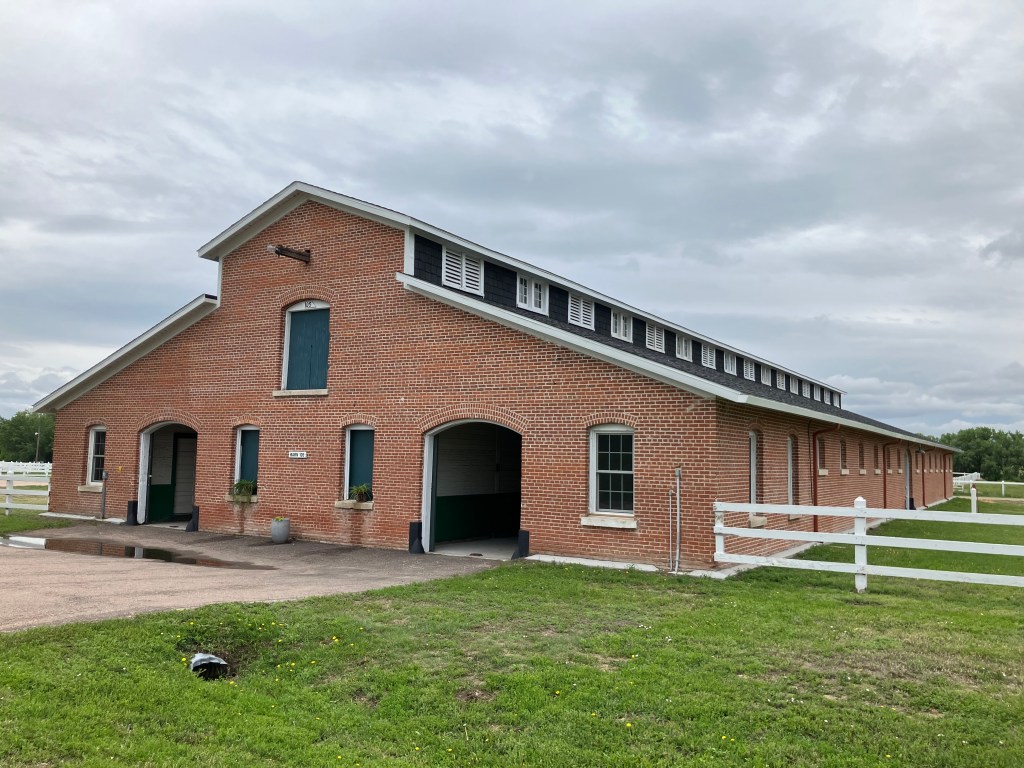
Fort Robinson has been around since the 1870s, playing a major role in the so-called Indian Wars, as well as the First and Second World Wars. The “Buffalo Soldiers” were stationed here, horses and mules were bred here, military canines were trained here, and it even served as a POW camp for German prisoners. The army decommissioned the fort in 1947, and it was converted into a state park in 1956.
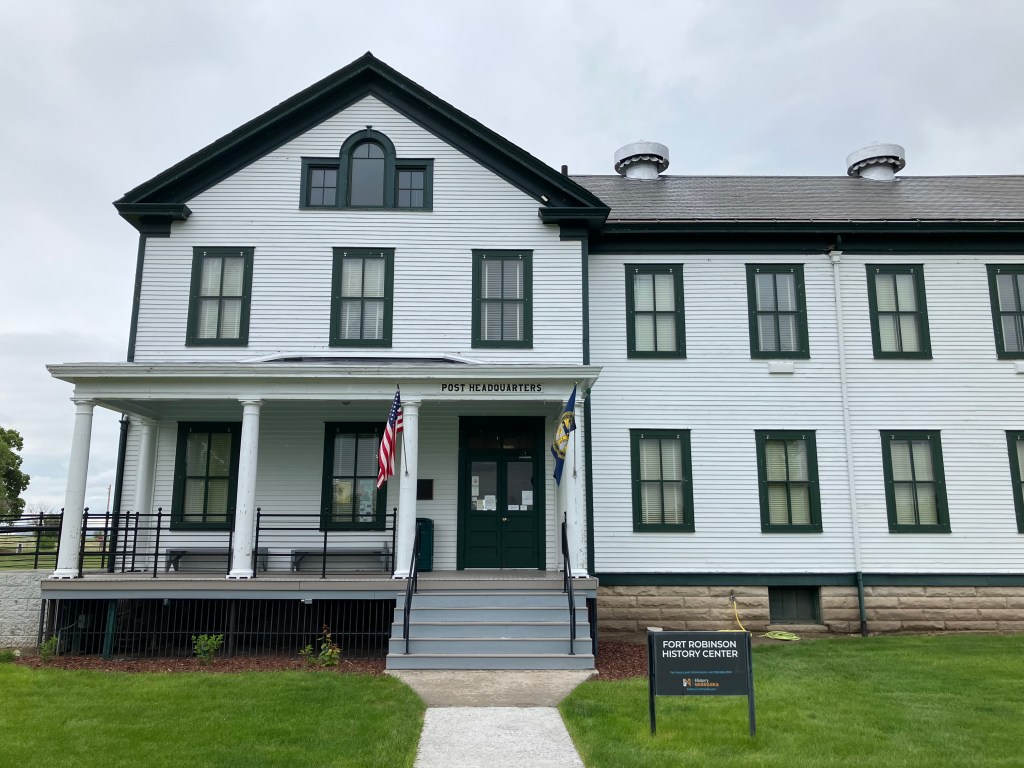
1905 Headquarters Building, now repurposed as a visitors center.
One of a number of large horse barns, from when Ft Robinson was a “remount depot.”

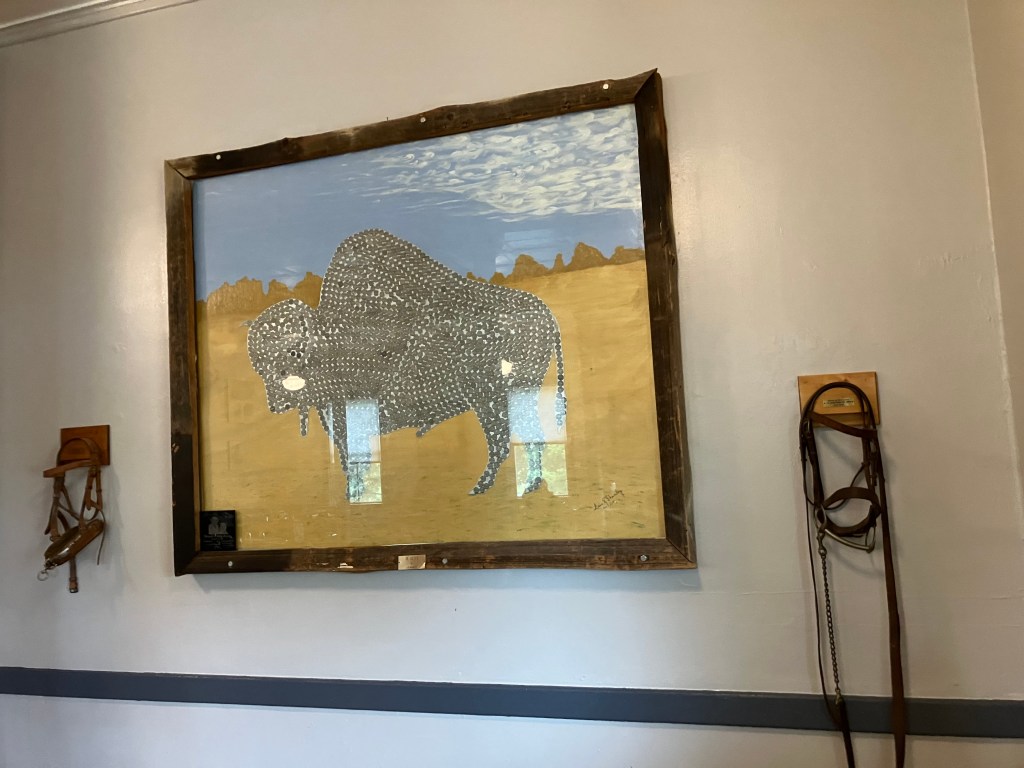
Per Cathy’s suggestion I visited Fort Ross and tracked down the family heirlooms–these consisted of a “shadow box” with mementos from Cathy’s father, and a large art piece shaped like a buffalo, made entirely of buffalo nickels that Cathy’s family had collected from a bar they used to run.
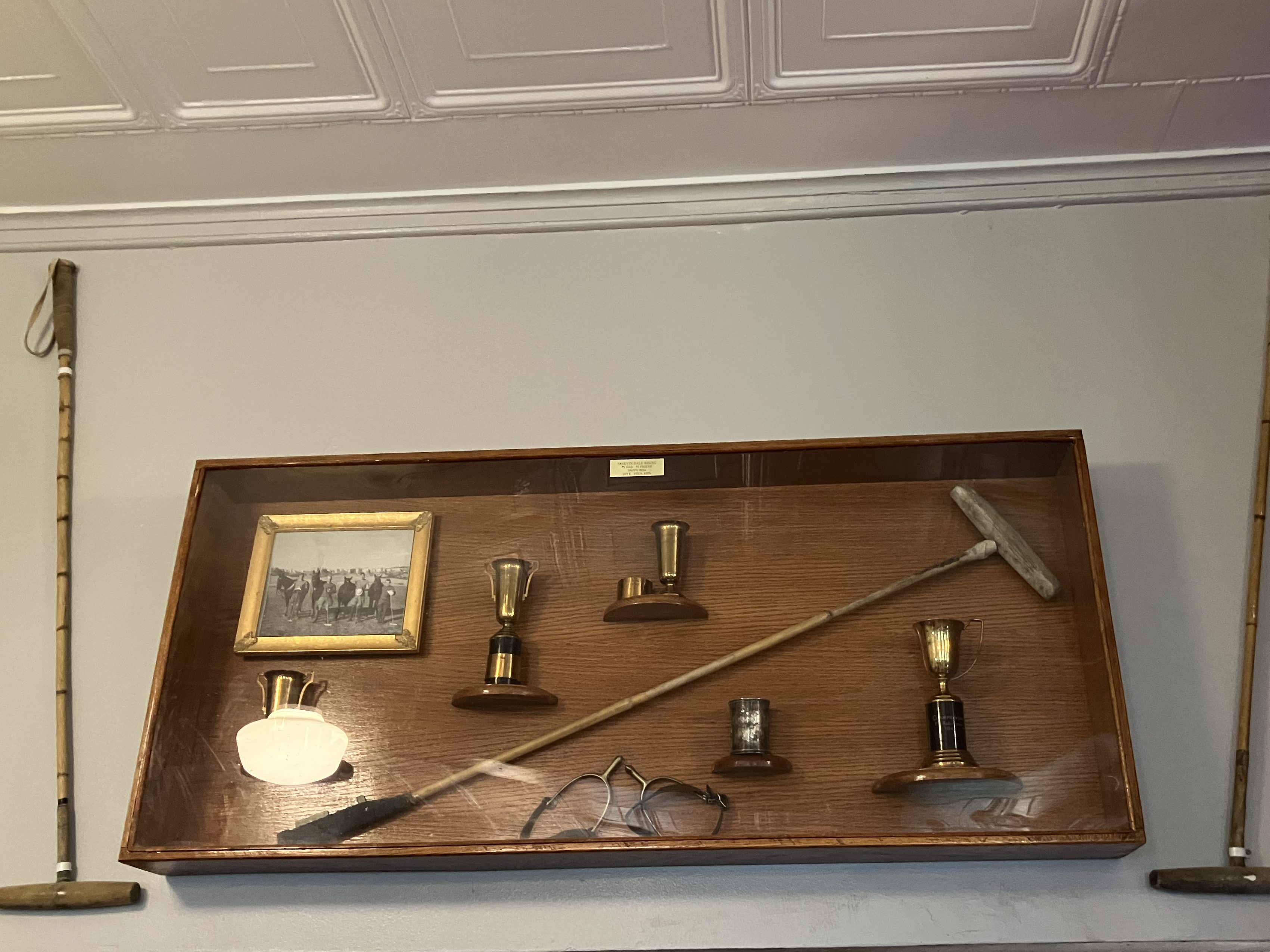
Cathy’s father was on the camp’s polo team.
A small fortune in buffalo nickels. (Apologies for the unavoidable reflection in the glass.)

A kind lady at the lodge helped me locate these items…and she turned out to be Cathy’s sister Diana. The resemblance is obvious.
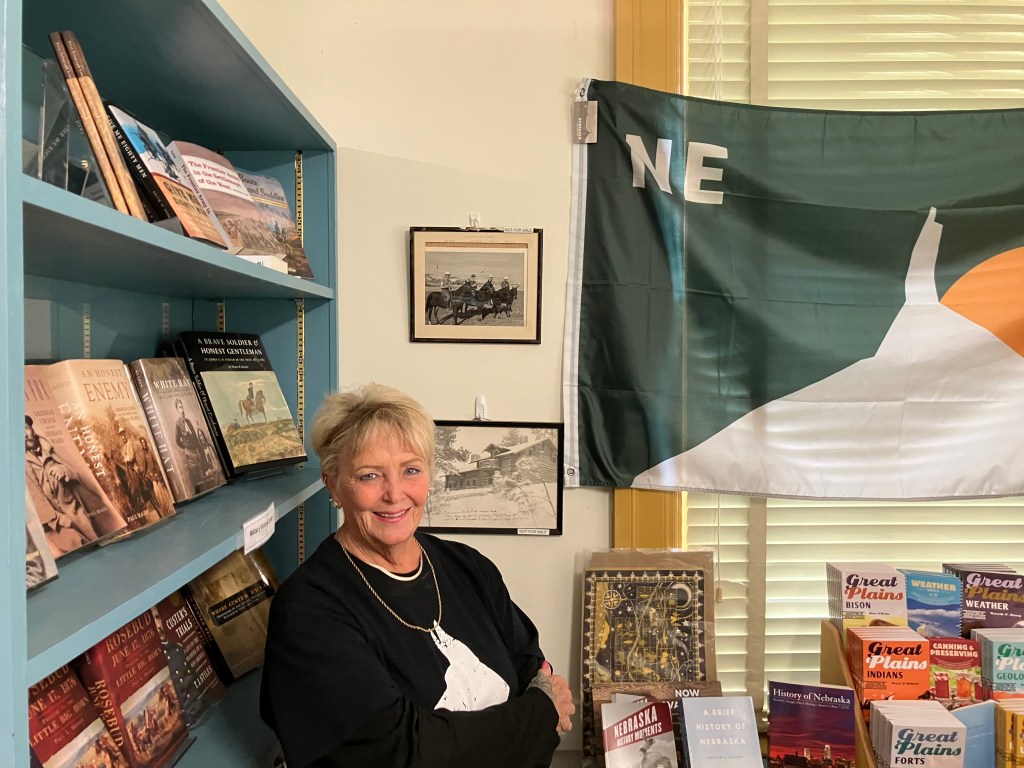
Sister Diana.

By now it should be pretty obvious that most of the towns along this stretch of Route 20 are quite small and spaced far apart. It’s certainly a big change from California, where I come from. The population density in California is 254 people per square mile. In Nebraska it is one tenth of that, at 25 people per square mile. In Wyoming it’s 6 people per square mile. You have to wonder what kind of impact these differences have on a person’s sense of self, sense of society, sense of independence.

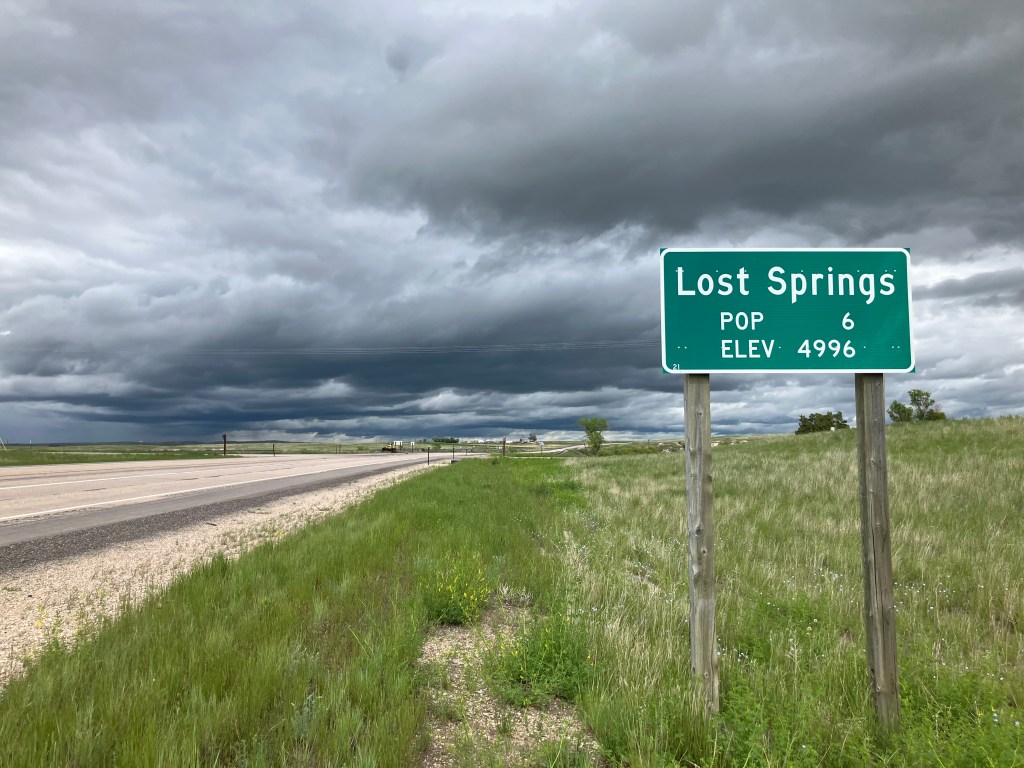
The smallest town that I passed today was Lost Springs, Wyoming. For some reason that I can’t fathom, they really leaned into their smallness when they commemorated the country’s bicentennial in 1976. At that time they erected this marker (which to me looks like a tombstone) that declares they are the “smallest bicentennial town.” According to the US Bicentennial Commission, in 1976 Lost Springs –with a population of 7–was the smallest incorporated town in the entire country.
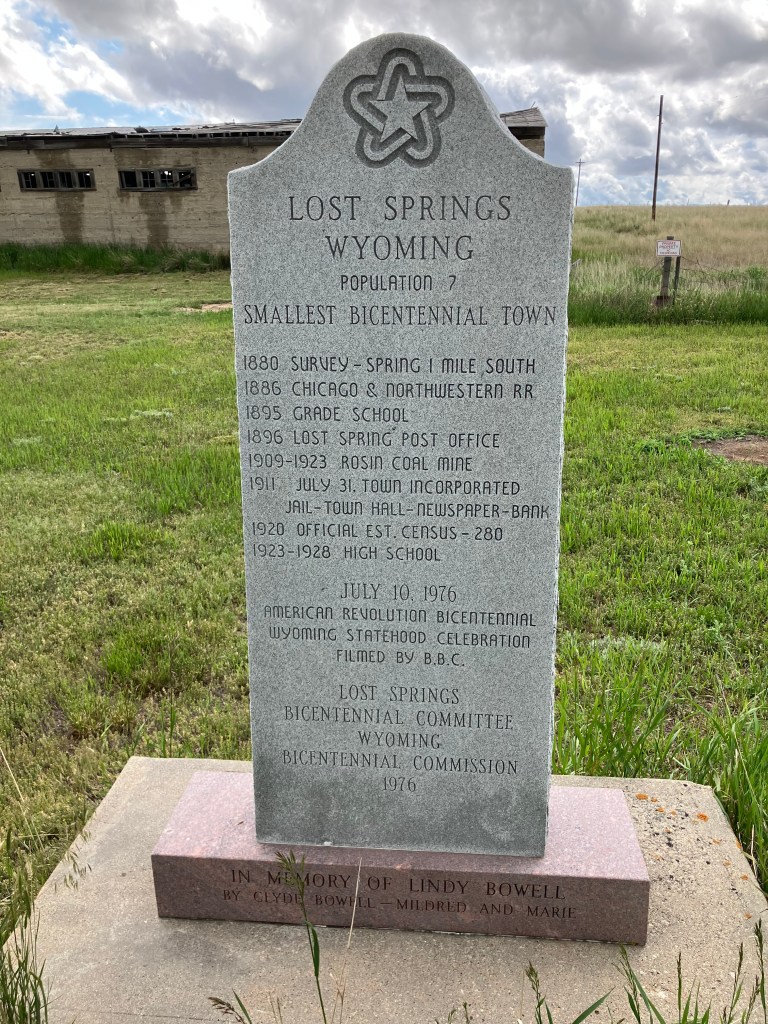
They’re even smaller now:
BRIDGE CORNER

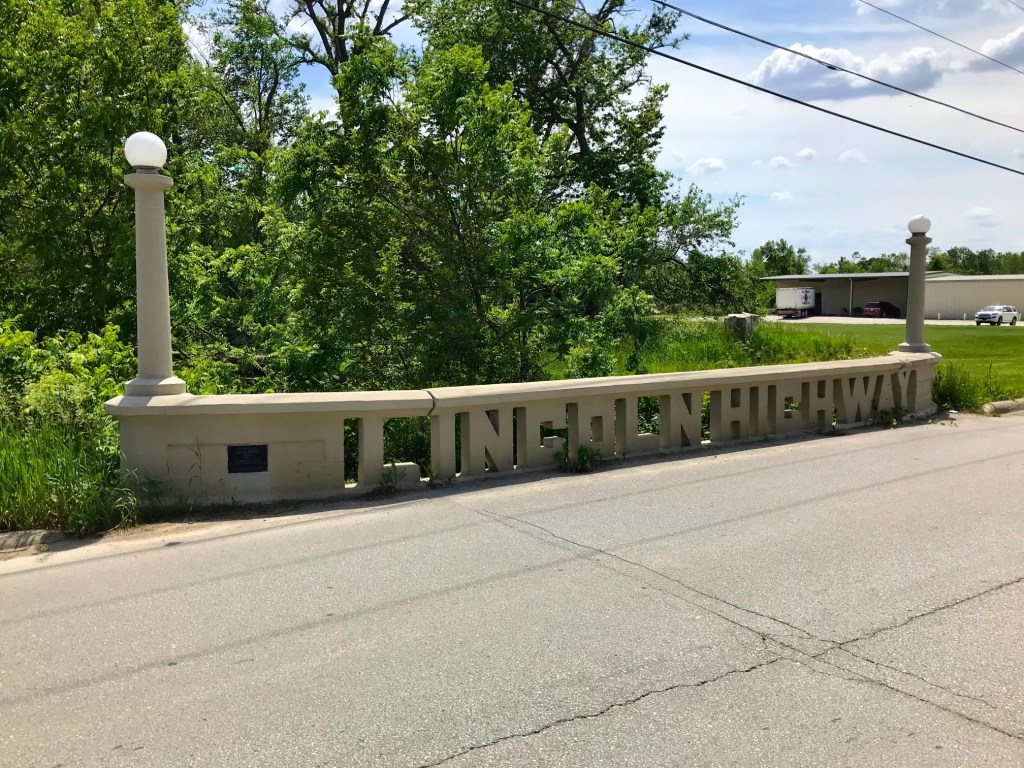
Near the town of Valentine, NE (pop: 2,600) a roadside sign directed me to a “historical bridge.”
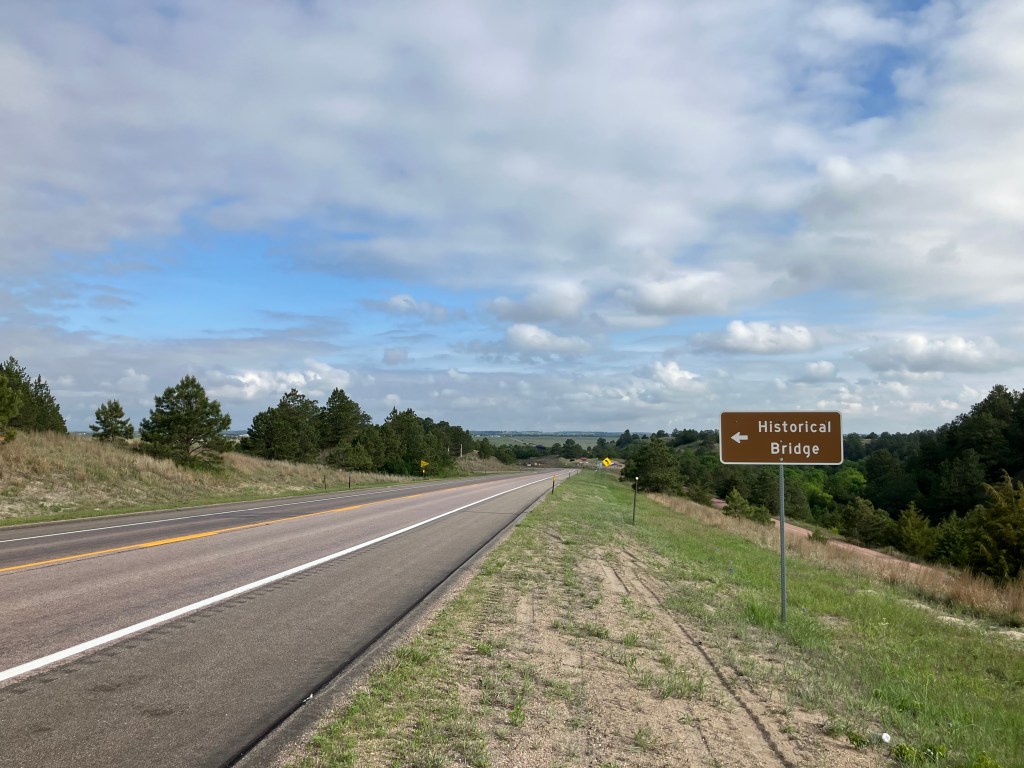
A marker explained that this is the Bryan Bridge, which is the country’s only “arched cantilever truss bridge connected by a single pin.” Whatever that means. It was also designated “the most beautiful steel bridge of 1932 in class C,” which sounds like it might be a narrow category, but what do I know?
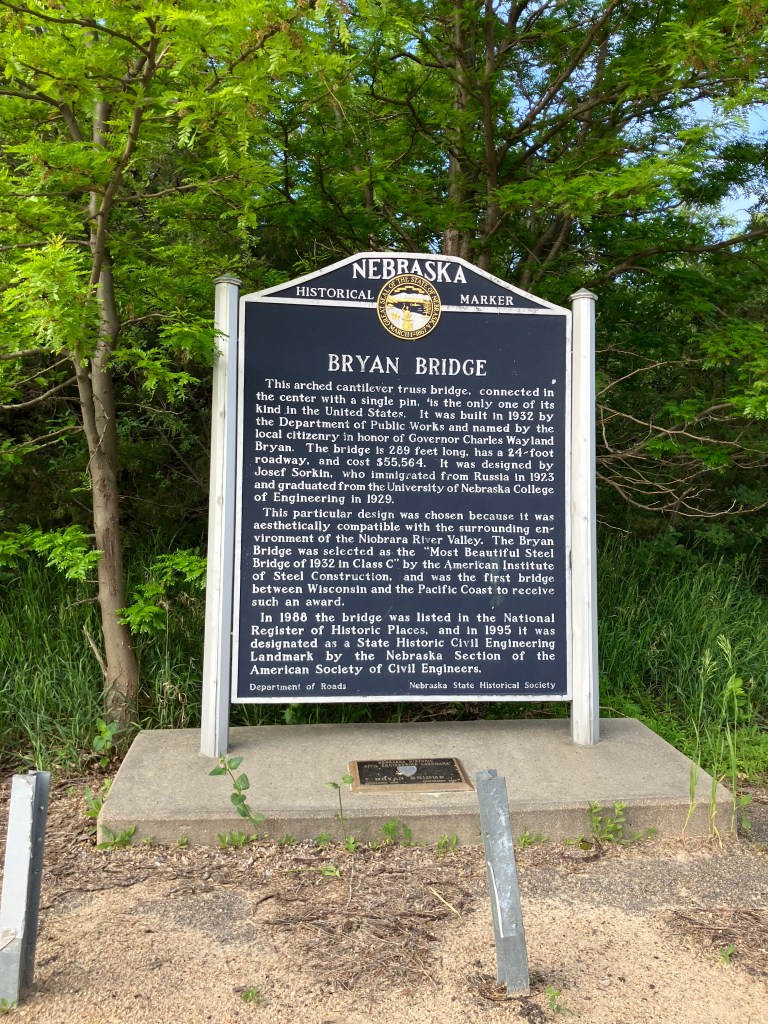
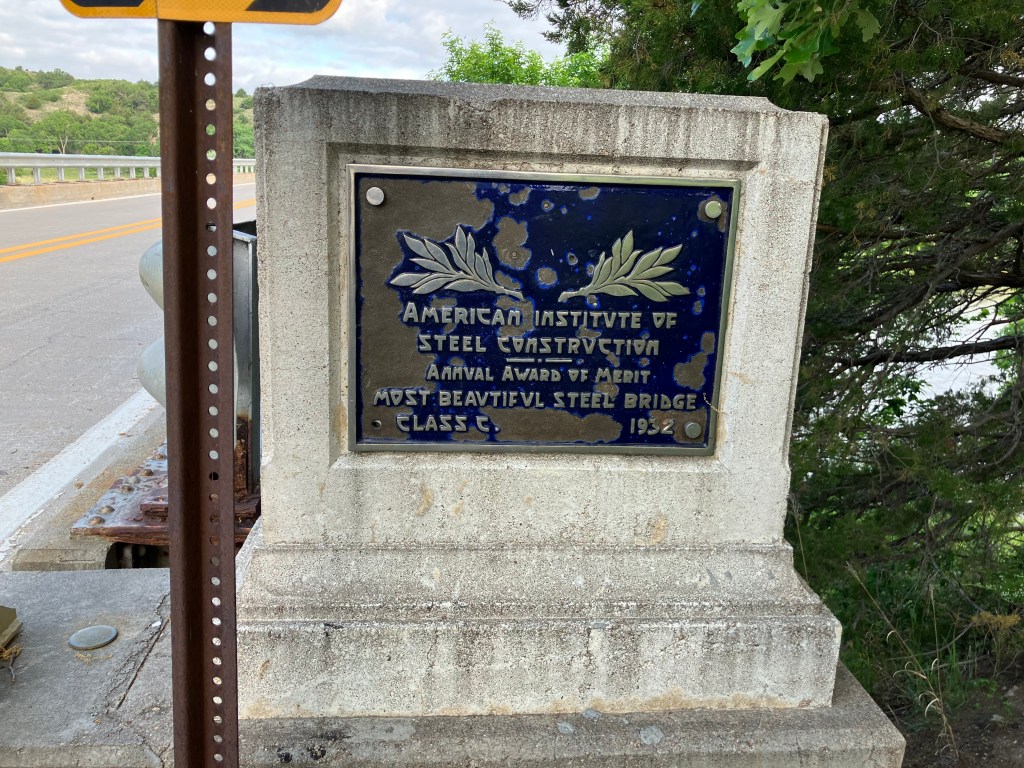
To test the “most beautiful” claim, I scrambled down the embankment and risked life and limb and tick bites to take the below photo from the bank of the Niobrara River.
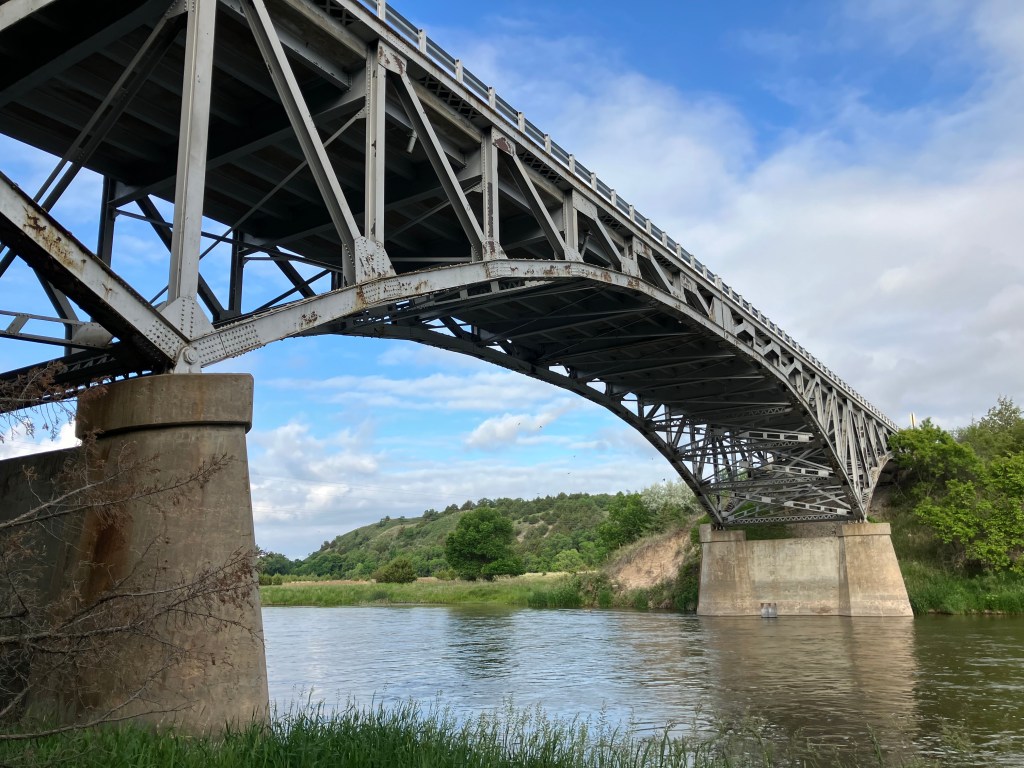
Most beautiful of all the class Cs in 1932? You be the judge.

BREW OF THE DAY

There aren’t many brew pubs along this stretch of US 20. But I did find a place called “Cowboy State Brewing Company” in Glenrock, Wyo (pop: 2,400). Long-time reader Peter D. had recommended the town to me, as it was his father’s and his grandmother’s home town.
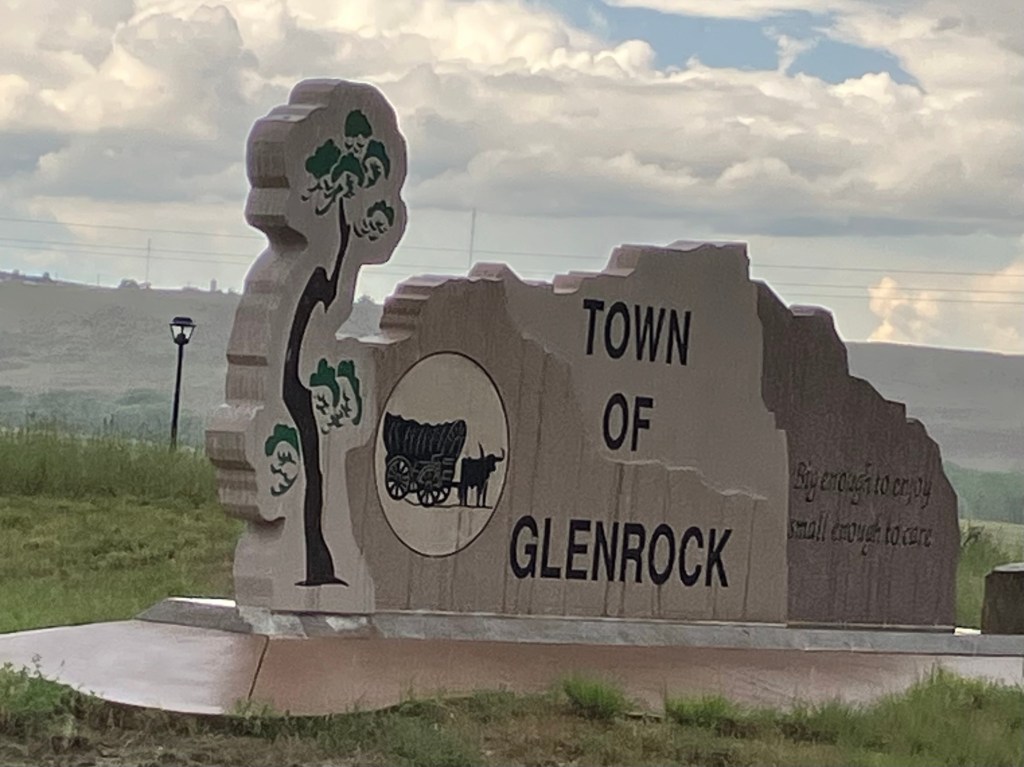
Now, Cowboy State is not your typical California-style brew pub. It’s a bar that dates back to the mid-1970s, with dim lighting, pool tables, and a bar stocked with gin and vodka. The place reeks of cigarette smoke, which might be because Nebraska allows smoking in bars, or maybe because 50 years of smoke can’t be eradicated from the pores of the room.
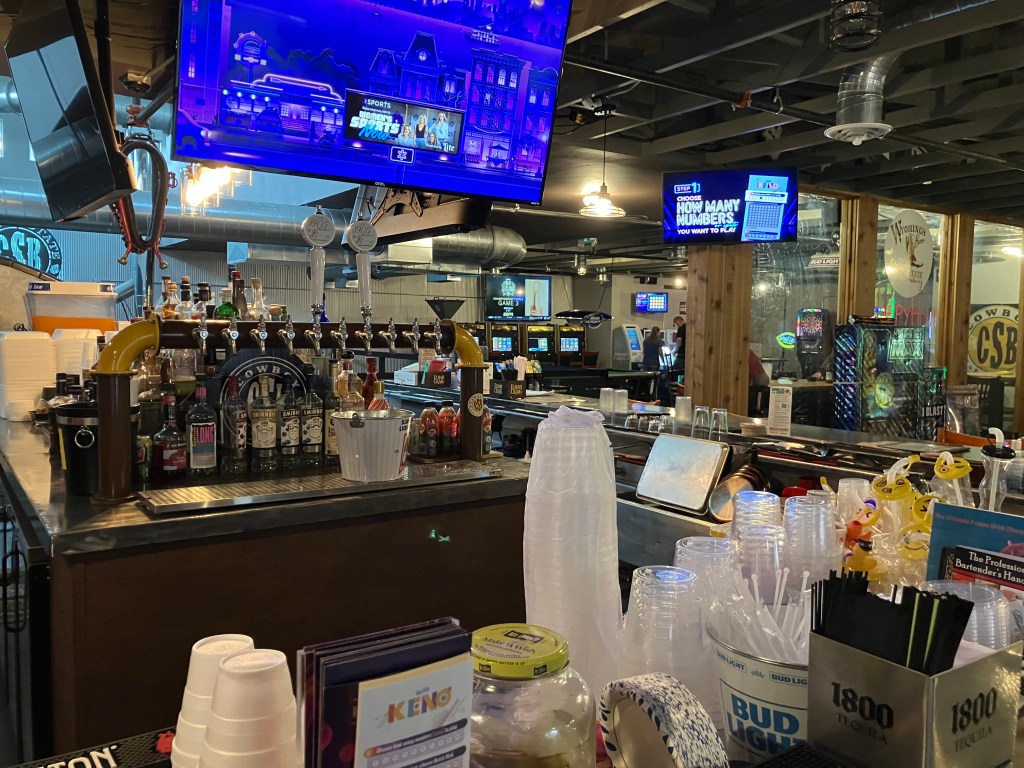
The 1970s called and they want their bar back.

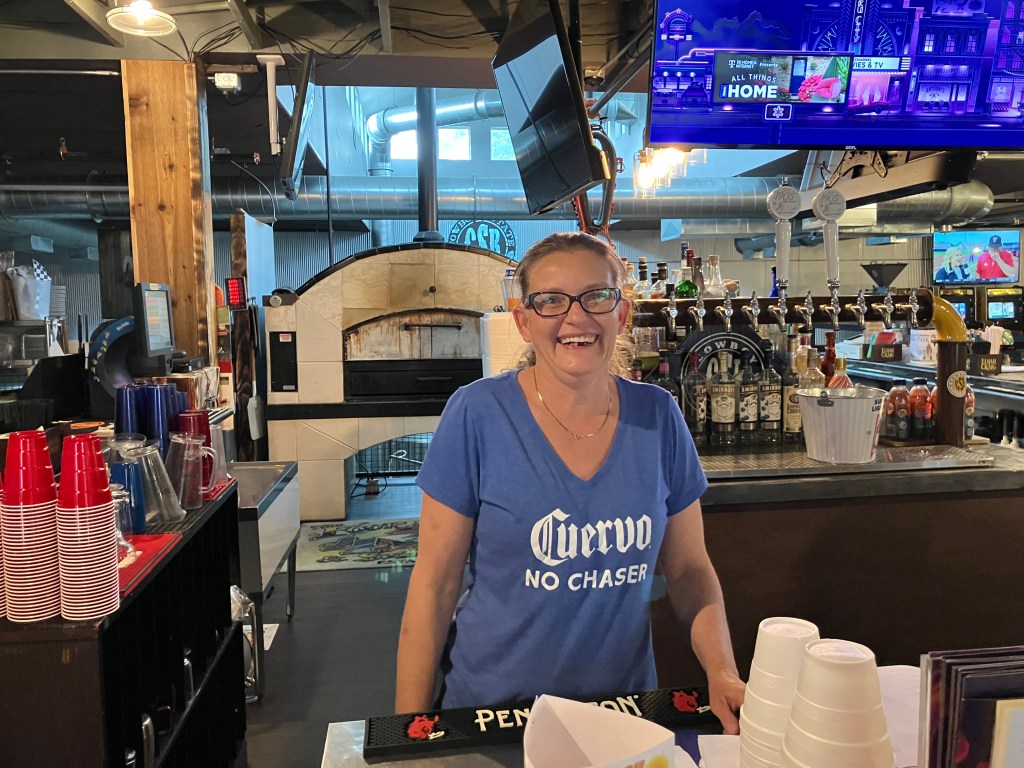
Now if you think this doesn’t sound like my kind of brew pub, you’re right. I asked the bartender, Billie, if this was really a place where they brewed their own beer. She said yes, but then admitted that they “had to let the brewer go,” and thus they aren’t making beer right now. Nevertheless, she still had some of the Cowboy Cream Ale that they had made for the State Fair last year. Did I want to try it? Now, I’m not sure what the shelf life is for beer, but I suspect it’s somewhat less than a year. Nevertheless, I told her to pour me one–I had a blog to write!
Before I get to the beer, let me just say that Billie is one of those people who make you feel welcome at a bar. She came here from Louisiana just about a year ago, and took over as the manager. She says she puts in about 70 hours a week, but she’s still all smiles and energy.
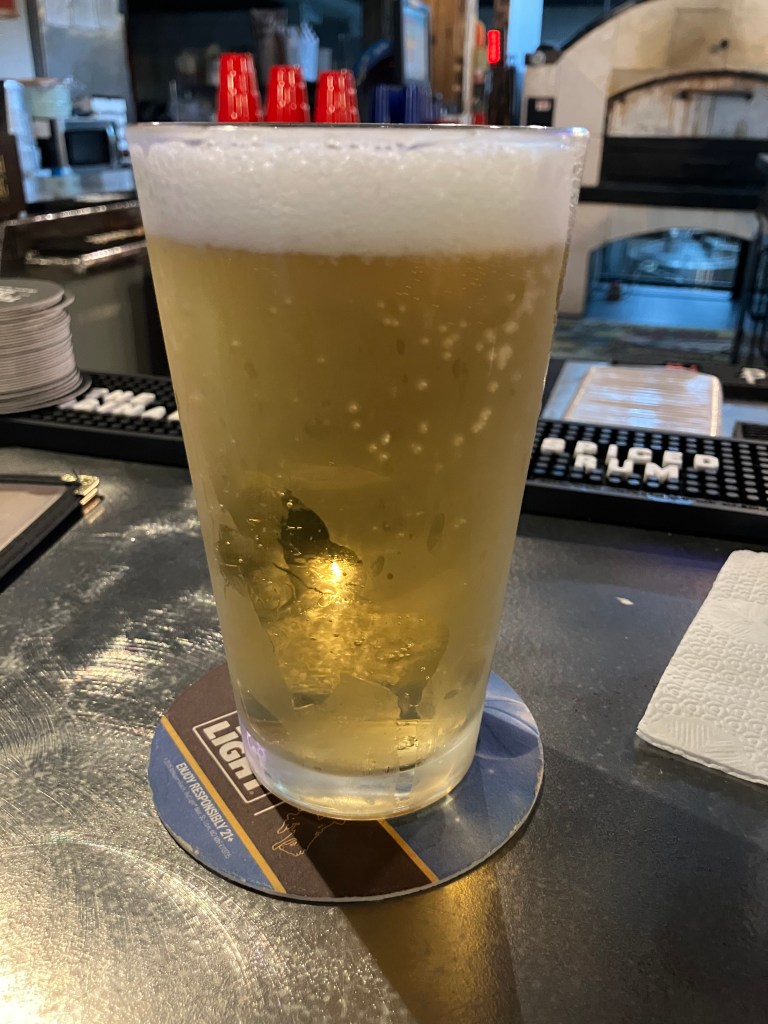
However, the beer wasn’t very good. Maybe it’s because it was old. Maybe it’s because it’s a weird recipe. Maybe it’s because it’s just not my style. But to me it tasted like Budweiser–that kind of skunky, watery, feed-grainy, metallic taste that mystifyingly is popular with 32 percent of American beer drinkers. I can’t in good conscience give it any stars. But I do need to acknowledge that it was popular at the Nebraska State Fair and is a favorite with the locals. So maybe it’s just me.

I should point out, though, that the beer was only $2 (which is just 50 cents more than Case’s lemonade). And Billie gave me a branded beer cozy!
Breweries · Cars · movie theaters · Road trips

Wow! Great Lakes!

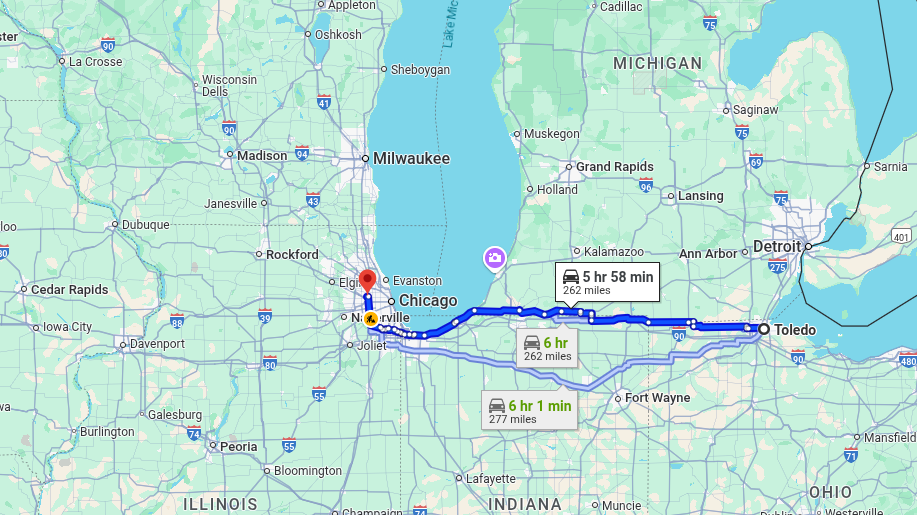
Today’s drive along highway 20 was reflective. The route took me from Toledo Ohio (at the west end of Lake Erie), around the bottom of Lake Michigan, and up to the town of North Lake, Illinois, which is just west of Chicago. Here’s a map:

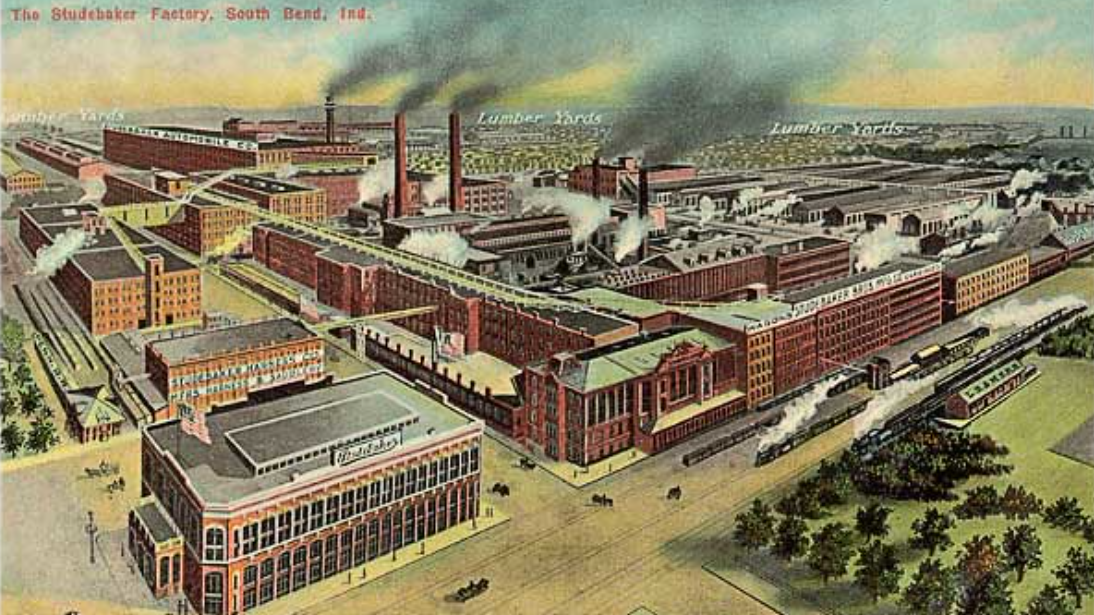
Though it doesn’t show up on this map, Route 20 passes through the city of South Bend, Indiana (pop: 103,400). Named after the southernmost bend of the St. Joseph River, South Bend has an interesting history. It’s been home to Notre Dame University since 1842 (Go Fighting Irish!), of course. But ten years later the Studebaker Brothers came to town and established a very successful wagon manufacturing plant that, around the turn of the century, switched to building automobiles. Studebaker was one of the larger “independent” auto manufacturers, and at its peak it employed 22,000 workers in South Bend. It would be stretching things to say that South Bend was a company town, but Studebaker certainly was a major contributor to the local economy.

Studebaker factory in South Bend, circa 1940.

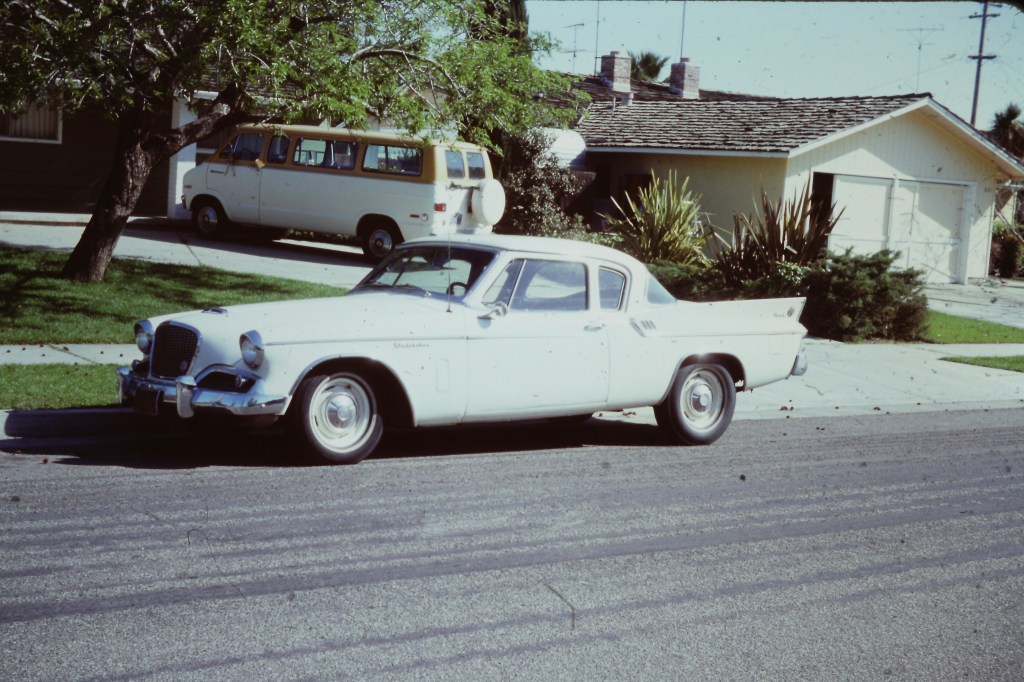
Some of you young ones might never have heard of Studebaker; it closed its doors in South Bend in 1963, and then shut its last remaining facility in Canada three years later. But I actually owned one. It was my first car, which I bought in 1978. Behold!

Parked at stately Boilard Manor around 1980.

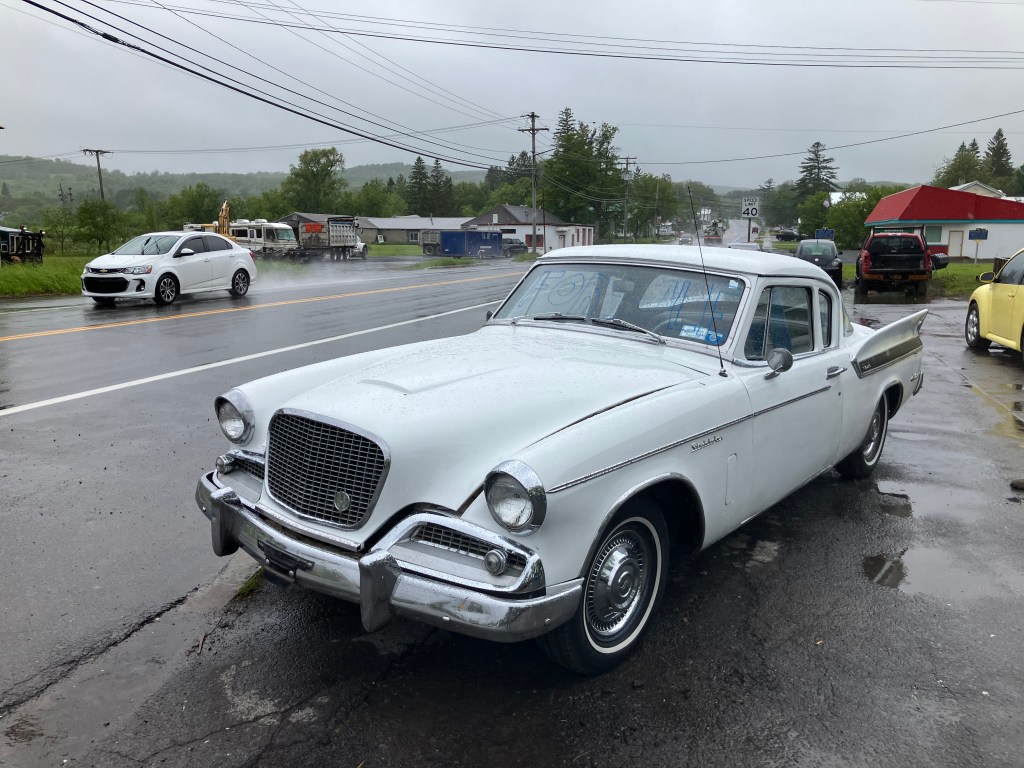
I owned that car for about 25 years, and then, in a rash act, I sold it. Recently I’ve been wondering if I should have kept it. I’ve even had dreams about it. And then, a couple of days ago, I spotted what at first glance appeared to be my old car on the side of US 20 in New York:

Back from the dead, like Christine?

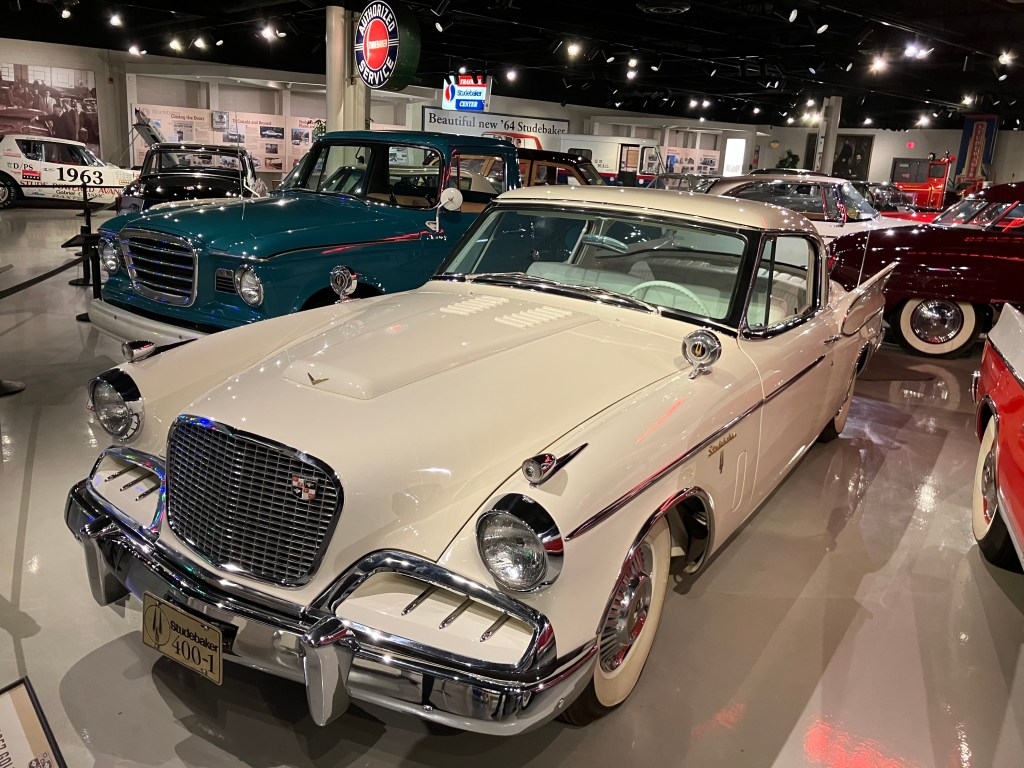
A couple of telltale signs convinced me this wasn’t the same car. But it was eerie nonetheless. And it was eerier still to see a version of the car again today, in the Studebaker National Museum in South Bend:

But I digress. My point was that Studebaker was a major contributor to South Bend’s economy. And so when it shut down in the 1960s, it had a major negative impact on unemployment. It’s estimated that, at the time of its closure, Studebaker employed two thirds of the city’s African-American labor force. To make matters worse, South Bend was already suffering from the general effects of deindustrialization that were besetting towns throughout the Rust Belt.

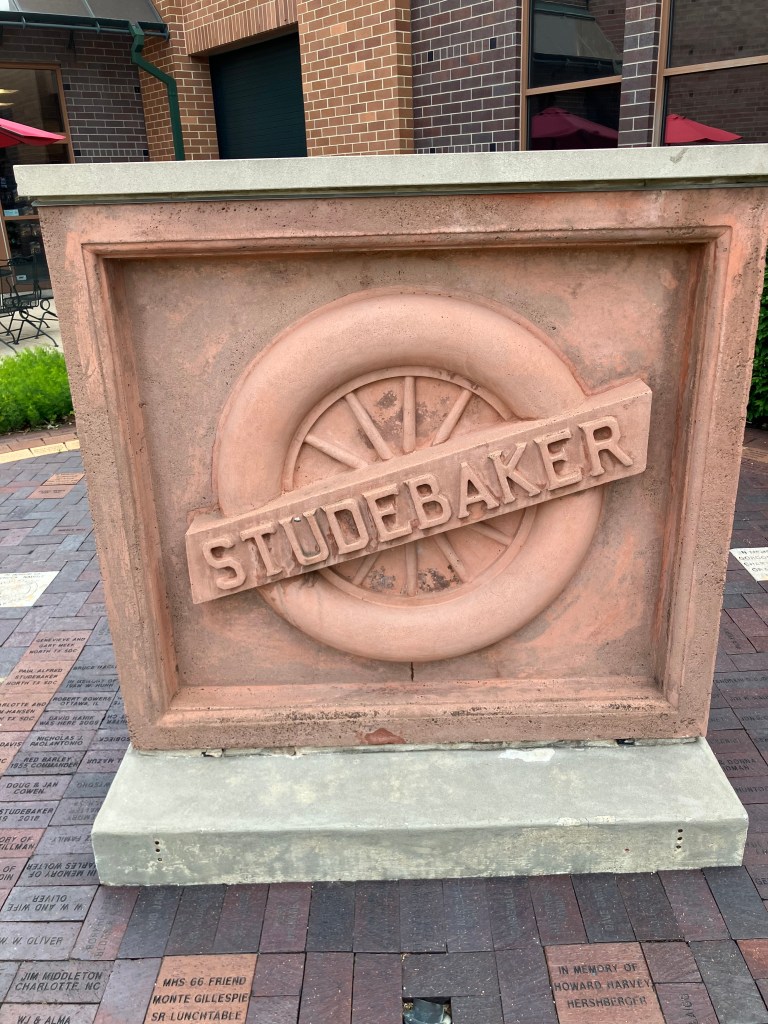
Terra Cotta logo that once graced the Studebaker factory.

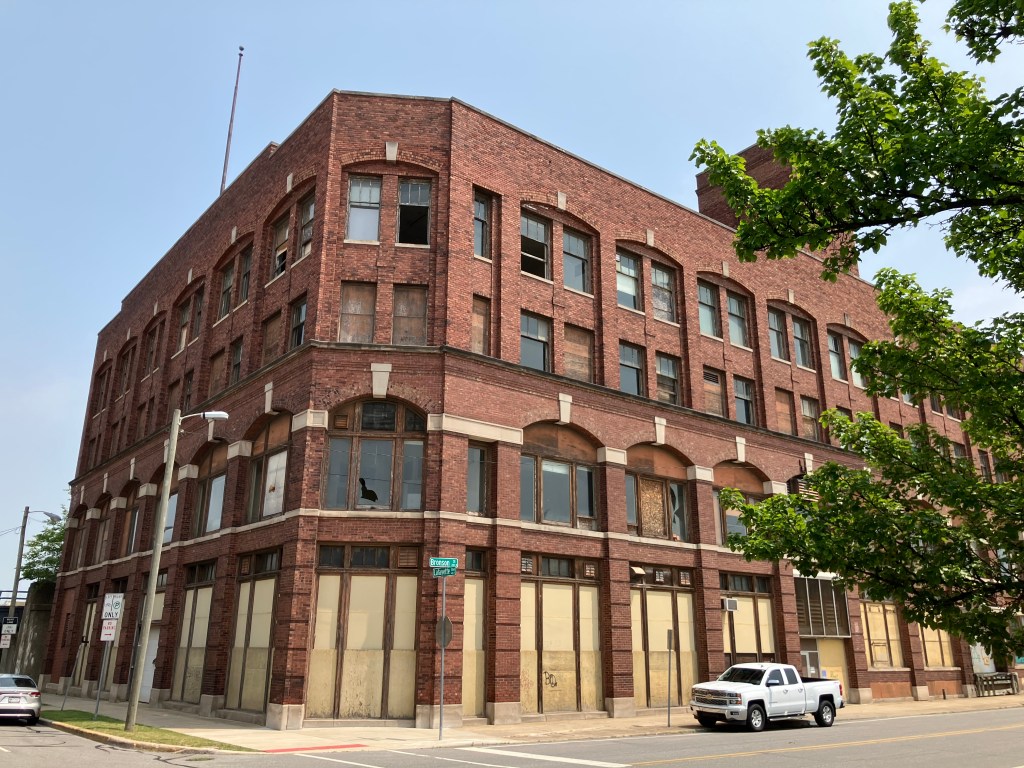
South Bend gained national prominence with presidential candidate Pete Buttigieg as mayor from 2011-2018. He and others have worked to gain investment in the city’s businesses and infrastructure. But I can report from my visit today there’s still a long way to go. Block after block has vacant and dilapidated buildings. The area around the old Studebaker factory is especially rough. Most of the Studebaker buildings have been torn down, but a few, such as Studebaker’s main administration building, still stand, albeit to no good purpose.

Used to be the nerve center of the Studebaker empire.

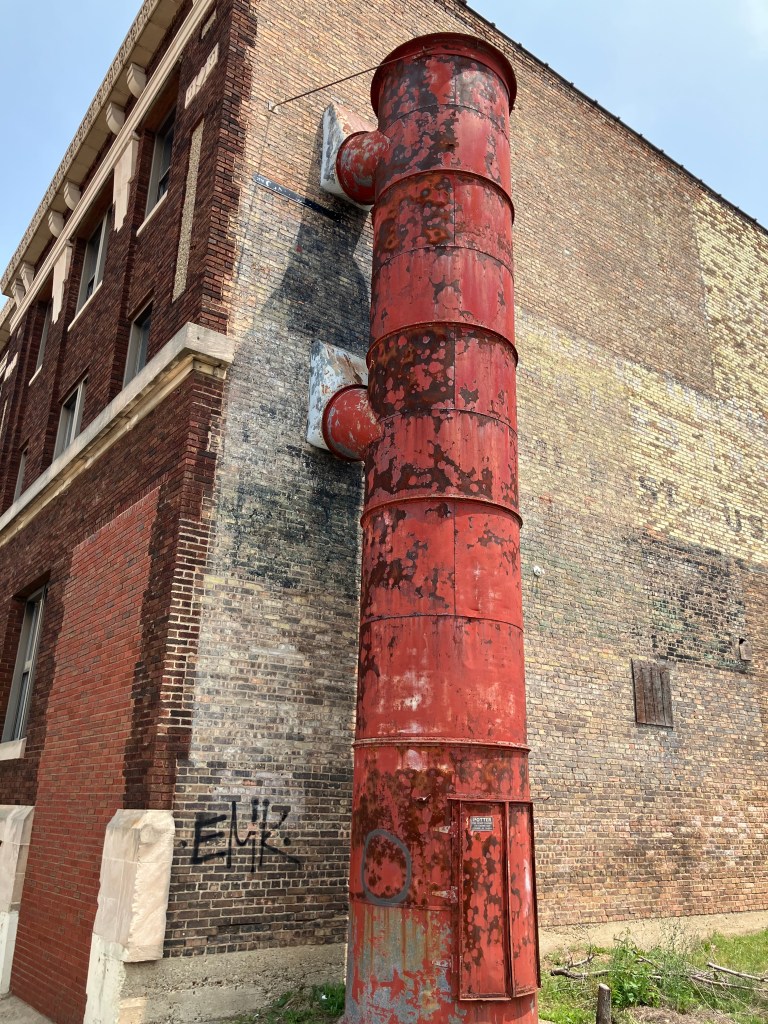
Here’s another random, old building on Michigan Street that appears to be serving no purpose. It caught my eye for two reasons: First, because of the tubular external fire escape.

I wonder if this is where the McDonald’s folks got the idea for their Playplace (TM)?
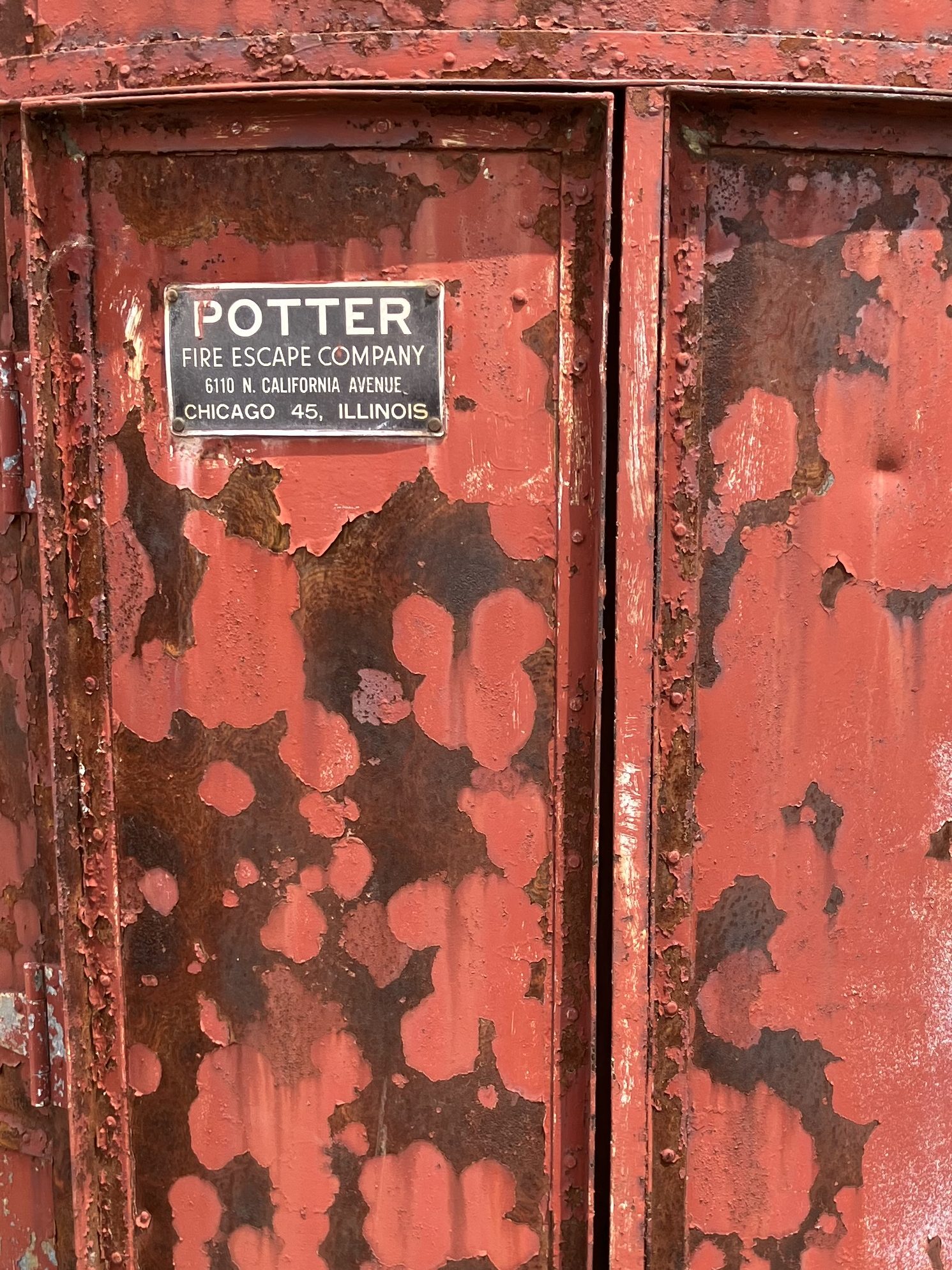
And Potter seems to still be in business today!
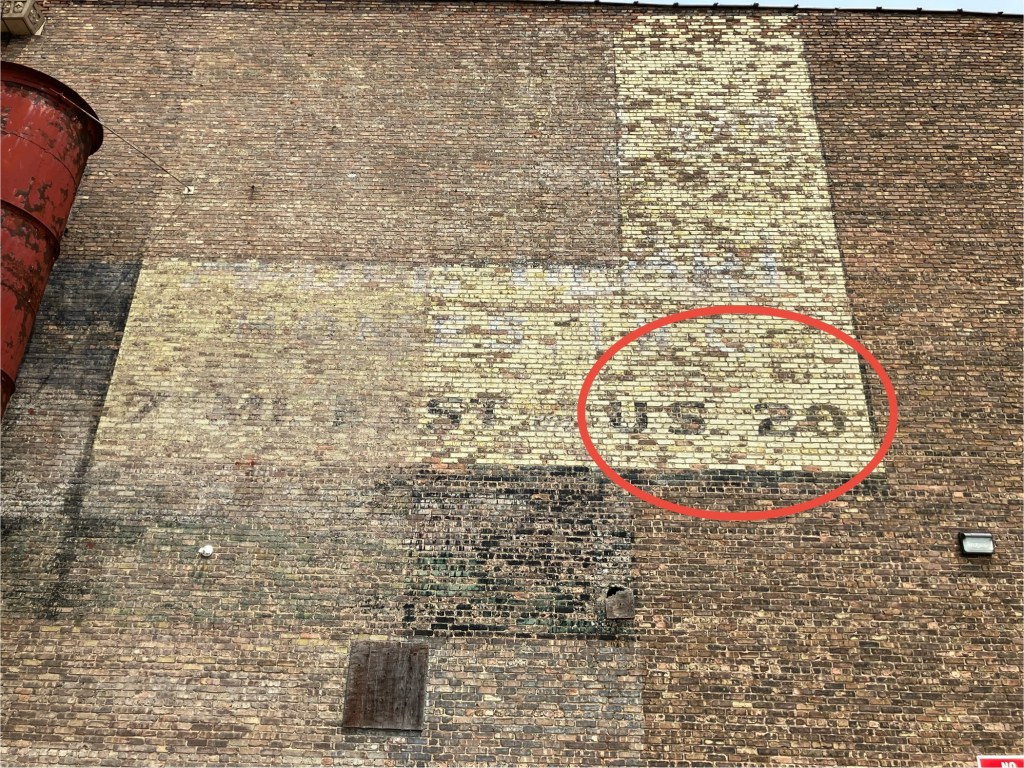
Second, and more importantly, the building caught my eye because of this barely-legible painted signage facing the road:

“US 20” is still clearly visible. (Less clearly, it seems to read “7 MICH ST.”) Funny thing, though, I had to turn off US 20 to drive down this road (on my way to a brew pub. More on that later). It turns out that US 20 used to be routed through here, before being re-routed around the downtown in the 1960s.

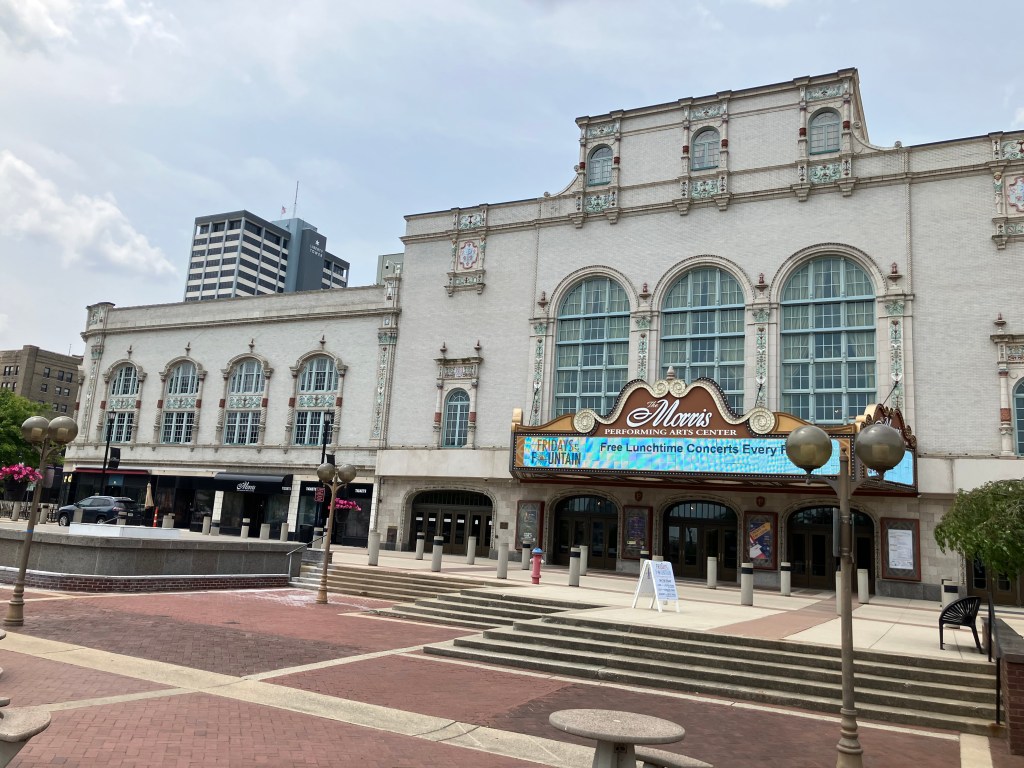
Now, some of you know my pet theory that you can tell a lot about the health of a town by its historic theaters. Almost all older towns have had a theater or two along the way. And almost all theaters declined with the advent of television and VCRs and such. But what did the towns do with their old theaters? Did they knock them down to make way for “progress”? Did they let them decay? Did they repurpose them? The answers to these questions tell a lot about the priority of the arts in the community, the extent of civic pride in the city’s history, the functionality of local government, and so forth. And I’m happy to report that South Bend has restored and preserved its beautiful, large, historic Morris Theater. The original theater opened in 1922 as a vaudeville house. It’s now a performing arts center that seats over 2,500. It’s home to the South Bend Symphony Orchestra, and it hosts broadway shows.

And the inside is even more beautiful than the outside!
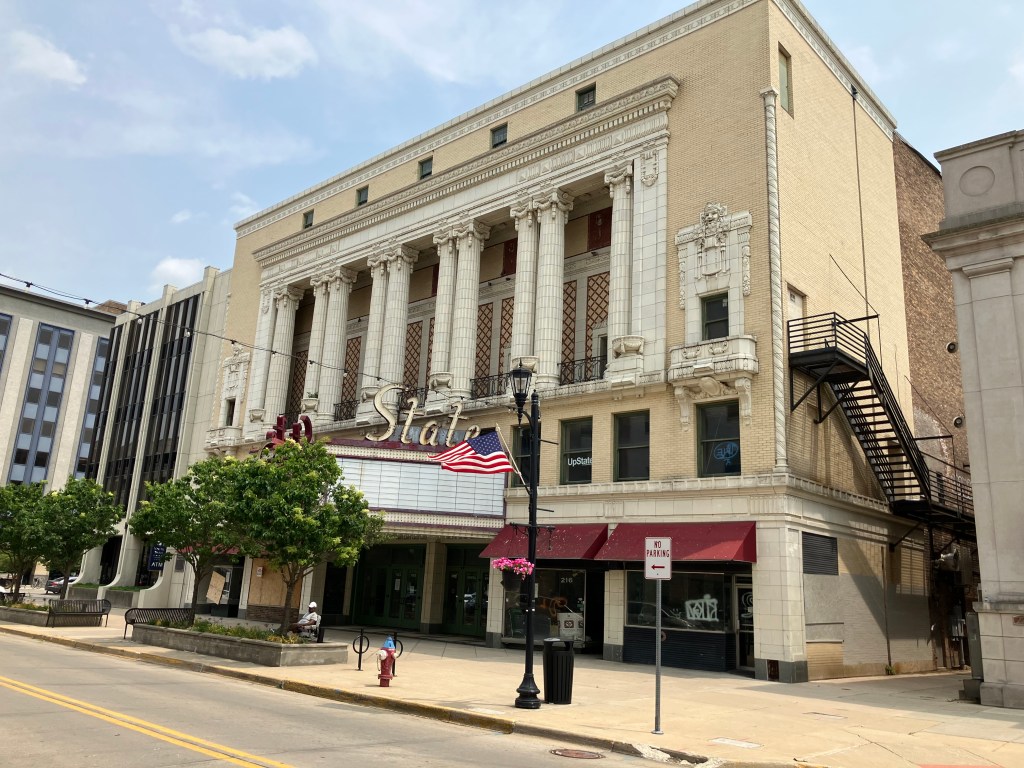
What’s more, South Bend has a second historic theater that it’s actively working to restore. The 1919 Blackstone-State theater was operating on and off up until 2016. As of a couple of months ago, the South Bend Redevelopment Commission approved the City’s purchase of the building for $800,000. Presumably, as a city-owned property, it will have more stability going forward.

Note the non-Potter fire escape.

So I judge South Bend to be on an upward trajectory, despite the significant challenges it still faces.

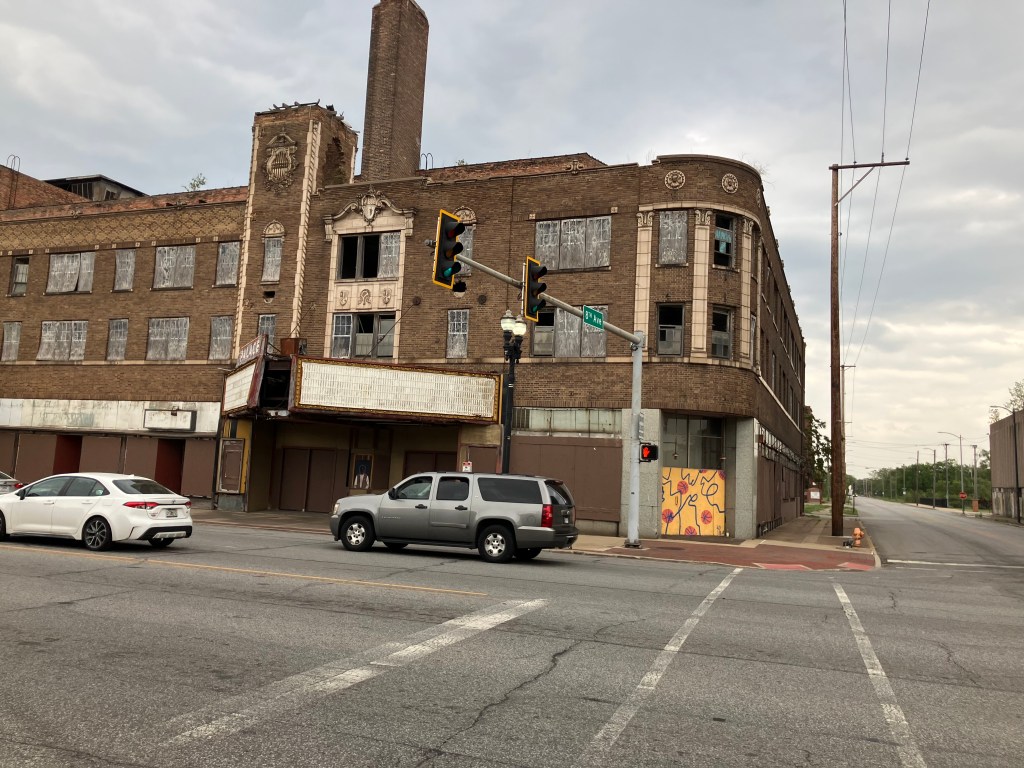
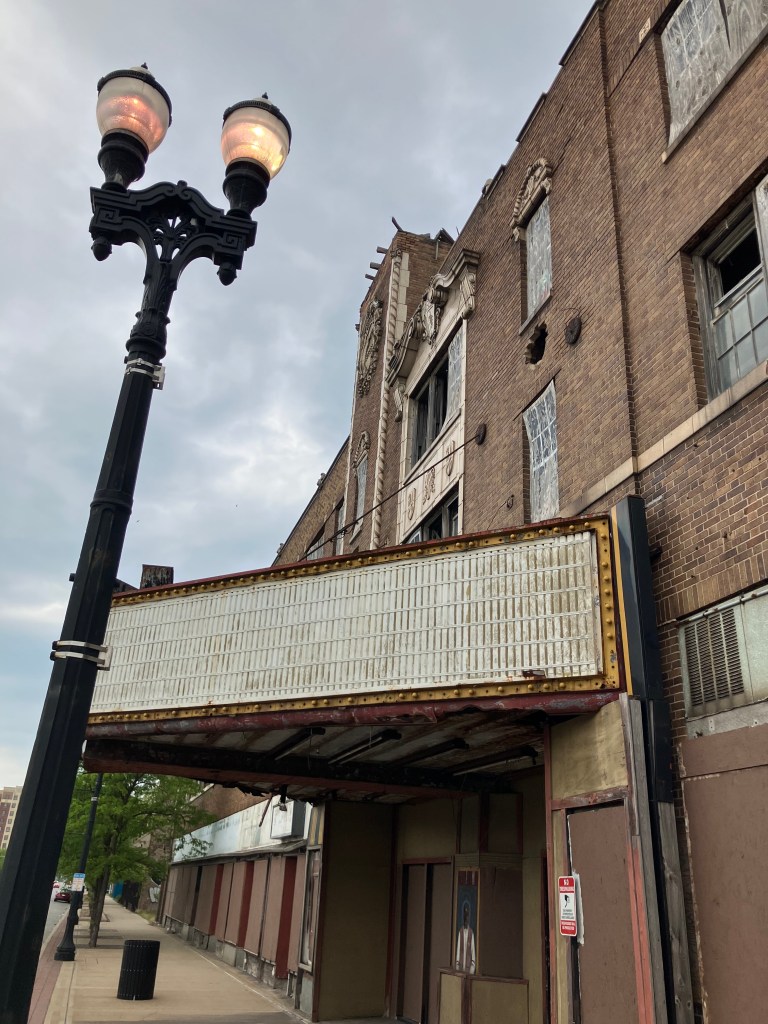
I’m less bullish on the next major town I drove through today: Gary, Indiana. I became quite depressed just passing through. Broadway was once a grand boulevard, but now it looked like it’d been bombed, with half-standing buildings, vacant lots, and rubble lining the street. People roamed the sidewalks in a fashion that seemed aimless and hopeless. And, most damningly, the historic theaters looked like they weren’t ever going to be saved.

Gary’s Palace Theater.
Detail of the marquee. That street lamp looks good, at least.

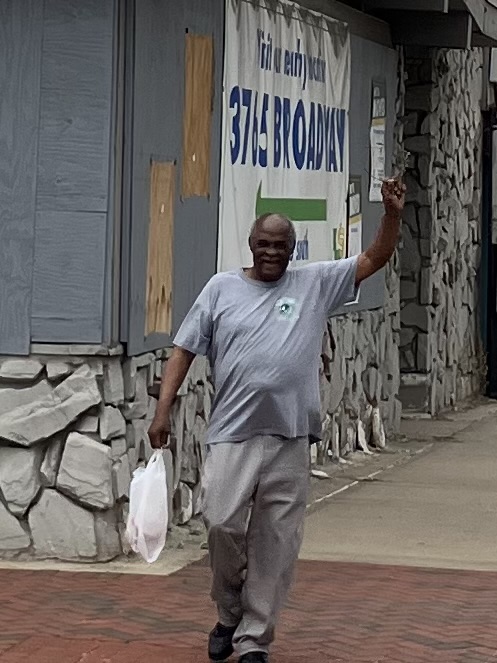
While I was taking a picture of the Palace theater (above) a man who was passing by stopped to tell me about how it used to be his favorite movie theater. “Apple” (as he called himself) used to sit up in the balcony and watch double features in the 1960s. He was sorry to see it go. Now, he says, he lives in an “old people’s home” and walks past the theater every day on his way to the corner store. He was a kind and sympathetic man, but he didn’t seem to have any spark in his eyes.

Apple, waving ciao.

Now, you probably know Gary Indiana for one of two things: the song from The Music Man (sung by a young Ron Howard), or the birthplace of Michael Jackson.

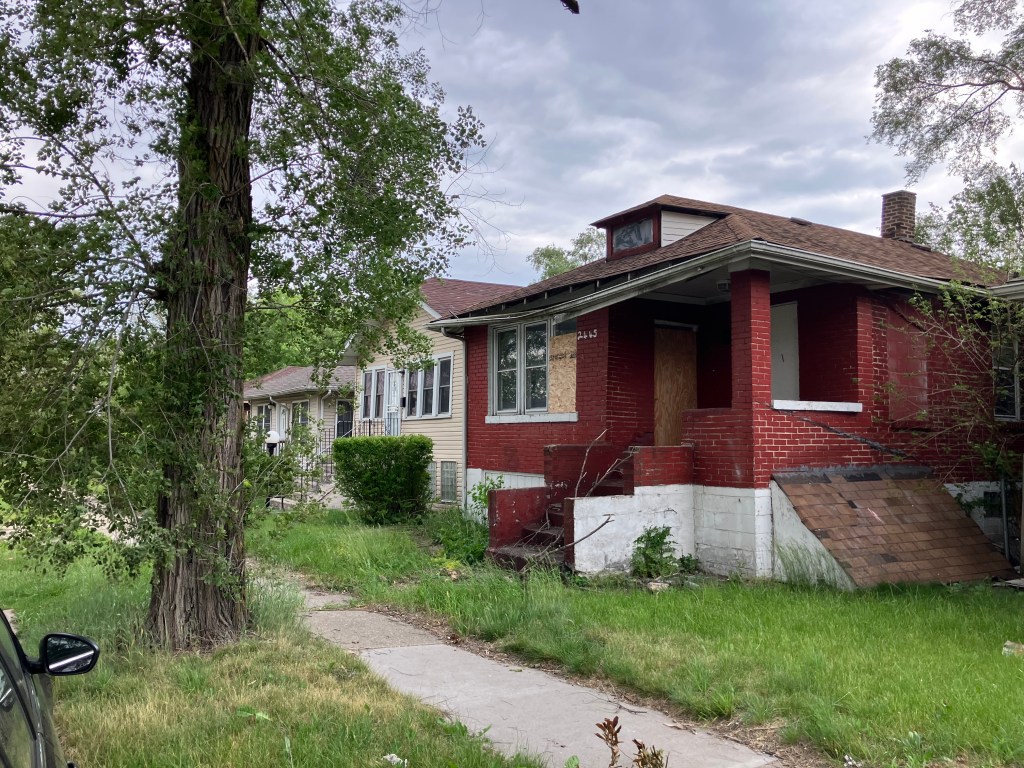
In fact, while driving through the town I passed a sign directing me to the Jackson House. I dutifully followed the sign and ended up on Jackson Street (whose name, I assume, was changed after the Jacksons became famous. Otherwise it would be too much of a coincidence!) The neighborhood is severely run down, and seems to be populated by people who haven’t had a break. There’s no obvious signs of graffiti or gangs or drugs or anything like that; just poverty and neglect. Many houses are boarded up and/or abandoned.

Sad state of affairs.

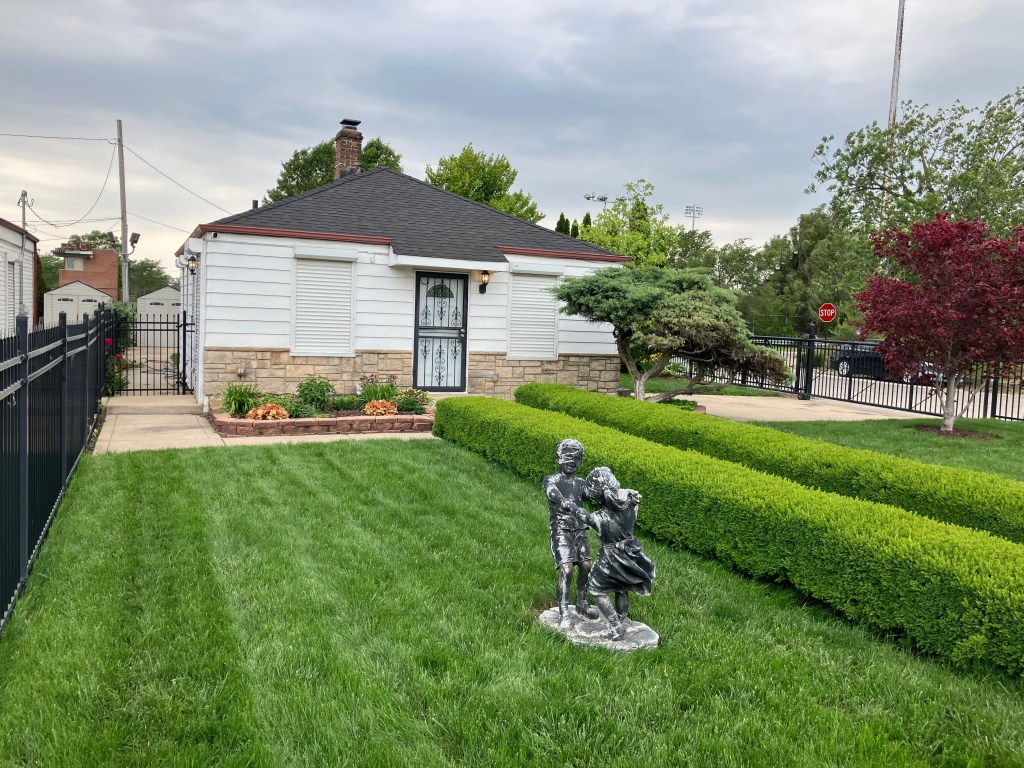
But then you come to the Jackson place. It’s a tidy and tiny (two-bedroom) bungalow, in which the eleven Jackson family members somehow lived. It makes me glad to know they hit the big time, but my heart goes out to the rest of the folks around here who didn’t.

Stately Jackson Manor.
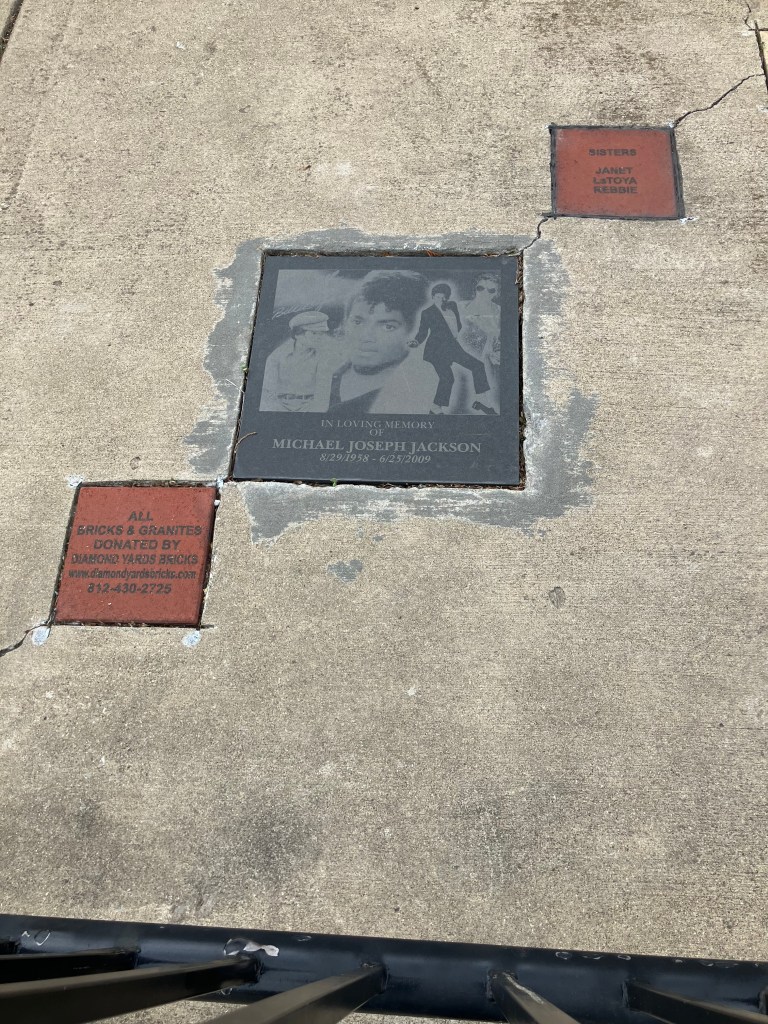
Memorials in the driveway. I don’t think I’d hire Diamond Yard Bricks to do any installation work.

Anyway, I left Gary feeling sad for a dead city and the people who still live in it.

After passing through Gary Indiana, Route 20 skirts around the edge of Chicago. I happen to love Chicago as a city, but visiting it is a commitment, and this is not that kind of road trip. So I stuck to Route 20, skirting around the outer edges of the city. I’ve parked myself in a nondescript town called North Lake, about 13 miles west of Chi-Town. Tomorrow I should finish crossing Indiana.

BEER OF THE DAY

I nabbed my BOTD at the South Bend Brew Werks. It’s another example of how South Bend is on the way up: It’s a nice, bright, new space with art on the walls and a big outdoor patio. They’re part of an energetic business district near the Morris Theater. They take their beer and their food seriously.

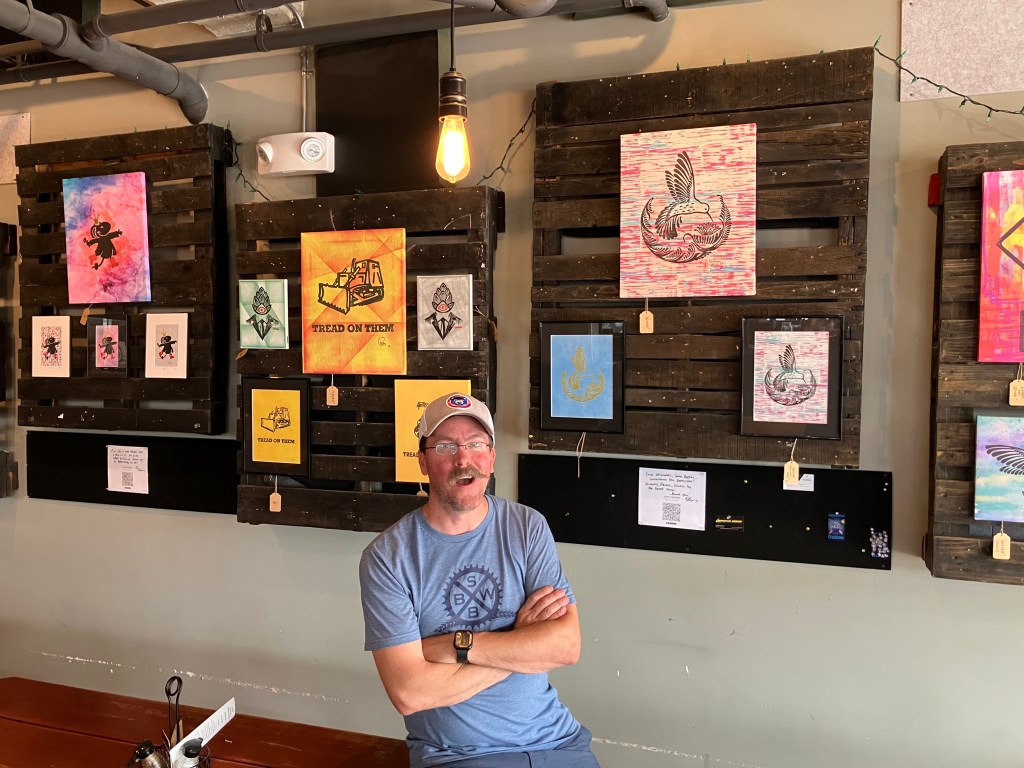
My server–Jason–was incredibly knowledgeable about beer, not just the stuff they brew but also the beers at breweries throughout the region. He’s also a rubber-stamp artist, and his work is currently hanging in this restaurant.

Jason, beer-savant.

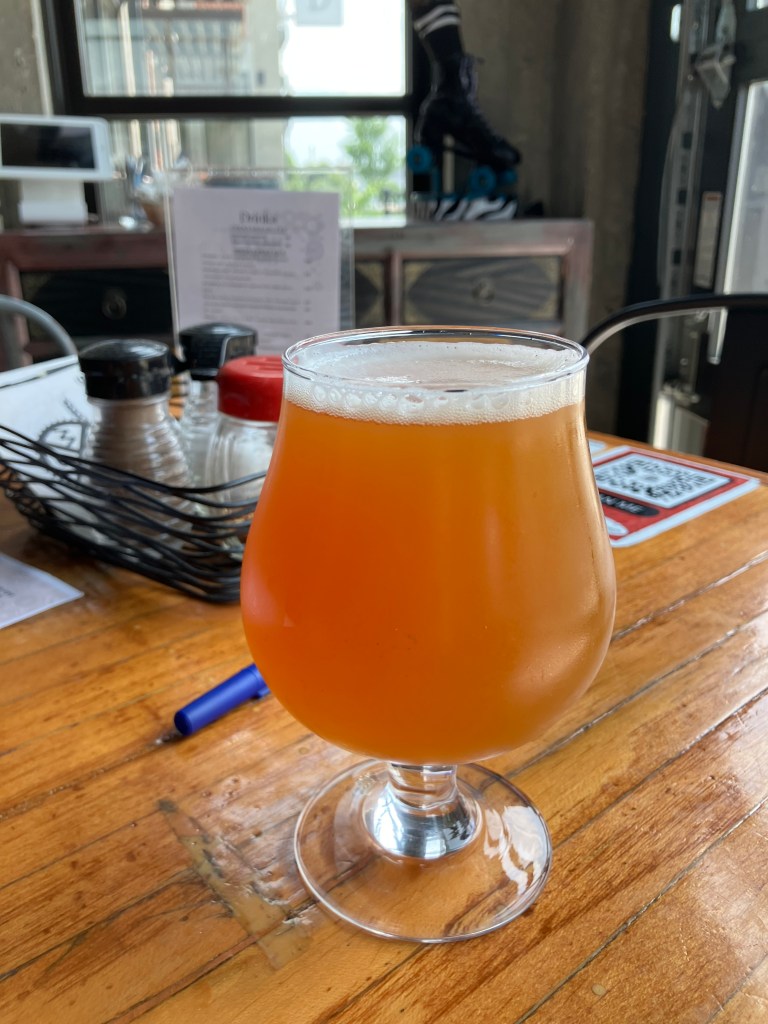
On Jason’s recommendation, I had the “Disinhibited Ep. IV: A New Haze.” It’s a double hazy IPA.

It’s a highly drinkable beer, though it clocks in at 8 percent ABV. The appearance, as you would expect, is hazy. And as an IPA, it has the expected piney hoppiness and medium carbonation. But the flavor is more interesting than your average IPA. It has notes of grapefruit and dandelion, balanced by the aforementioned hops. There’s just a suggestion of sweetness. Overall, the flavor is more sunny than bright, and more juicy than refreshing. It’s a very solid effort and manages to stand out in a world dominated by endless IPAs. 4 stars.

COINCIDENCE CORNER:

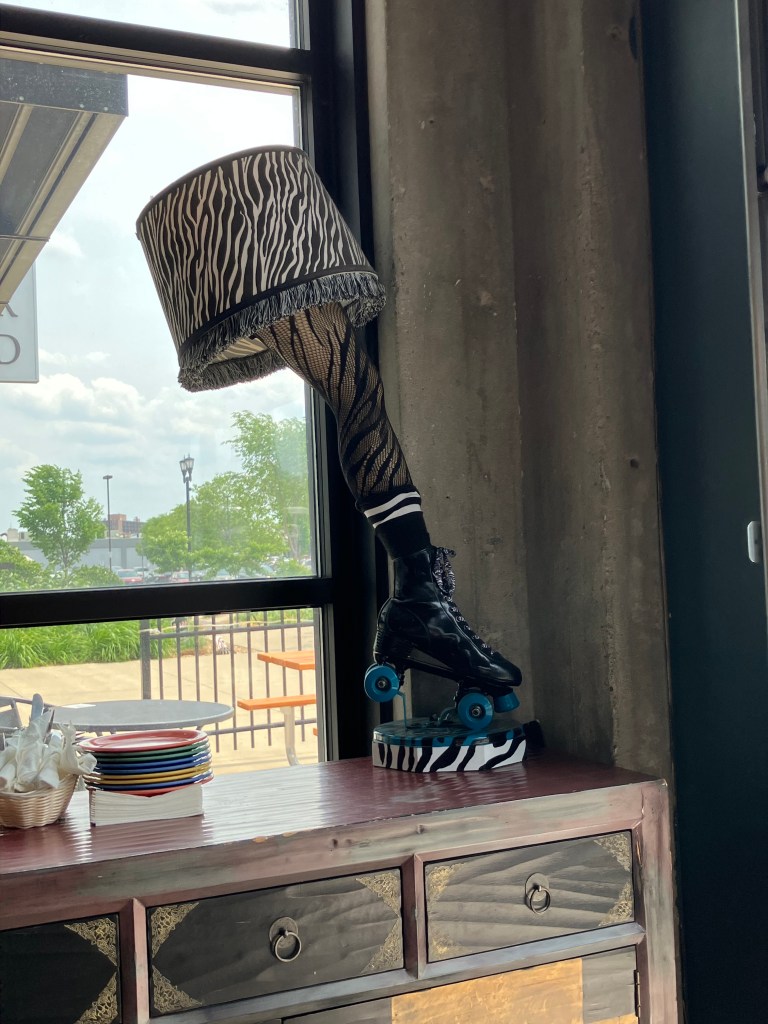
Yesterday I posted a picture of the Christmas Story house in Cleveland. Today I saw this in the corner of the South Bend Brewing Company:

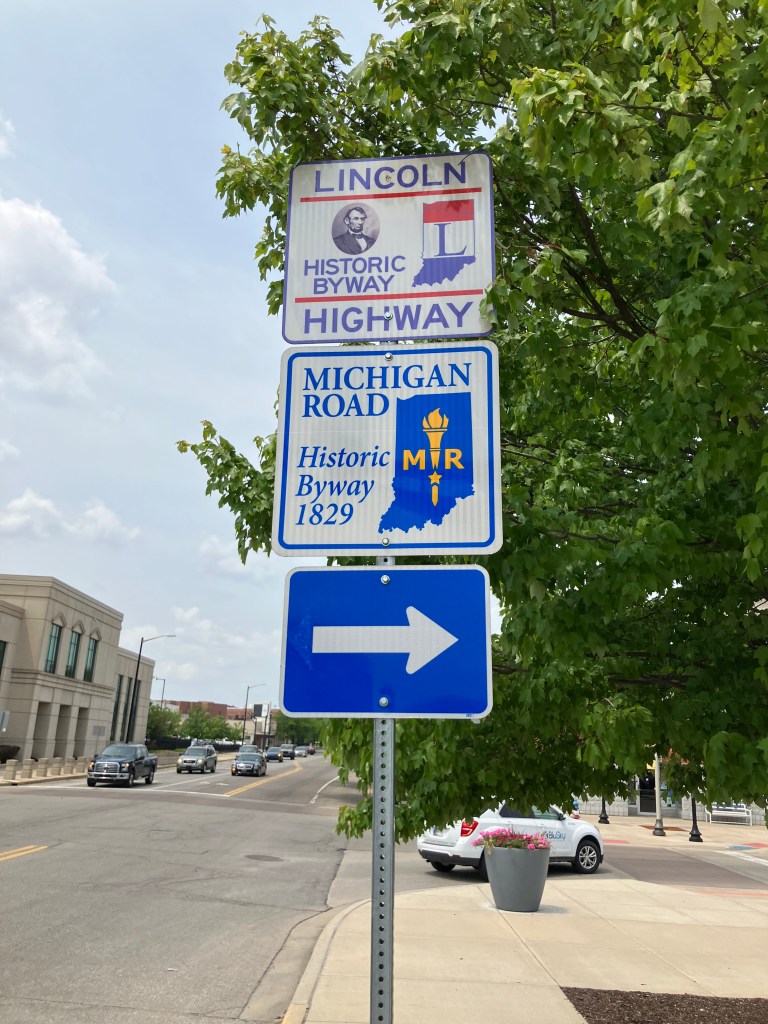
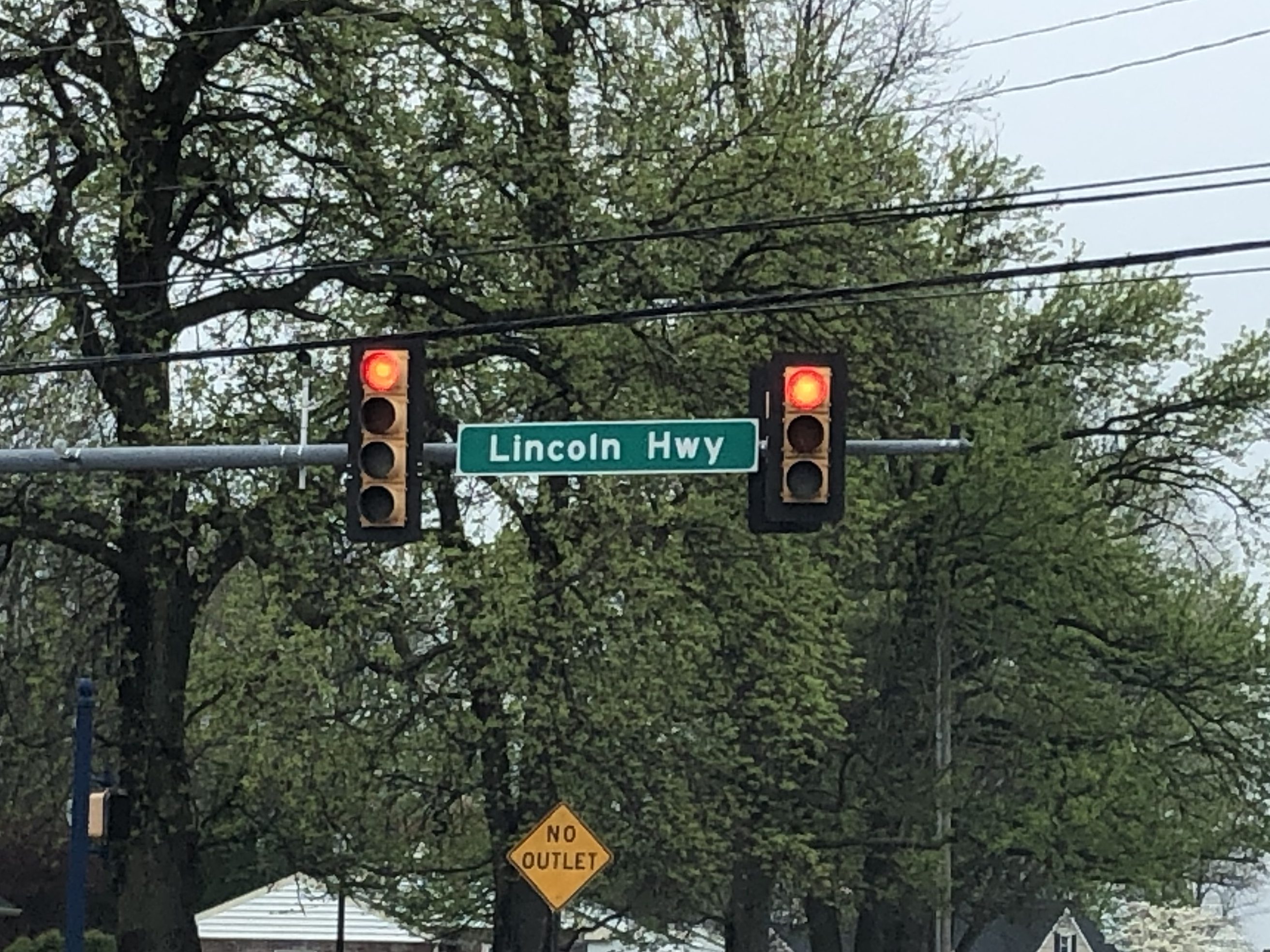
Also, in April I did a blog post about the stretch of the Lincoln Highway that runs near my home in El Dorado County, CA. Today I saw this on a street corner in downtown South Bend:

California history · Cars

Googie!

The other day I was driving along the freeway, observing the passing phalanx of big, blocky buildings behind the trees and sound walls that flank the freeway. These buildings all seem to have been conceived by a kindergartener for whom the words “office building” and “box” are synonymous, and then value-engineered to the apotheosis of vapidity–nondescript, slab-sided edifices with bands of tinted windows and, at a top corner, a single word in an unembellished font: “Kaiser,” “Allstate,” “Lennar.” We live in an age of soulless and tedious architecture.

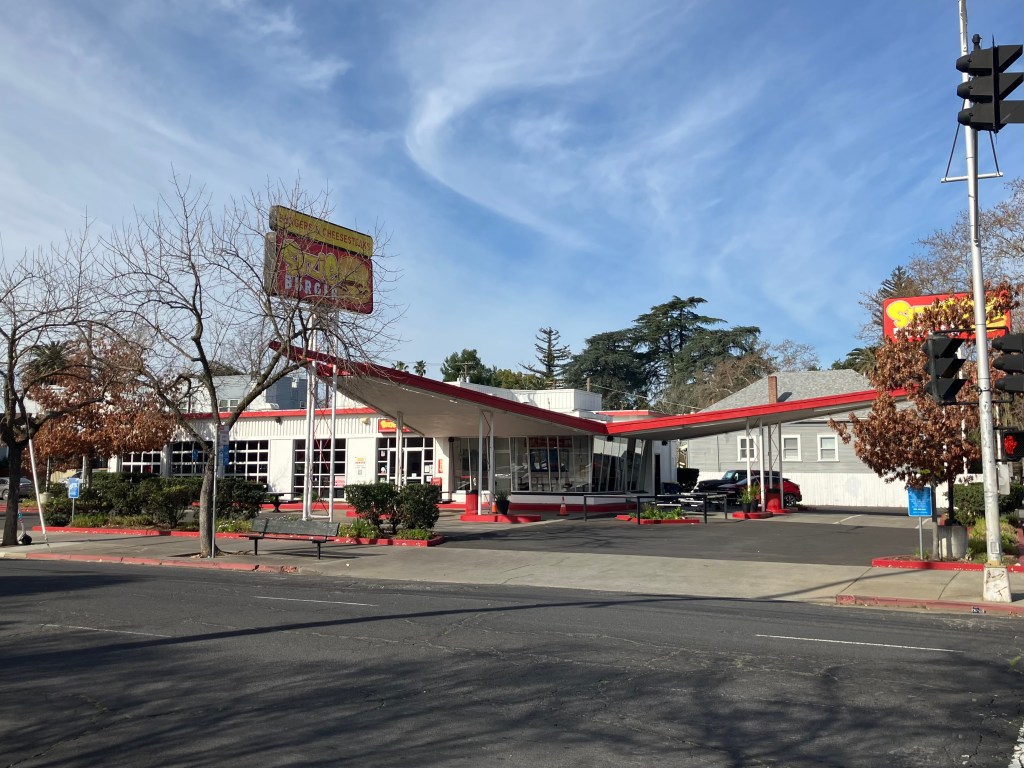
And then, a little later, I spotted this in Sacramento:

Don’t scratch your cornea on that pointed roof!

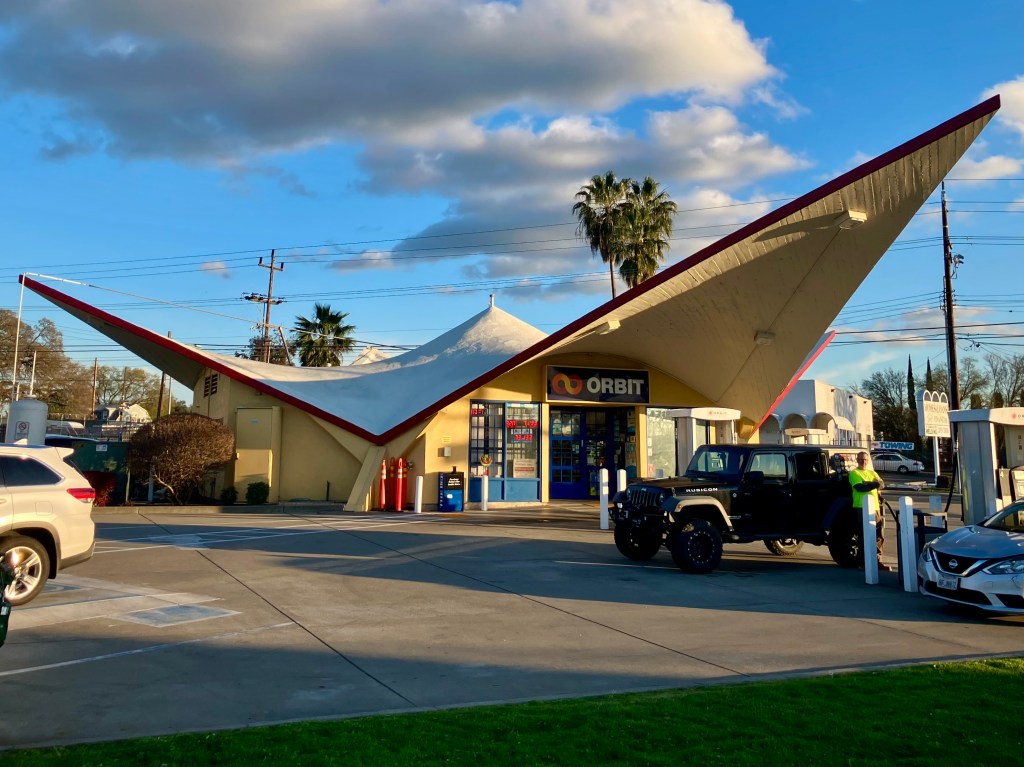
Now this building has style and soul! I realize that’s not a great photo; it was difficult finding the right angle. But it’s an old Orbit gas station, now repurposed as a hamburger joint called Suzie Burger.

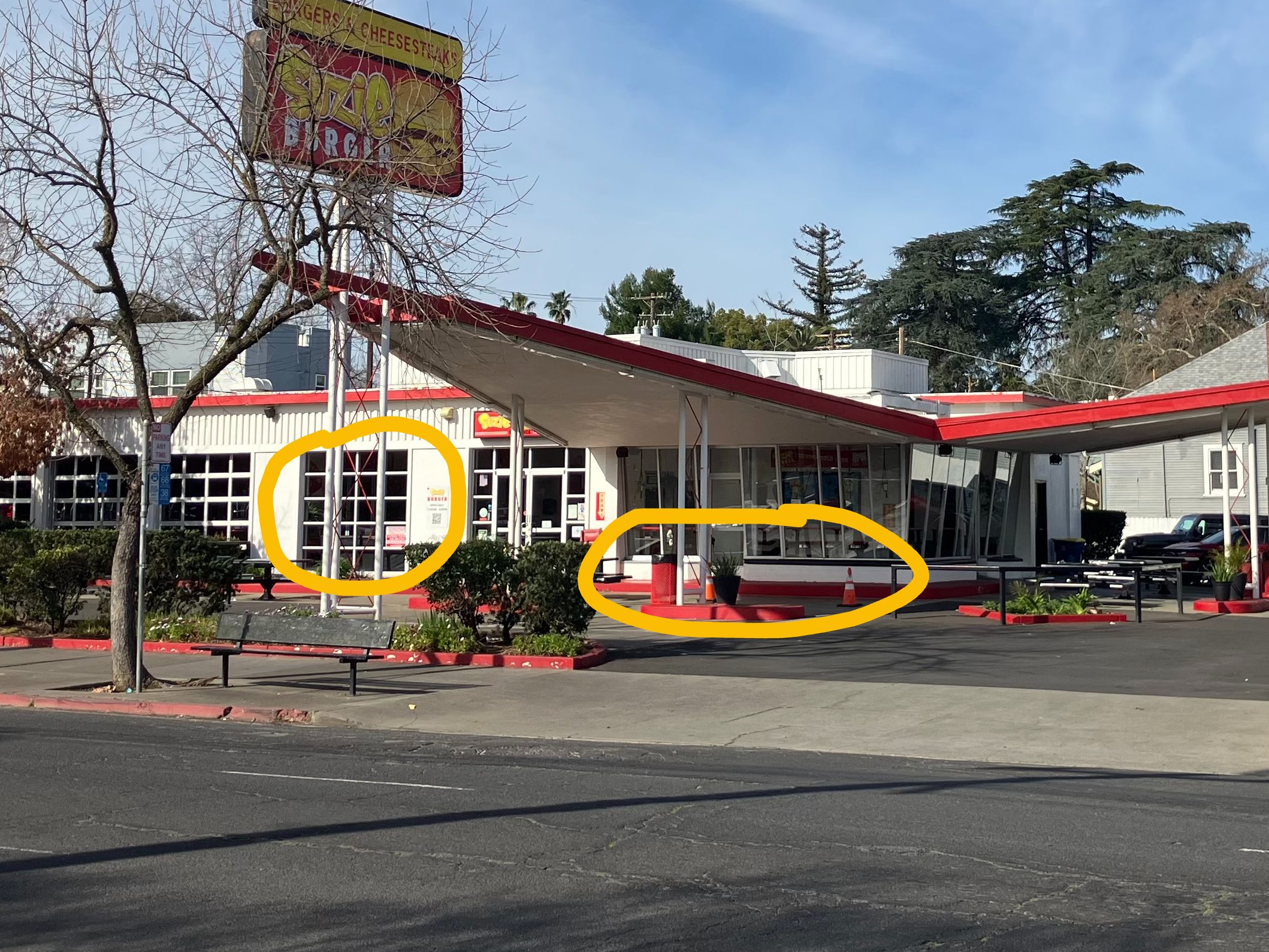
That this was once a gas station is obvious. Note the islands where the gas pumps once stood, and the enormous mullioned windows that used to be roll-up doors in front of the service bays.

These Times They Are A-changin’ indeed.

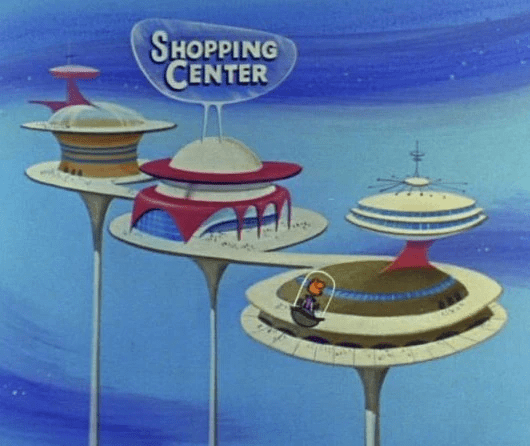
Orbit gas stations used to be all around the Sacramento area, first showing up around 1963. They represented the future, or at least what people during the age of black-and-white TV and AM radio thought the future would look like. It’s got a very Jetsons vibe, all upswept and angular and exaggerated.

Jane’s addiction.

According to this website, Orbit’s distinctive four-point architecture was the brainchild of some guy named Ed Ward. There were about a dozen of them at their peak. Now, it seems that most have been torn down in the intervening 60-odd years. And yet the good people at Suzie Burger recognized that Orbit’s retro look would be a great calling card for their old-school burger joint.

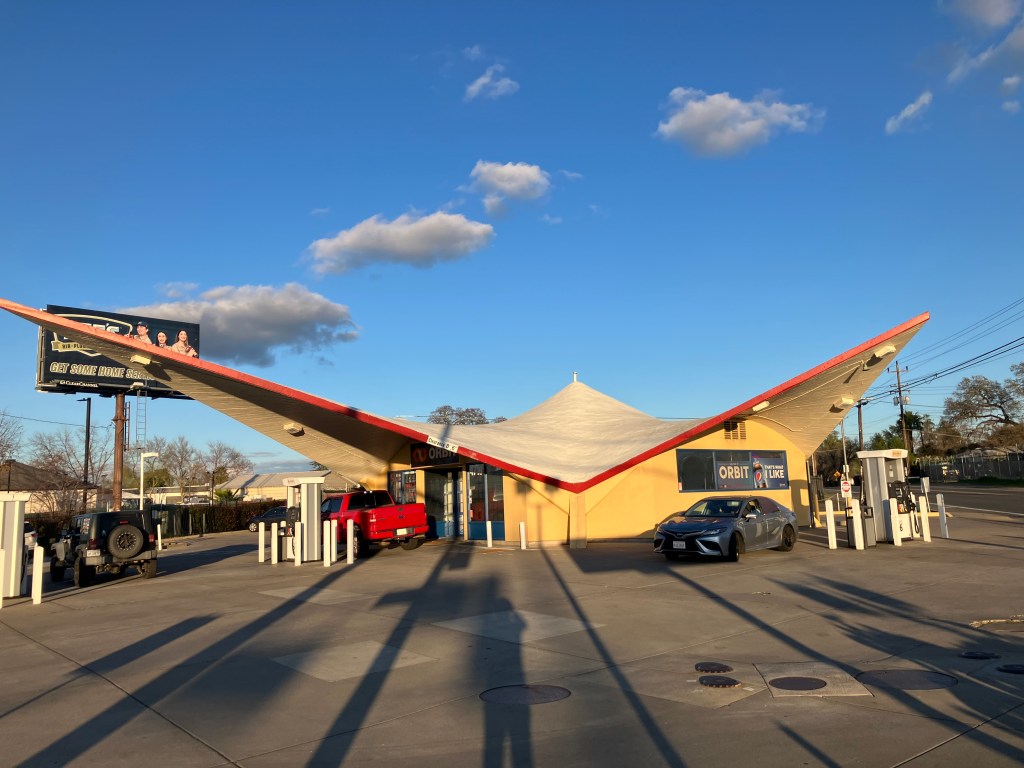
I remembered that when I lived in Sacramento (pop: 525K) in the 1980s, there was still a handful of Orbit gas stations in operation. In fact, I regularly gassed up the Studebaker at an Orbit station near my apartment in Carmichael. What had happened to it? Had it been torn down? Or had it been converted to some other use? I decided to take a drive out there to find out. And what to my wond’ring eyes should appear but this:

“It’s alive!”

Not only had it not been torn down, but it was still operating as a gas station. It even still bears the Orbit name!

So take that, you big, ugly, featureless office buildings! Even at age 62, this Orbit is still going strong. Next time you find yourself in Sacramento make sure you gas up at 4716 Auburn Blvd and support the preservation of Googie architecture!

Cars · Movies · Road trips · trains

Runnin’ On Empty

Well, there goes yet another year. And that’s kind of sad, if you think of your lifetime as a gas gauge that is counting down to empty, and there’s no gas station anywhere on your planned route. In fact, there’s not even a gas filler pipe on the whole car. You just drive it til it’s empty and that’s it. Off to the crusher.

But surely that’s not the right way to think about these things; instead, we’re advised to roll down the window, turn down the radio, and pay attention to all the cool things we’re seeing and doing as we drive our car along the unsigned and mysterious Highway of Life. And if we’re lucky, there’s still enough gas in the tank for some more adventures. As they say, life is a journey.

And speaking of journeys, I’ve got some good ones planned for 2025, including a winter trip to Needles, CA (pop: 4,800) to see one of the last remaining Harvey Houses, and a visit to Blob Fest in Phoenixville, PA in July.

Adele seems to have fallen on hard times…

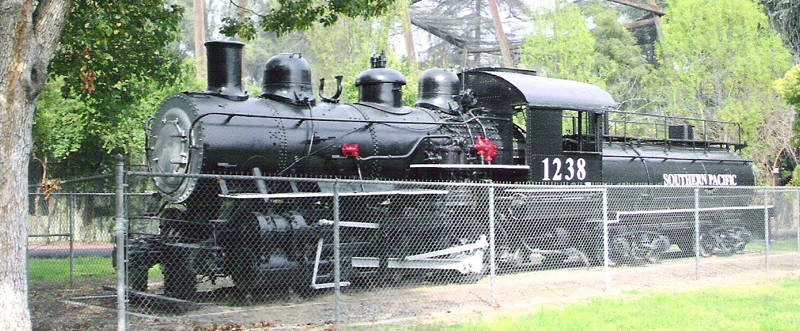
I’m also planning a return to the town of Kingsburg, CA to witness the delivery of a century-old, 82-ton steam locomotive. The delivery has been delayed several times, but the current best guess is January or February.

Old #1238 cools its heels in Fresno, waiting to be moved to its new home in Kingsburg.

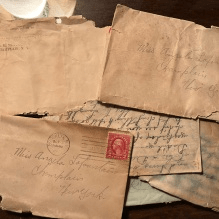
And speaking of a hundred years ago: alert readers will recall that I received a cache of love letters my grandfather wrote to his then-girlfriend in 1925 and 1926. I have transcribed all 17 of those letters and I’ve posted them here. Feel free to read them while you’re waiting for the ball to drop in NYC.

And with that I will wish a Happy New Year to all. We’ll see you in 2025! Your mileage may vary….

bridges · Cars · Puns · Road trips · Yard art

O Say Can You See?

The short answer is: Not very well.

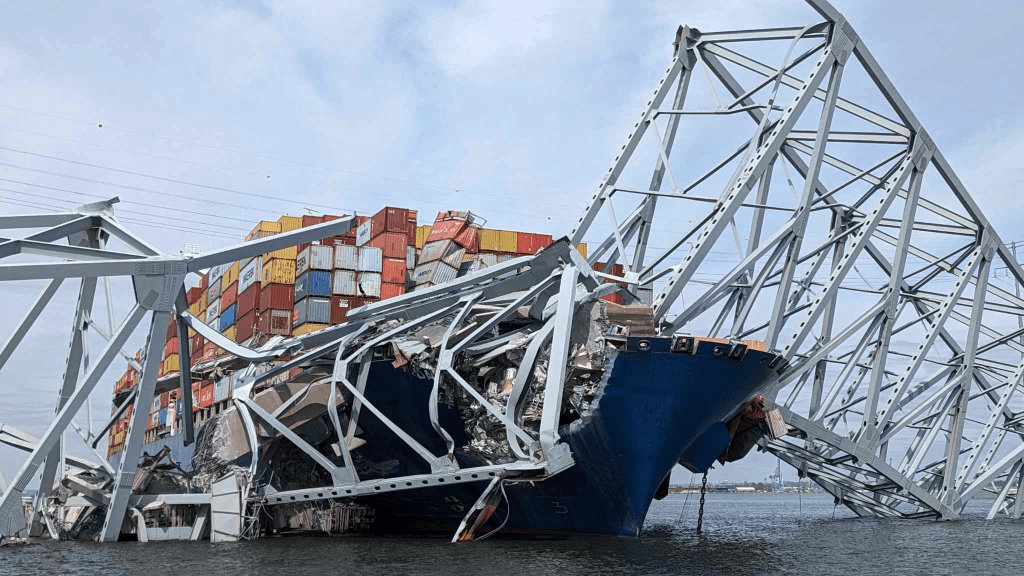
The longer answer is this: Son Ian recommended I take advantage of my proximity to Baltimore (pop: 570,000) and check out the remains of the Francis Scott Key bridge, which collapsed a scant 3 weeks ago. It’s the kind of light-hearted whimsy we Boilards are known for.

The FSK Bridge opened in 1977, and it carried over 11 million vehicles annually until a container ship struck one of its piers last month. Much of the span is now underwater, posing a hazard to ships.

“My bad!”

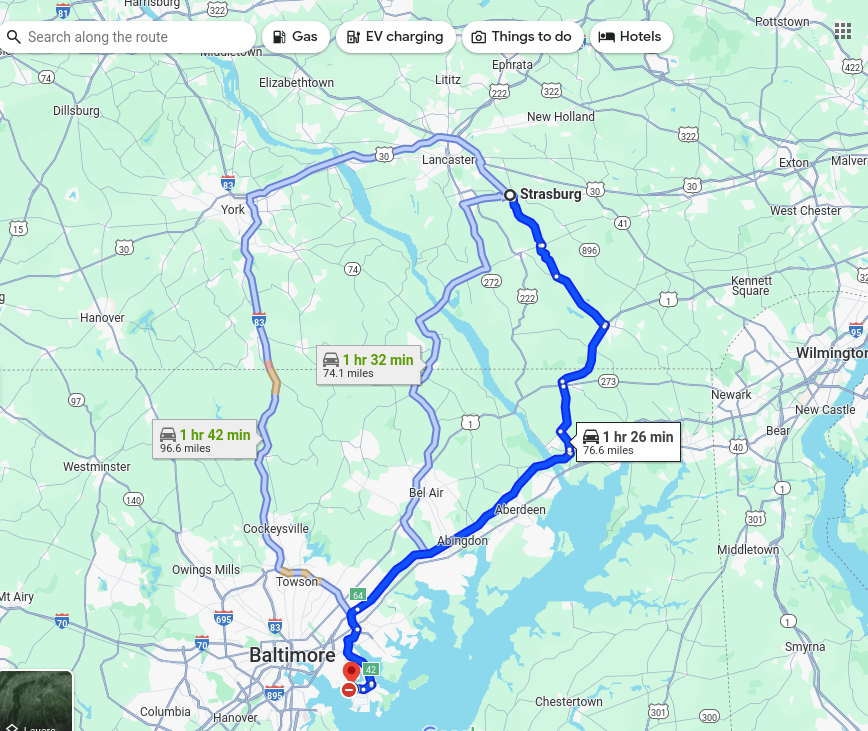
This week the Army Corps of Engineers is supposed to be removing much of that wreckage. It should make for a cool photo op! And according to Google Maps, I was only about an hour and a half from the foot of the bridge.

How hard could it be?

So after getting a cup of coffee and a Power Muffin from The Speckled Hen in Strasburg, I set out for the greater Baltimore area.

Getting there was easy enough–until the last couple of miles, when I encountered a police roadblock. They weren’t going to let me get anywhere close to the foot of the bridge. I’m not sure what I was expecting. I guess I envisioned a big, Roadrunner-style “Bridge Out” sign on sawhorses a dozen yards from the shore of Boston Harbor.

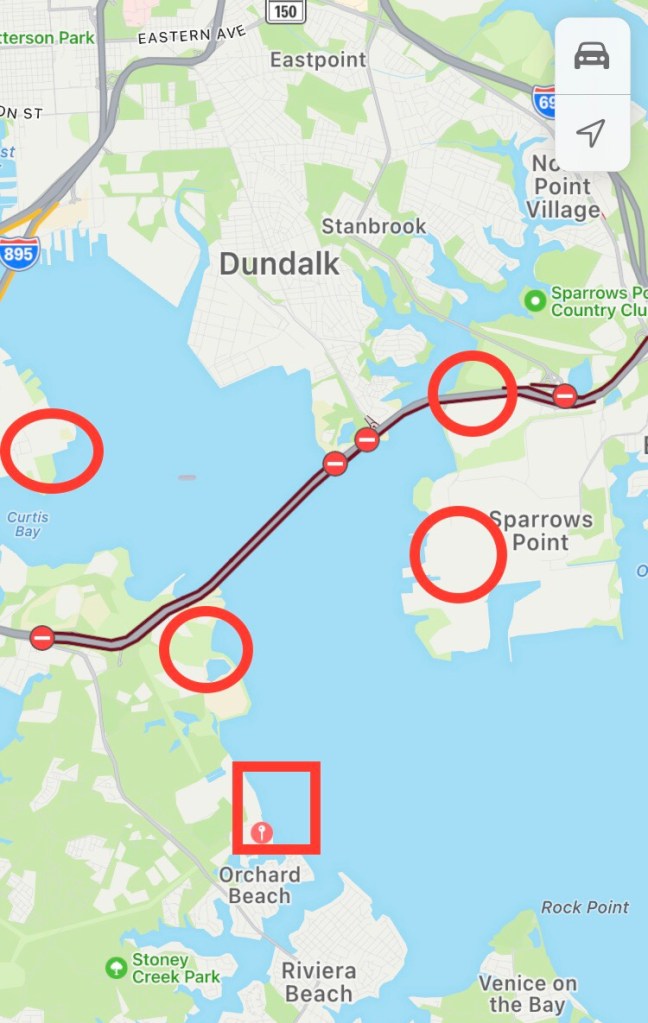
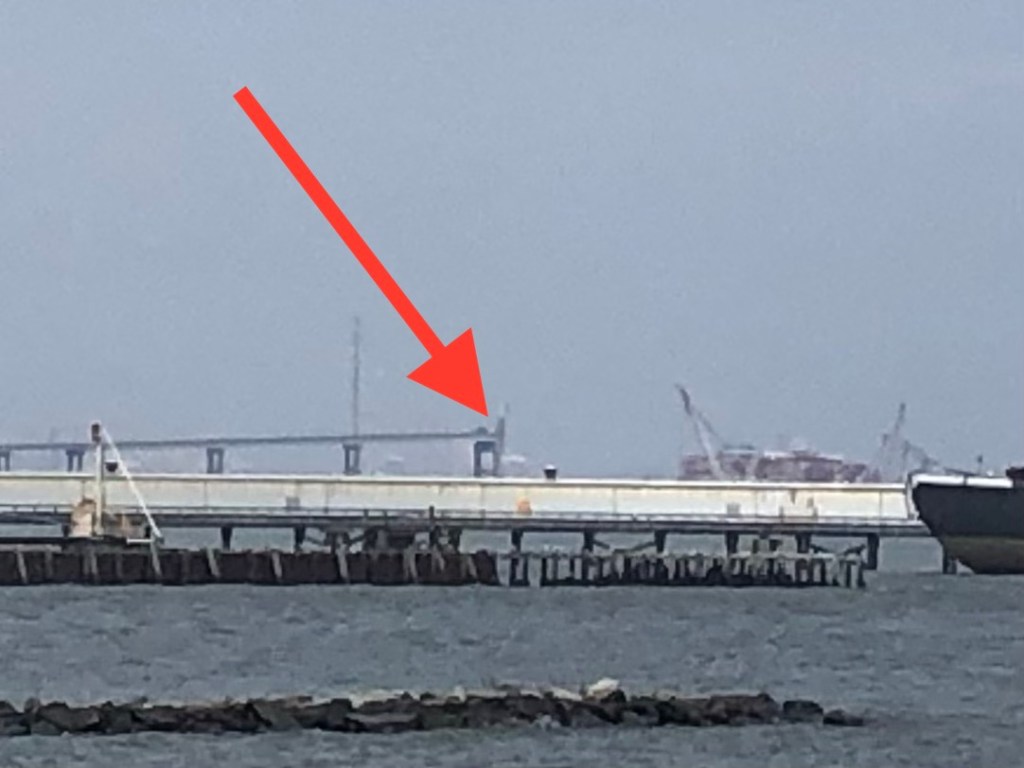
No matter. There’s more than one way to skin a cat. I consulted Google and found a nearby spot that should afford a good view of the salvage operation. Alas, all the property in the area seemed to be a naval base or some other official facility that prohibits visitors. Undeterred, I drove under the harbor through the miraculous Baltimore Harbor Tunnel, and approached the Key bridge from the southern end. More roadblocks. Finally, I headed further south to a private beach community, where through a combination of illegal parking and trespassing I was able to get a decent view of the Francis Scott Key bridge in the distance.

Circles represent my failed attempts to see the bridge; the square is where I finally succeeded.
FSK Bridge in the background, terminating at the head of the arrow.

So, now with that pointless project out of the way, I began a leisurely drive in the direction of Philadelphia.

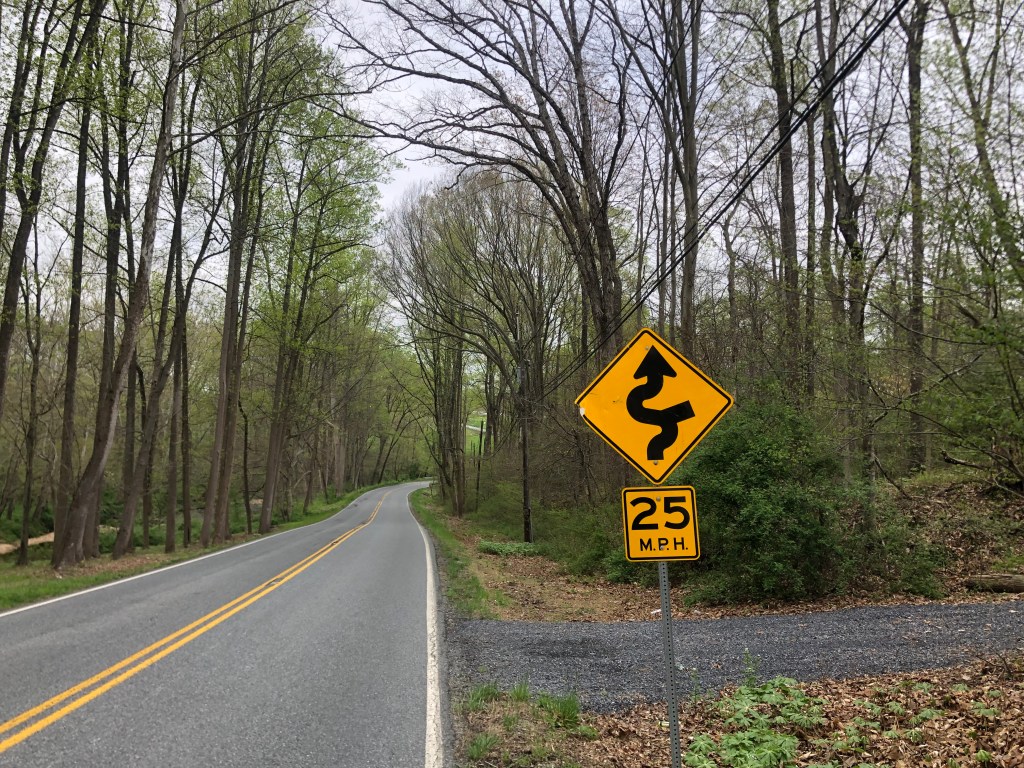
The drive through the Maryland countryside was pleasant and picturesque. The road carved its way through hills dense with trees and other flora. My only complaint is that some of the signage was a bit hard to comprehend at a glance.

Signs like these remind me of the nighttime driving scene in Pee Wee’s Big Adventure. It appears in the following clip, which is only 45 seconds. Note that the guy who uploaded the clip wants to point out you can see a pulley system moving the scenery. But we want to watch the clip just for the signs.

I know just how you feel, Pee Wee.

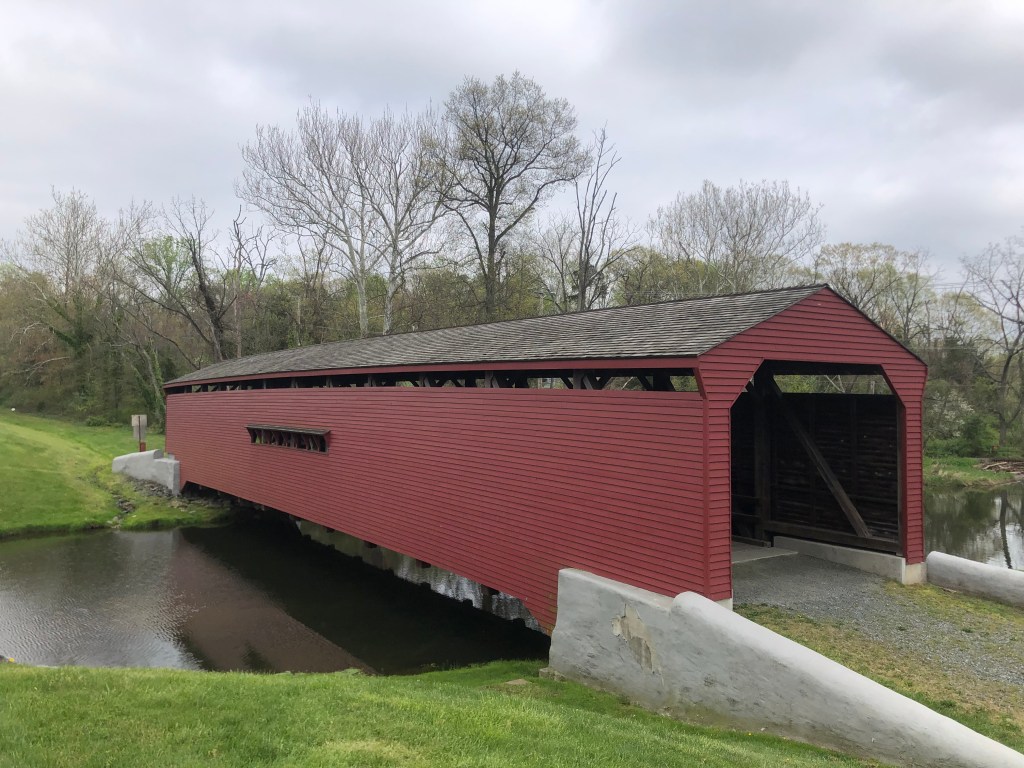
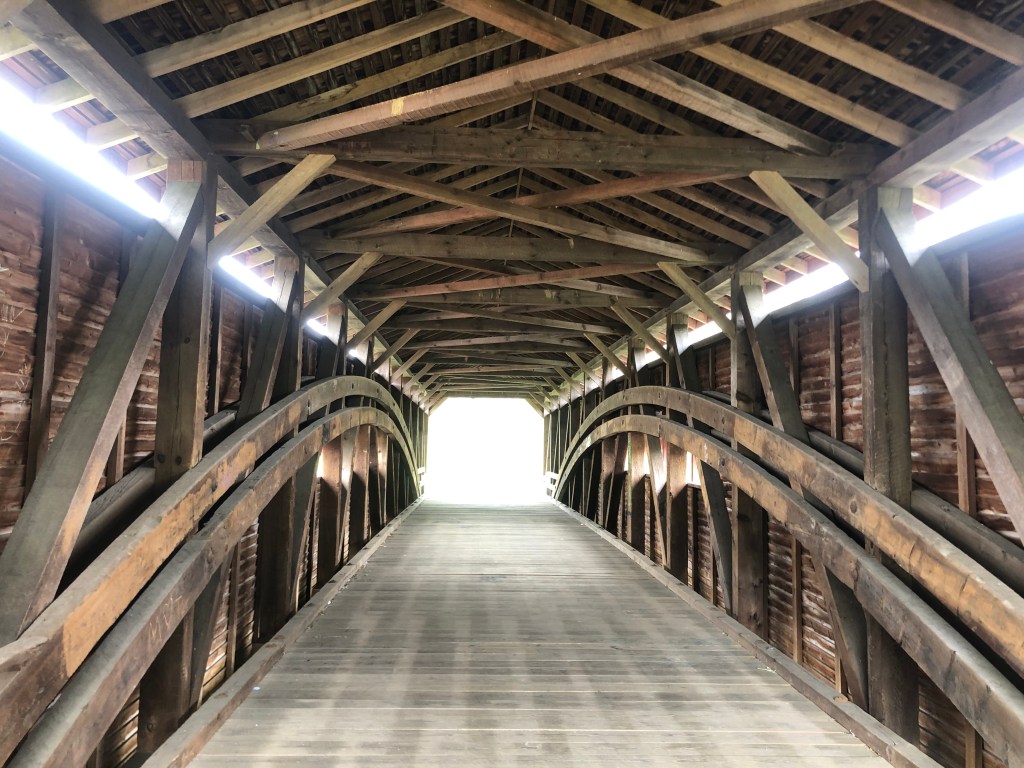
Along the way I passed another bridge that, like the FSK Bridge, no longer carries traffic. The Gilpin’s Falls covered bridge in Maryland’s Cecil County was originally constructed in 1860, and restored in 1959 and again in 2010. And unlike the FSK Bridge, it still sits on the same piers where it was placed in 1860.

Straight out of The Bridges of Cecil County.
Where form and function come together

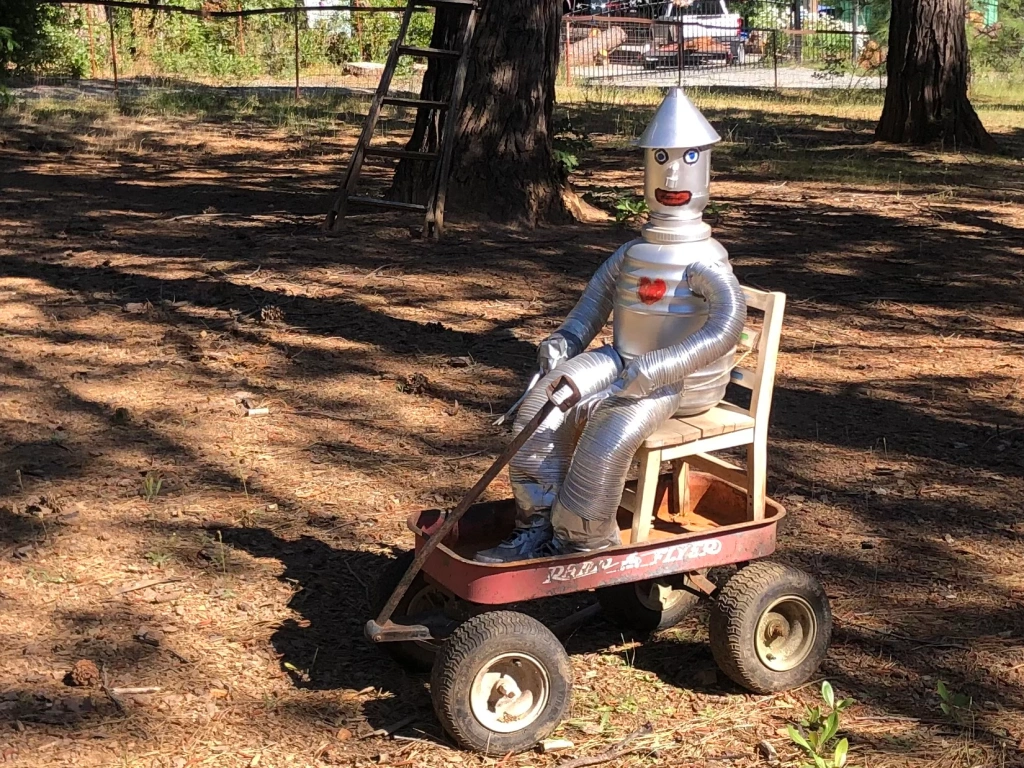
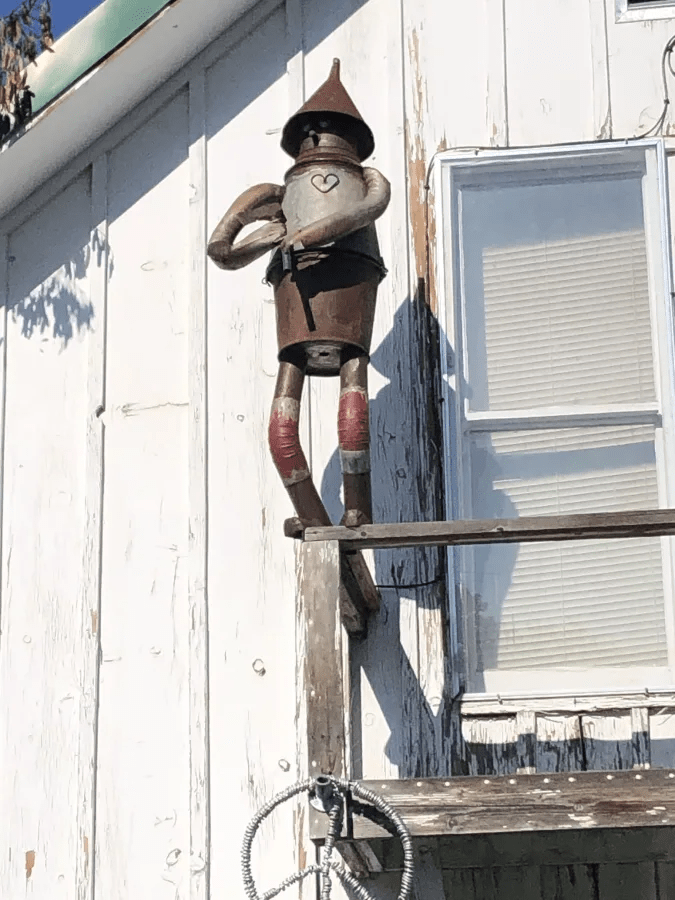
The next roadside attraction requires a bit of a setup: You may recall that I’ve been charmed by Tin Man-themed yard art that I’ve spotted on my travels. Here are two recent examples:

In Georgetown, CA. Blog post here.
In Lakeview, Oregon. Blog post here.

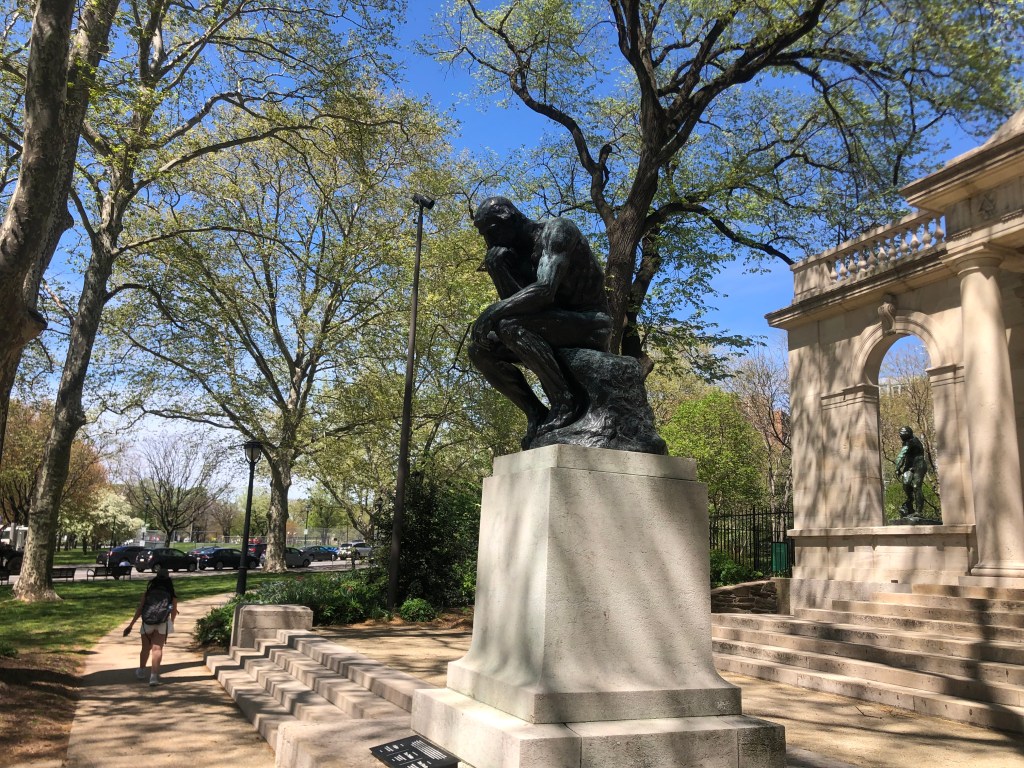
Now, recall my photo of Rodin’s “The Thinker” that I took in Philadelphia:

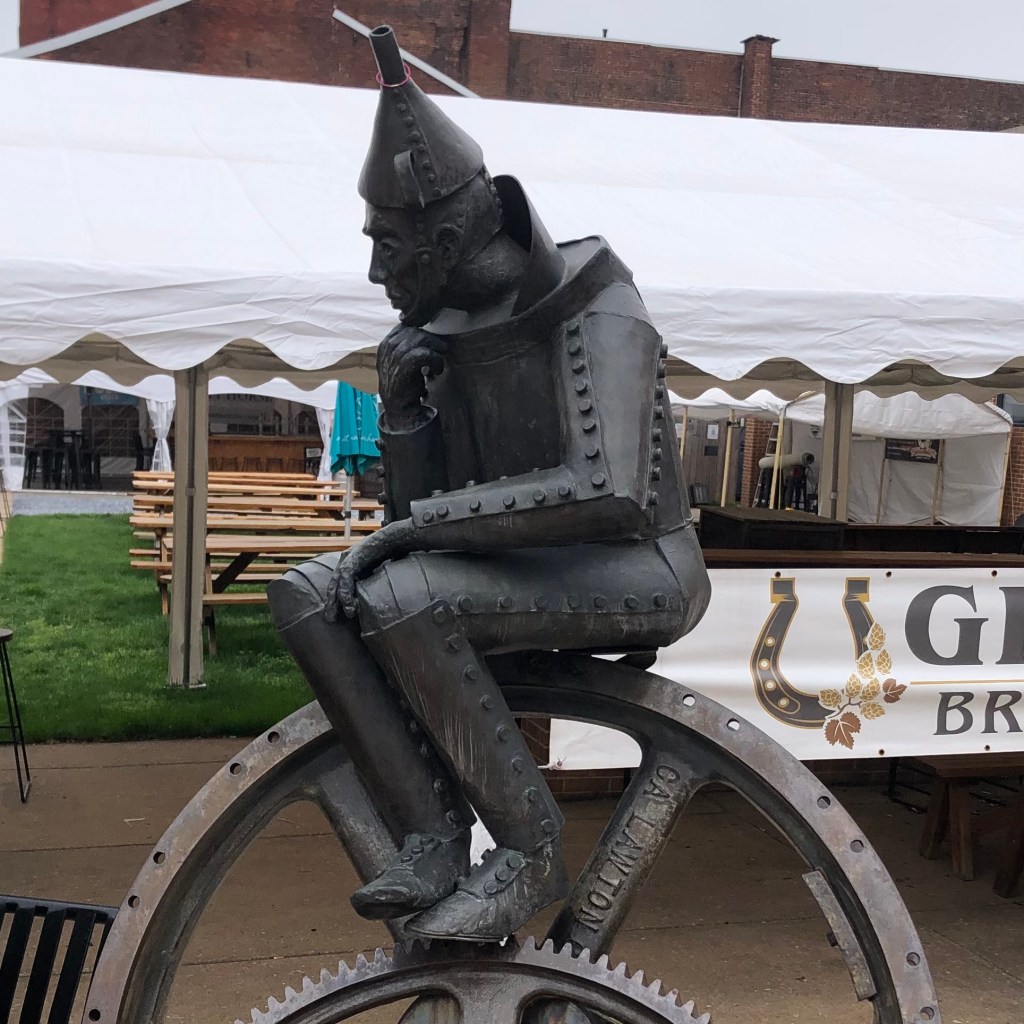
Put them together and what do you get? This sculpture of “The Tinker” (note spelling) that sits in front of a brewery in York, Pennsylvania.

For some reason I think this is brilliant!

The artist claims his sculpture says something about York’s industrial history. I don’t know about that, but I’m simply taken by the whimsy and humanity of the thing. As I’ve said before: This world needs more Tin Men.

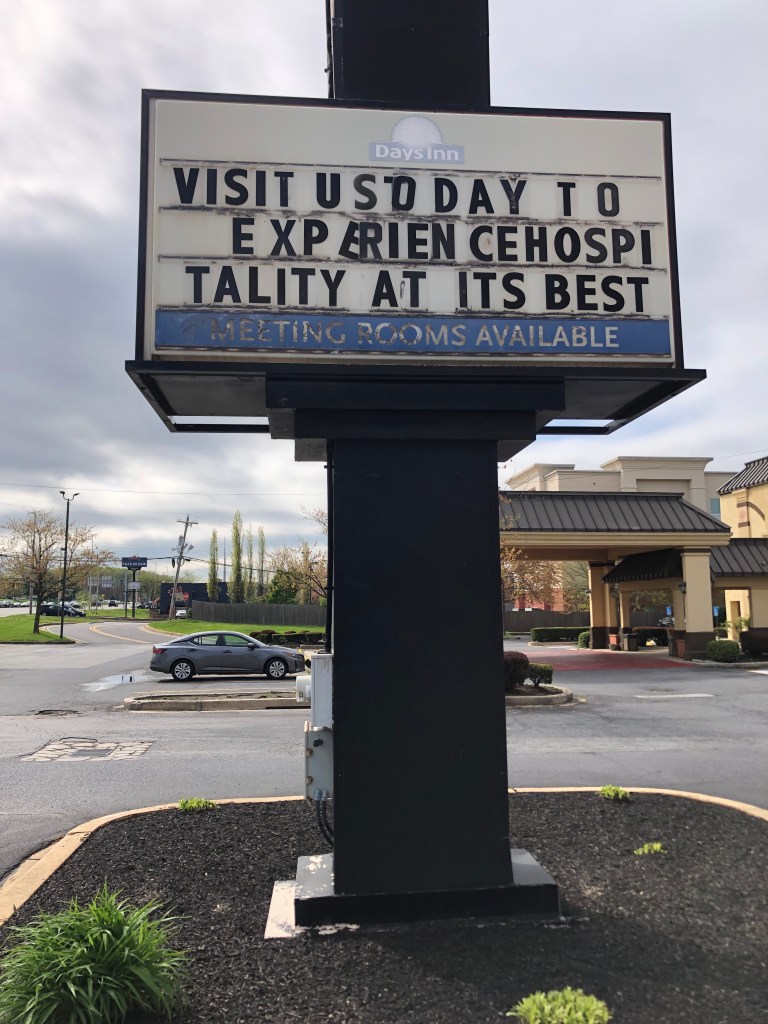
I stopped for the night in Wilmington, Delaware–less than an hour from Philly. After my big splurge on the Red Caboose Motel last night I figured I’d bed down in a simple Days Inn. Upon my arrival, I was greeted by this sign whose reference to “”the best” seems like a dubious claim.

At least they didn’t make the common error of adding an apostrophe to “its.”

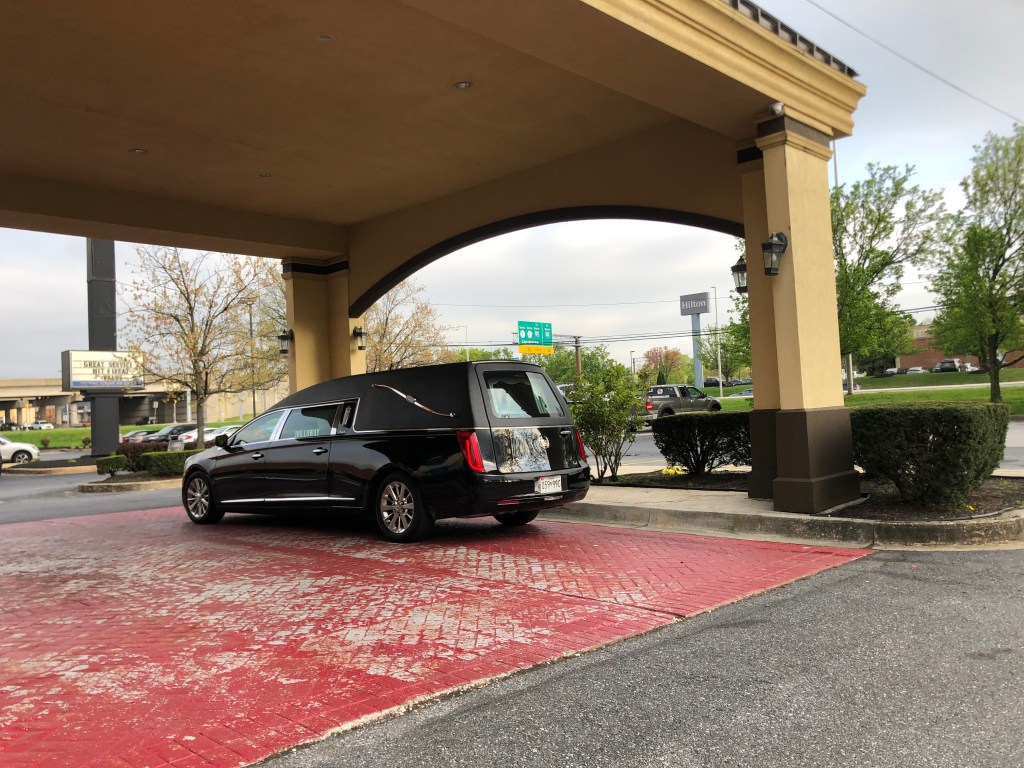
Then I got to the office and saw this idling near the front doors:

Must be check-out time.

Tomorrow I’ll head back into Philadelphia. God willing.

Mail Corner

Loyal reader Brian W sent along this photo he took of a Lincoln Highway sign he spotted near Route 30 in Tama, Iowa. It dates from 1915, which is just two years after the Lincoln Highway was established.

It’s a far cry from the boring, utilitarian signage I encountered today in Strasburg.

Brew of the Day

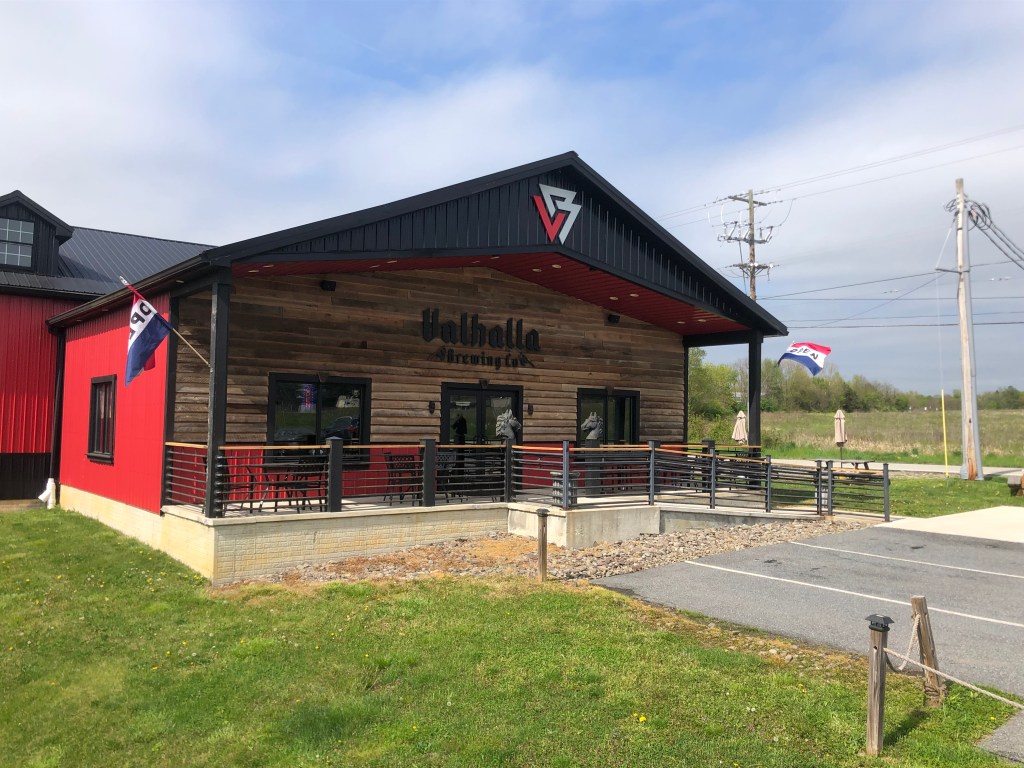
I got today’s BOTD at Valhalla Brewing Company in Elkton, Maryland. It’s an out-of-the-way roadhouse with an empty parking lot and an nearly-empty bar. The bartender spent most of his time leaning on the bar and staring at his phone. But to be fair, it was 2 in the afternoon on a Thursday.

Middle of nowhere. Which I guess is where you’d expect to find Valhalla.
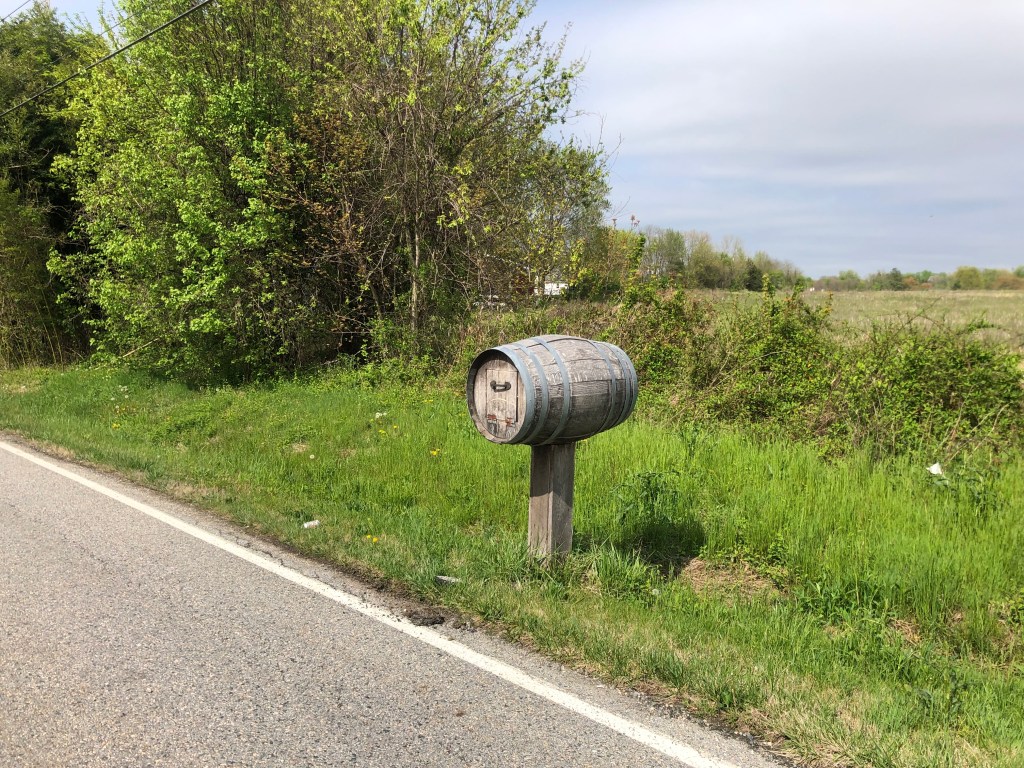
Cool mailbox, though.

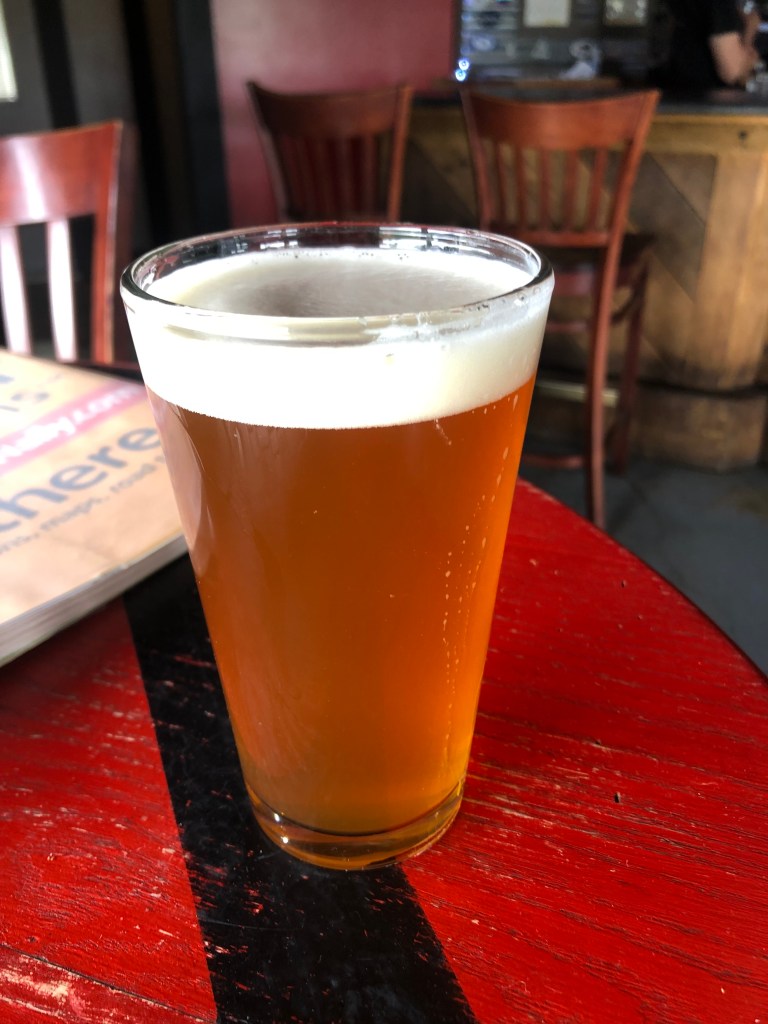
I chose the Zombie Ice Double IPA. It turns out it’s a guest brew, made by 3 Floyds Brewing Co, in Munster, Indiana. Behold the golden-copper color:

The first sip suggested that this is just a basic IPA. But with subsequent sips it became more interesting. The usual citrus and hops are omnipresent, but as you move through it you detect orange peel, library paste, and shoe polish. You might not think that sounds especially tasty, but somehow it works. There’s a total lack of pretentiousness about this beer (except for its name, of course). It’s solid, genuine, and hardworking. I give it a solid 4 out of 5 stars.

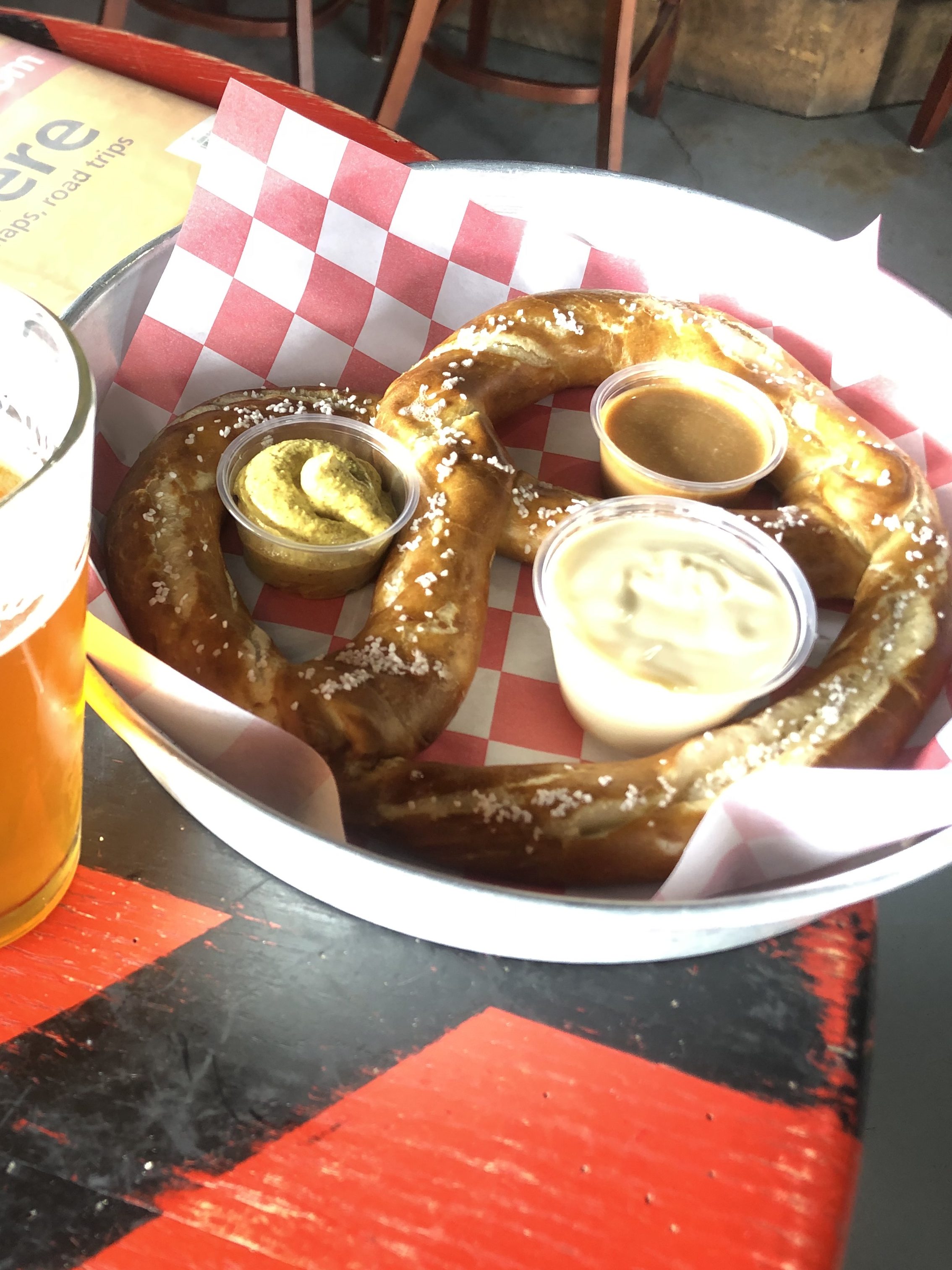
In the interests of full disclosure, I should note that I paired this IPA with Valhalla’s “Big Ass Pretzel,” which is served with mustard, beer cheese, and a maple-caramel sauce that is to die for. So consider that it might just be the pretzel talking. In fact, the Pretzel gave the beer 5 stars.