2025 Poe Cocktails · Uncategorized

Cocktail 11: Ligeia

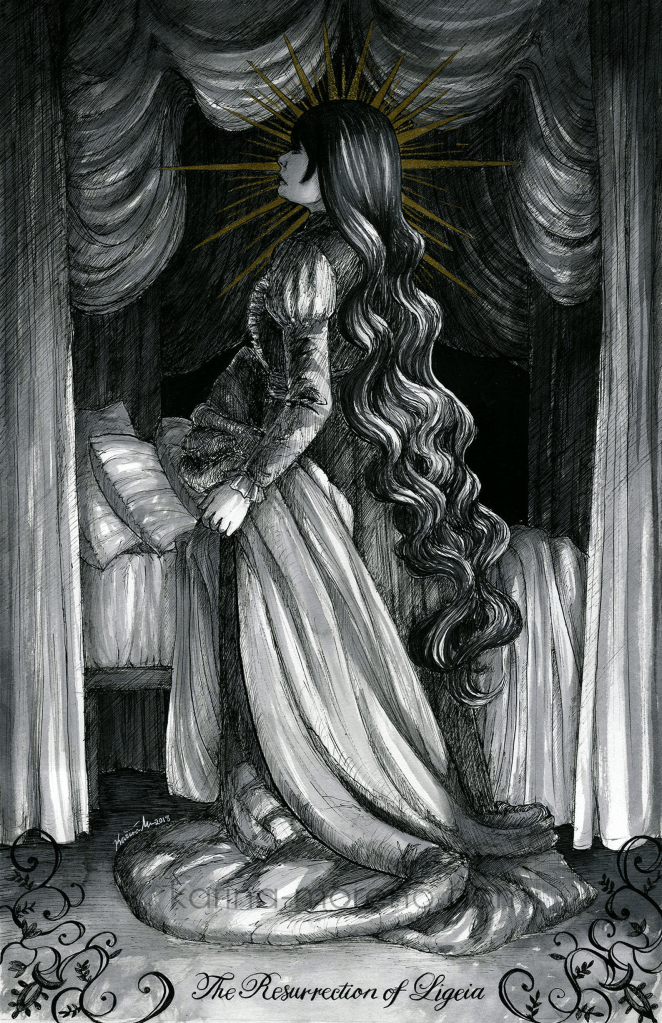
Yet, although I saw that the features of Ligeia were not of classic regularity — although I perceived that her loveliness was indeed “exquisite,” and felt that there was much of “strangeness” pervading it, yet I have tried in vain to detect the irregularity and to trace home my own perception of “the strange.” I examined the contour of the lofty and pale forehead — it was faultless — how cold indeed that word when applied to a majesty so divine! — the skin rivalling the purest ivory, the commanding extent and repose, the gentle prominence of the regions above the temples; and then the raven-black, the glossy, the luxuriant and naturally-curling tresses, setting forth the full force of the Homeric epithet, “hyacinthine!”
The Tale

In the first half of this story the narrator meticulously describes his wife Ligeia with soaring, worshipful, effusive and poetic language that would make King Solomon blush. In extreme detail he sketches the features of her face, her hair, her forehead, her stature, even her voice in the most grandiloquent language. And anticipating the rules of political correctness by two centuries, he hastens to add that she’s not just hot; she’s also smart, with greater knowledge of “moral, physical, and mathematical science” than anyone he knew, man or woman. And then he describes how she died, and how he was devastated by the loss. 

Somewhat less effusive is his description of his rebound squeeze, Lady Rowena Trevanion. In many ways Rowena is the opposite of her predecessor: fair where Ligeia was dark-haired, blue-eyed in contrast to the “brilliant black” of Ligeia’s peepers.

And instead of lavish praise, the narrator confides that he “loathed [Lady Rowena] with a hatred belonging more to demon than to man.” Then she too falls ill and is declared dead. And yet, while lying on her death bed, she repeatedly fights off Death, each time briefly returning to life, until at last she rises from the bed. Her shroud falls away and in appearance she is…Ligeia. The narrator doesn’t seem too excited about this.

The full story is here.

The Drink

For this cocktail we’re going to tap into that long, flowery description of Ligeia, with the “Homeric epithet” of “hyacinthine.” `It seems he associates her with the fragrant, colorful flower that evokes spring and rebirth.

Now, there is a class of Hyacinth cocktails which make use of either hyacinth flowers or of fruits and botanicals that impart a similar blue color. I couldn’t find hyacinth flowers this time of year, so I instead went with a mix of violet and elderflower liqueurs, combined with a highly-botanical gin. Now, if you stubbornly opt for actual hyacinth, make sure you use grape hyacinth, as the other variants are toxic and could make you into the latest meal for the Conqueror Worm. I played it safe and went a different, flowery route. The resulting recipe creates a light, floral drink that will have you “aroused” by Ligeia’s “large and luminous orbs.” (Those are Poe’s words, not mine!)

Ingredients:

1 oz gin

1 oz violet liqueur

½ oz Elderflower liqueur

Splash of lime juice

Sprig of mint (as garnish)

Combine all the liquid ingredients in a shaker and shake well. Add ice and shake some more. Strain into a champagne flute or some other glass that’s as graceful and slender as Ligeia. Garnish with mint, which, at least in my garden, keeps returning even though I thought it had died many times over.

Poe-Script

Within this tale, Ligeia composes a poem which you will recognize as “The Conqueror Worm.” In fact, the short story “Ligeia” was originally published without the poem in 1838, then Poe published “The Conqueror Worm” as a stand-alone poem in 1843, and then he revised “Ligeia” to include the poem in 1845. Kind of like how I’m going to re-use this blog post as an entry in my Poe cocktail book.
Uncategorized

Cocktail 1: The Raven

“Be that word our sign of parting, bird or fiend!” I shrieked, upstarting—

“Get thee back into the tempest and the Night’s Plutonian shore!

 Leave no black plume as a token of that lie thy soul hath spoken!

 Leave my loneliness unbroken!—quit the bust above my door!

Take thy beak from out my heart, and take thy form from off my door!”

            Quoth the Raven “Nevermore.”

The Tale

“The Raven” is of course one of Poe’s most famous works. As we all know, it is an 18-stanza poem written in trochaic octameter. This poem has got it all: a tragic love story (“the lost Lenore”), references to Greek mythology (“bust of Pallas”), alliteration (“the silken, sad, uncertain rustling”), and a mystical talking raven (“Nevermore!”).  It’s hypnotizing, moody, mysterious, and yet lyrical. It is a masterpiece.

Therefore it’s not surprising that, after its publication in January 1845, Poe became famous throughout the land. And yet, he was only paid $9 by The American Review, which published the poem. Once upon a midnight dreary, indeed.

This poem is so well-known and euphonious that it has spurred innumerable parodies and burlesques. Lisa Simpson’s version on The Simpsons is especially worthy, and yet I will always remember when I was first introduced to “The Raven” in a Bullwinkle cartoon in the 1960s.

The full poem is available here.

The Drink

Probably all the “ravens” you and I think we’ve ever seen are actually crows. Ravens are bigger, with distinctive beaks and tails. But does it really matter? They’re both big, black birds. And that’s the look we’re going for with this drink.

So I got me some Van Gogh Double Espresso vodka. It’s a surprisingly tasty liquor on its own, particularly suited for those of us who like our depressants delivered with stimulants. This vodka has two things going for it: (1) it has a dark color, evocative of a raven (or a crow). To be honest, it’s not quite black; rather, it’s a dark brown. But we have a black cat (Vincent) who, as he’s aged, has taken on a somewhat brown cast. So maybe dark brown in the ballpark of black? (2) It’s said that Van Gogh was an avid and enthusiastic reader of Poe. It’s further said that his “intensive reading of Poe’s works helped him to process and internalize his thoughts and emotions, which then manifested in his art.” I take all this as confirmation that the Van Gogh vodka would make a great starting point for this drink. Let’s get to work!

Ingredients:

1-1/2 oz. Van Gogh Double Espresso vodka

½ oz. Kahlua

¼ oz. mezcal (the smokier the better)

1 shot espresso

A couple of pinches of edible black glitter

Black feather (for garnish)

The bottle of Van Gogh already has a syrupy sweetness to it, even though it’s marketed as a vodka. So, this will have to be counterbalanced with something to keep it out of the land of the cloying. For this, I added a shot of straight espresso for its bitterness and roastiness, and a little bit of mezcal for its earthy, smoky flavor. Truth be told, I found this formulation to be a bit too harsh, so I then added a little Kahlua to take the edge off. This seems to be the sweet spot.

So far, the drink presents a dark brown color. But to make it more raven-y, I added two pinches of edible black glitter. This gives it a deeper black color and that shimmery, sparkly gloss that ravens are so well known for. Not.

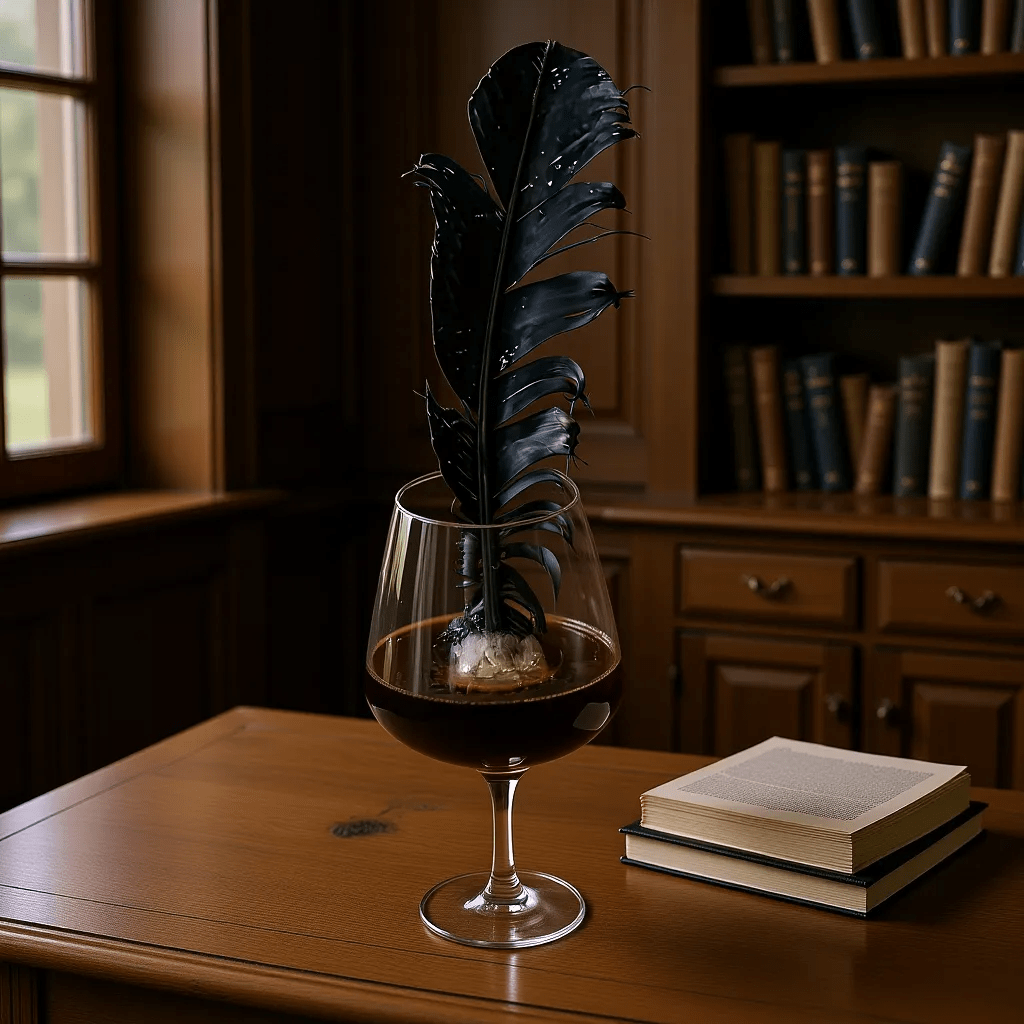
But as if that doesn’t drive home the point strongly enough, we’re going to add a black feather–a “black plume as a token of that lie thy soul has spoken.” Simply proceed thus:

  1. Remove a single black feather from a nearby raven (or, in a pinch, a crow will do). Alternatively, you can go to your nearest craft store. Place this feather point-down in a small glass with about an inch of water, and stick it in the freezer. You may need to use some tape to keep the feather upright. This is going to serve as your ice cube/garnish.
  2. Make yourself a shot of espresso, and put it in the fridge to cool for a few minutes.
  3. In a mixing glass, combine the vodka, Kahlua, mezcal, and espresso with ice. Stir, and strain into a bar glass of your choice.
  4. Add a few pinches of the black glitter, and stir.
  5. Finish it off by adding the ice cube/feather. (You may have to briefly warm it in the microwave to loosen the ice from the glass.)
  6. Will you ever go back to your old Dark N Stormy? Nevermore!

Poe-Script

It is said that Poe gained inspiration for this poem from Dickens’ Barnaby Rudge, which featured a talking raven. The non-Philistines among you who regularly read my blog (waytrips.travel.blog) know that Dickens himself had a pet raven named ‘Grip.” In fact, Grip became such a part of the public imagination in Dickens’ day that people would say “Get a Grip!” to convey that someone should ground themselves in reality, rather than stories.

(I totally fabricated that last assertion.)

Uncategorized

Mike the Headless Chicken

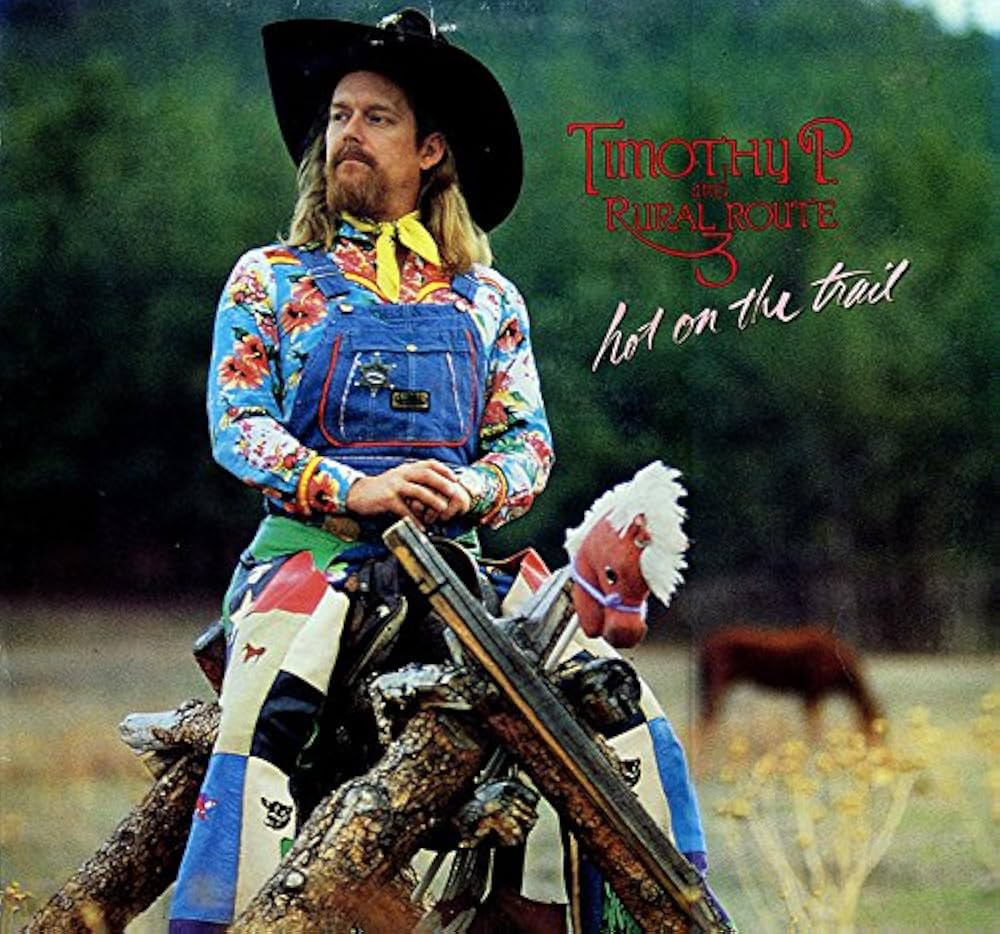
The other week I shared a blog post about the town of Fruita, Colorado–a town that is “famous” for, among other things, its Mike the Headless Chicken Festival. Faithful reader Brian W informed me that his brother-in-law Timothy has written and performed a song about Mike at the festival. (How come my relatives don’t have credits like that to their name?) In the 1980s Timothy made records as Timothy P and the Rural Route Three, whose music has been described as “a blend of country, honky-tonk, and hippie rock styles.” A Facebook page suggests he’s still in the business. Sadly, I haven’t been able to find an actual recording of his Headless Chicken song.

Photo supplied by Brian W.

This got me interested in discovering what kind of a song one could write about this Headless Chicken. And I discovered that it’s a somewhat popular subgenre on YouTube. Here are a few examples for your entertainment and/or edification:

Best visuals, but lousy music (IMO).

Best (i.e. only) live performance I could find.

Best lyrics and production values…but no video.

Feel free to write and record your own Mike the Headless Chicken song, and I’ll post it on this blog. Meanwhile, if you need inspiration, the following “children’s cartoon” about the story of Headless Mike is simultaneously informative and unsettling:

Uncategorized

Dime-Store Delicacy

Before we launch into today’s review, let me share a spooky discovery that’s appropriate for the season.

I am currently visiting the town of Mendocino (pop: 731) on California’s northern coast. Today I happened upon a forlorn place called Evergreen Cemetery. Despite its lush-sounding name, Evergreen occupies a couple of dusty acres of arid land and dead weeds on the edge of town.

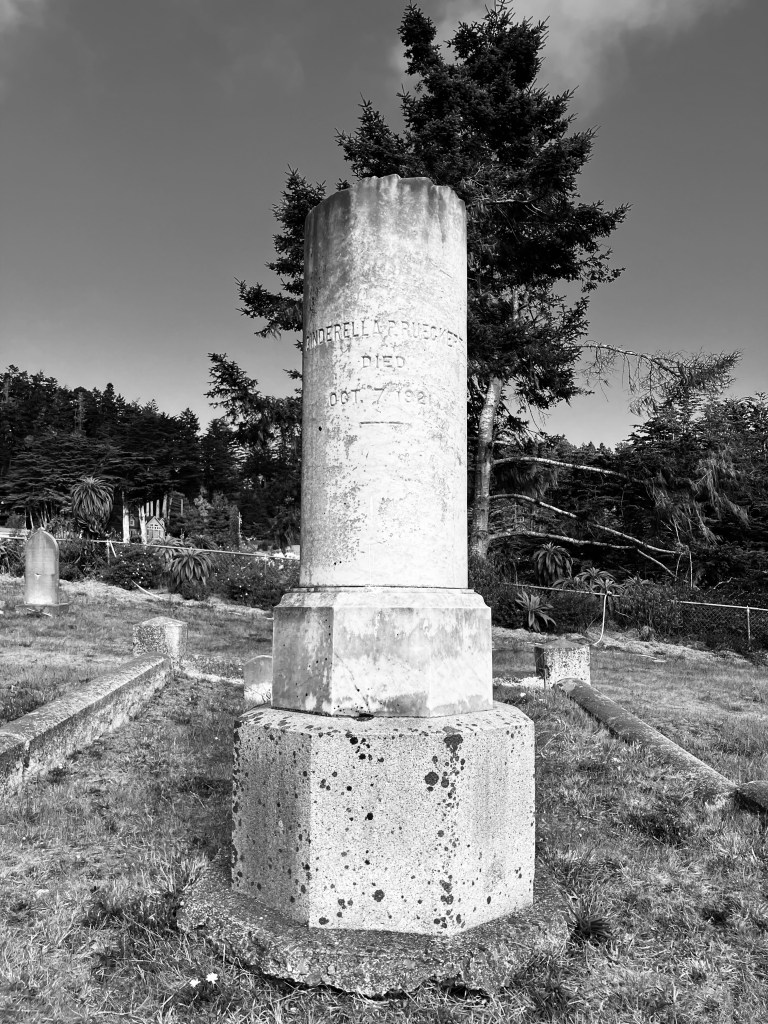
Nevergreen” Cemetery. (I decided to present my photo in black and white to make it spookier.)

Off to one side of the cemetery is an interesting grave marker: It’s a stone column maybe three feet in diameter, which has the appearance of being truncated by some kind of earthquake or act of vandalism. Upon closer inspection, it seems the marker was designed merely to look like the top had broken off. I guess it was an artistic choice.

Broken Baluster

The inscription on the marker reads:

Cinderella P. Rueckert

Died

Oct. 7, 1921

Now that’s an interesting name, on an interesting marker, for someone who died almost exactly 103 years ago. I figured I’d research the back story.

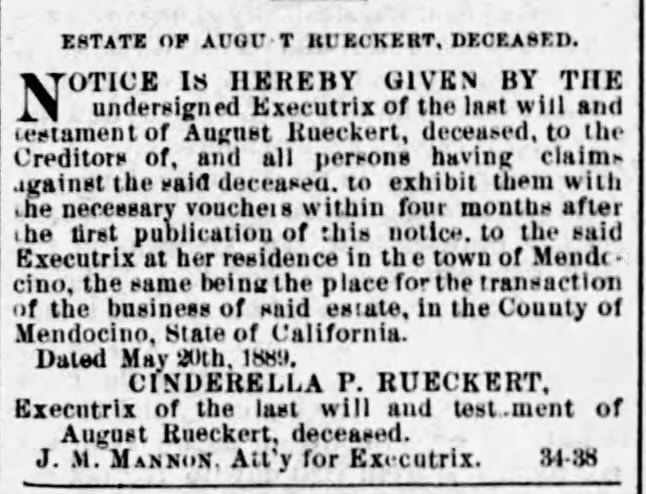
I couldn’t find her obit; just this legal notice she placed as “executrix” after her husband died.

It seems Cinderella was her real name (her mother is said to have been a fan of fairy tales), and she was born in 1840 (exact date unknown) in Illinois (city unknown). She came to Mendocino and married a watchman at the local sawmill in 1875. She was widowed in 1888, and supposedly inherited a small fortune. She spent her remaining 33 years living in a house the street from the cemetery, selling apples from her trees to passersby.

Cinderella’s house still stands today!

Now, here’s the spooky part: She was a ghost! Sort of. We now turn to the Kelley House Museum website for details:

“A Swedish lumberman…liked to use Evergreen Cemetery as a shortcut home from town. He would become inebriated and sing at the top of his lungs in the middle of the night passing Cinderella’s home. She got so irritated she found a newly-dug grave awaiting a burial service the next day, bedecked herself in a sheet, then crouched in the grave awaiting the wandering drunk. She popped out of the grave whooping and screaming, and you can be sure the man never shortcut through the graveyard again.”

Let me end with a photo from the back deck of my hotel. I tell you, this is one of the eeriest towns I’ve visited outside of Pennsylvania!

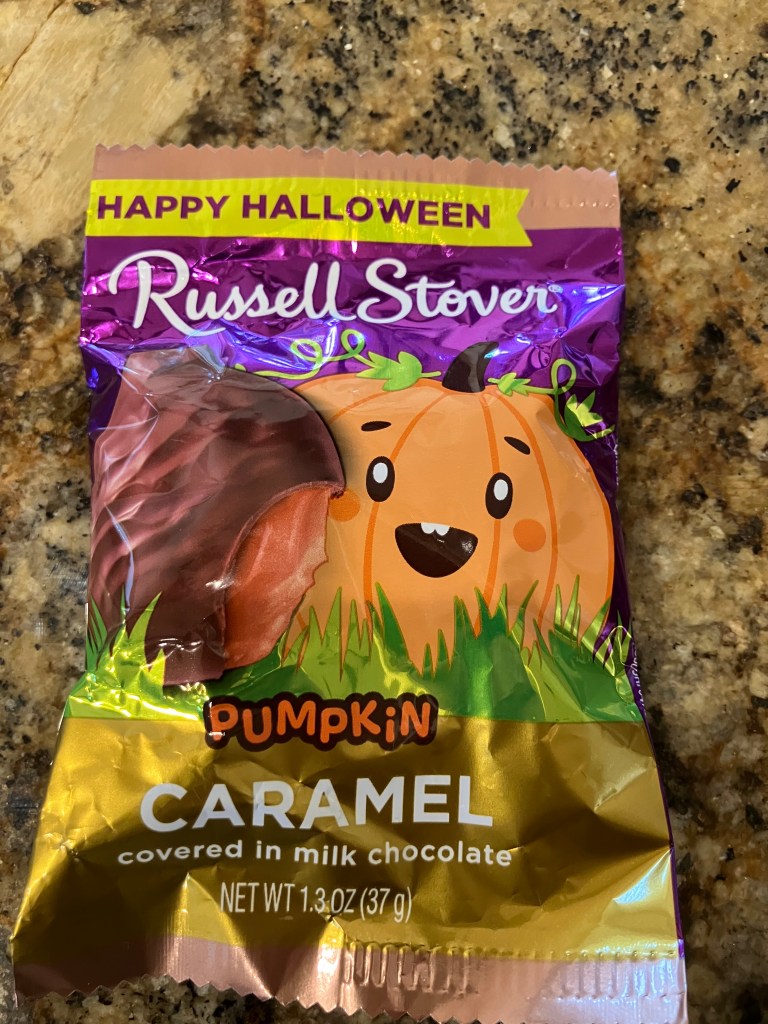
Now it’s time to get down to business. Today we’re checking out the “Happy Halloween Russell Stover Pumpkin Caramel.” Or at least that’s how I read the jumble of words scattered across the packaging.

Alert readers will recall that we’ve examined Russell Stover “confections” in the past. But this Caramel version seems to have escaped our notice. Until now. Let’s apply our rating rubric!

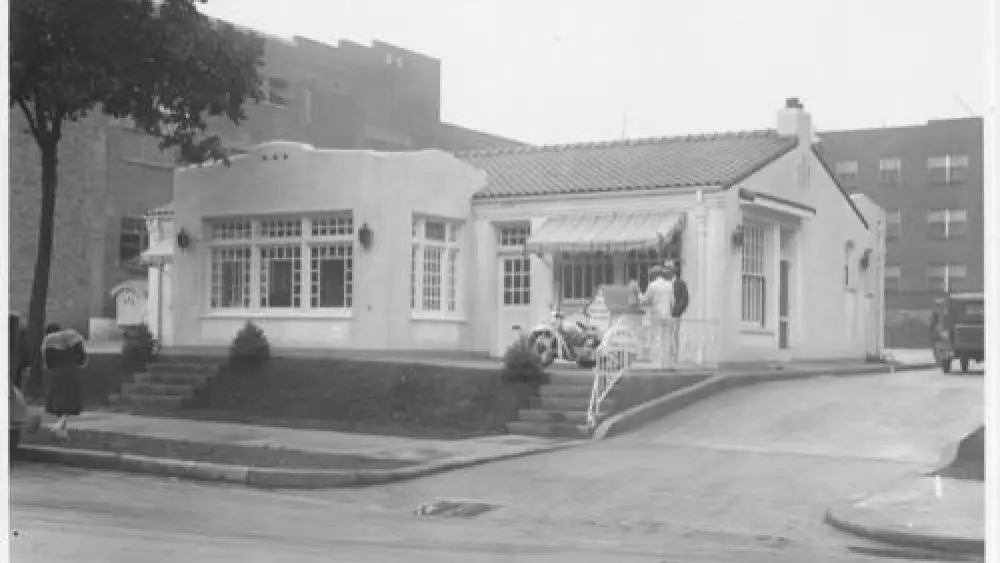
Conceptual Soundness: Russell Stover Candies began in 1923 as “Mrs. Stover’s Bungalow Candies,” and specialized in selling boxed chocolates brings bargain prices. This was just two years after See’s Candy was launched. I can’t find any information about their rivalry, but I’ve always felt that Russell Stover’s is the cheaper, everyman candy. Where See’s sells through an exclusive network of their own stores, Russell Stover’s seems to be available at every drugstore in the country. That in itself would appear to be a legit marketing strategy, trading exclusivity for ubiquity.

Mrs. Stover’s actual bungalow, in Kansas City, around 1930.

This particular candy is part of Russell Stover’s pumpkin series. They are chocolate pumpkin shapes filled with different kinds of gooey candy. They are clearly marketed for Halloween, sold individually at a reasonable price, and decorated with an illustration of a smiling jack o’lantern. Overall, it’s a solid concept. 4 points.

Appearance of the Treat: It’s your standard Russell Stover’s foil packaging. It features a nose-less, buck-toothed pumpkin with an expression like Don Knotts in his dotage. It’s not exactly an image suitable for Rod Serling’s Night Gallery, but it is colorful and evocative of Halloween.

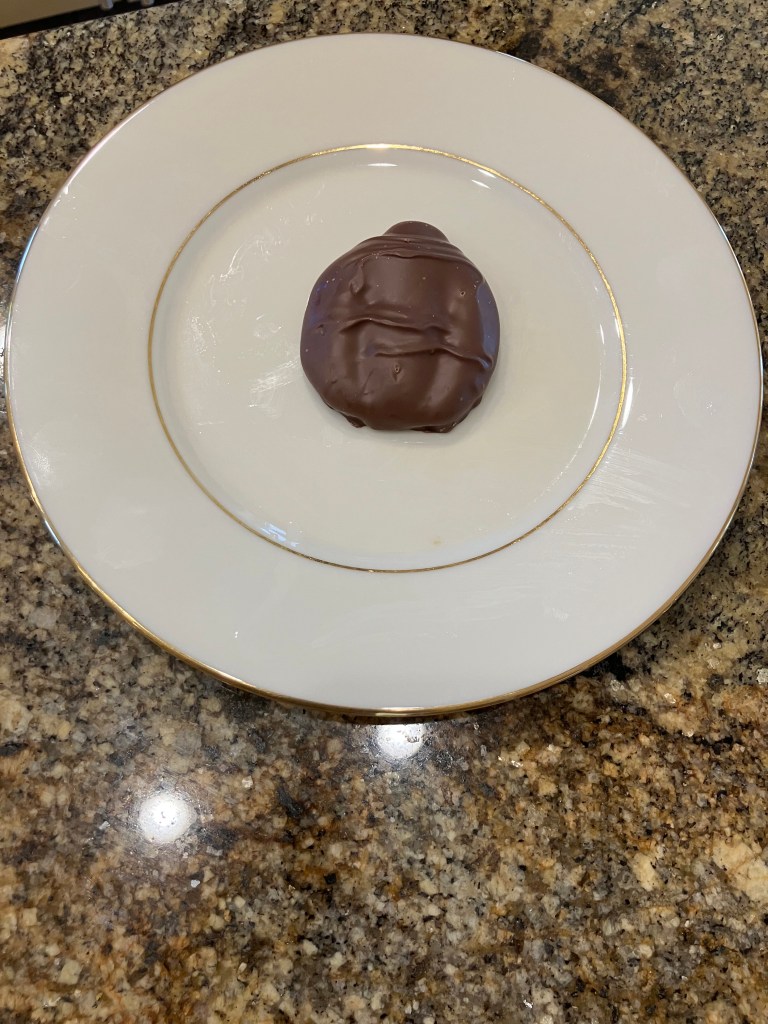
But then you remove the packaging and are faced with the candy itself. I know I’ve ranted about this in the past, but it bears repeating: there is an inexcusable, possibly criminal, disconnect between the image on the package and the actual product within. This brown blob is evocative of meconium. 1 point.

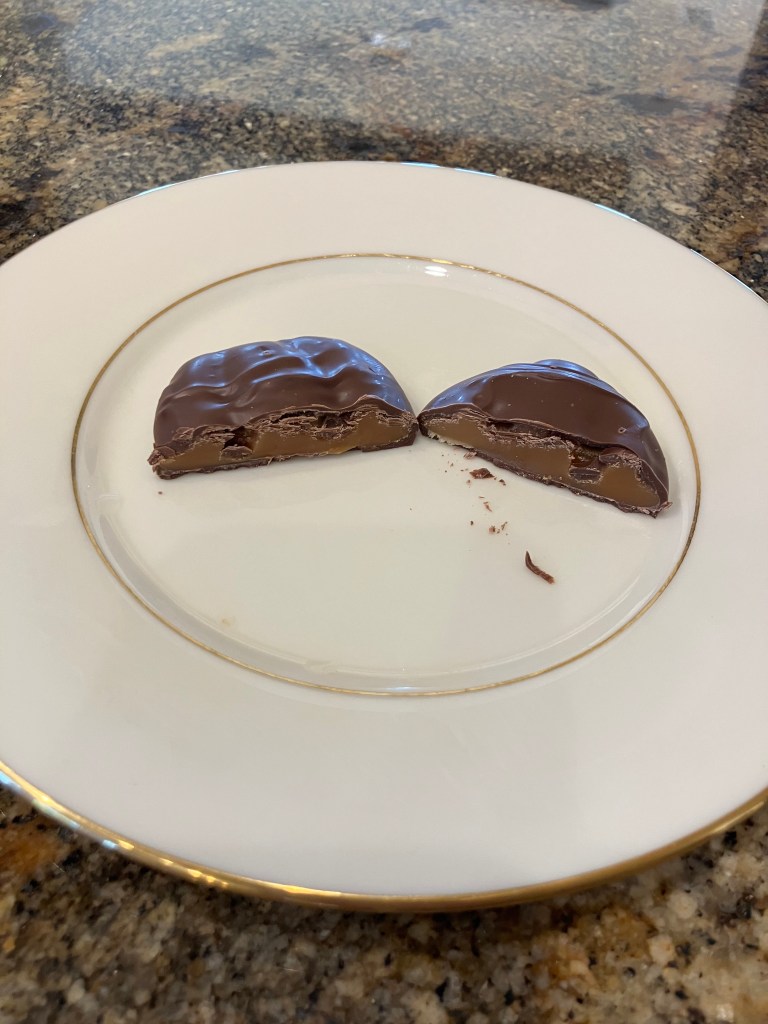
Taste. I have to admit, this is a toothsome Halloween candy. There’s a satisfying crack of the chocolate shell when you first bite into it, and then there’s the pleasant mouthfeel as you masticate the chocolate together with the caramel filling. That caramel is surprisingly tasty, without the chemical notes that one often associates with cheap drugstore candy. It’s got a bit of a Snickers vibe going on, without the nuts. I’ll give it 3.5 points.

Value. These are a buck each at our local CVS. What other chocolate-adjacent candy product could you get for that price? Most of the similar candies weigh in at just ounce, so this gives you 30 percent more candy. I’m sure you’d get tired of eating these all the time, but as a single treat, $1 is a definite bargain. 4 points.

Total Treat Score: 11.5/16 points

Get one today! Chances are they’re available within walking distance of wherever you are!