Road trips

Back To Benjamin

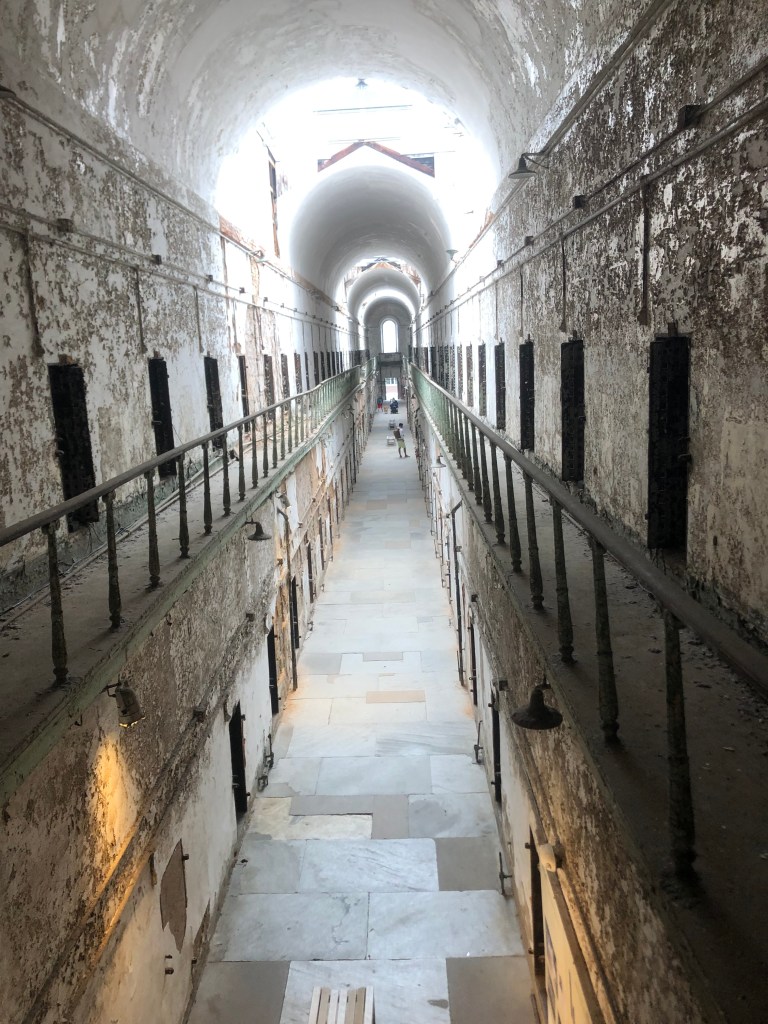
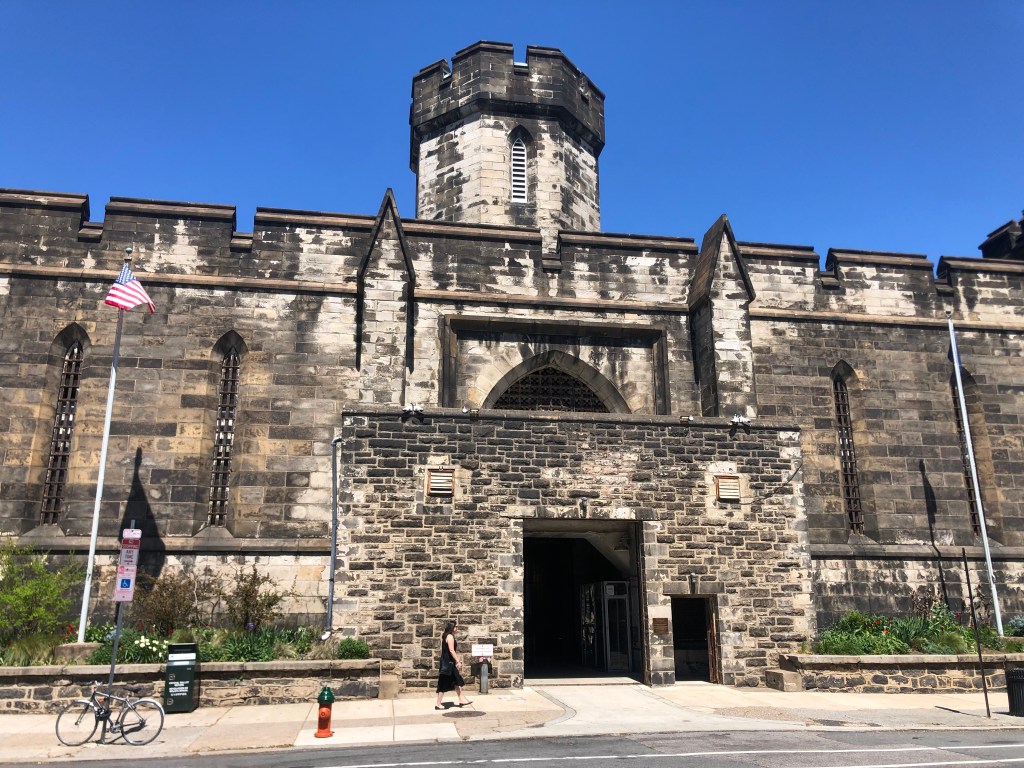
Today I returned to Philadelphia to finish up my Ben Franklin research. This took me to a couple of sites that you might not associate directly with Franklin. For example, I spend a couple of hours meandering about the labyrinthine Eastern State Penitentiary. Opened in 1829, it’s considered the world’s first true “penitentiary,” designed specifically to promote penitence among its inmates. Toward this end, prisoners at Eastern State were kept entirely isolated from one another, housed in (relatively large, by today’s standards) cells that resembled small chapels, prohibited from speaking, and given solitary jobs to perform. The idea was that isolation would impel prisoners to reflect on their crimes and on spiritual salvation.
“A Mighty Fortress is Our God…”
Reminds me a bit of my visit to the old Preston Castle reform school. The blog post is here.

What does this have to do with Ben Franklin, you ask? Eastern State Penitentiary was a direct (though delayed) outgrown of a meeting held at Ben Franklin’s house in 1787. Franklin and other notable Philadelphians formed “The Philadelphia Society for Alleviating the Miseries of Public Prisons,” and many of the points for which the Society advocated were adopted into the design of the new prison. It was truly a paradigm shift in the punishment of lawbreakers.
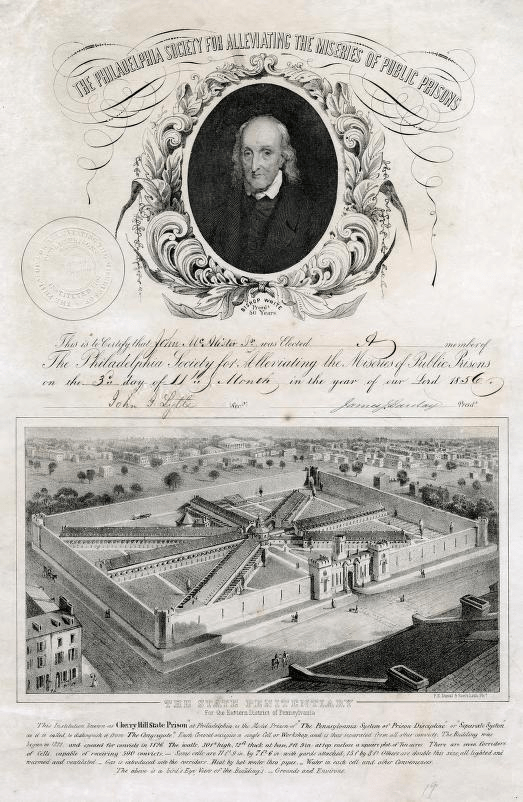
The model underlying Eastern State was adopted across the world, with many hundreds of prisons following the so-called “Pennsylvania System.” Over time, however, Eastern State’s approach proved too costly, and the principles of isolation and silence were officially abandoned at the prison in 1913. It closed due to obsolescence in 1970.
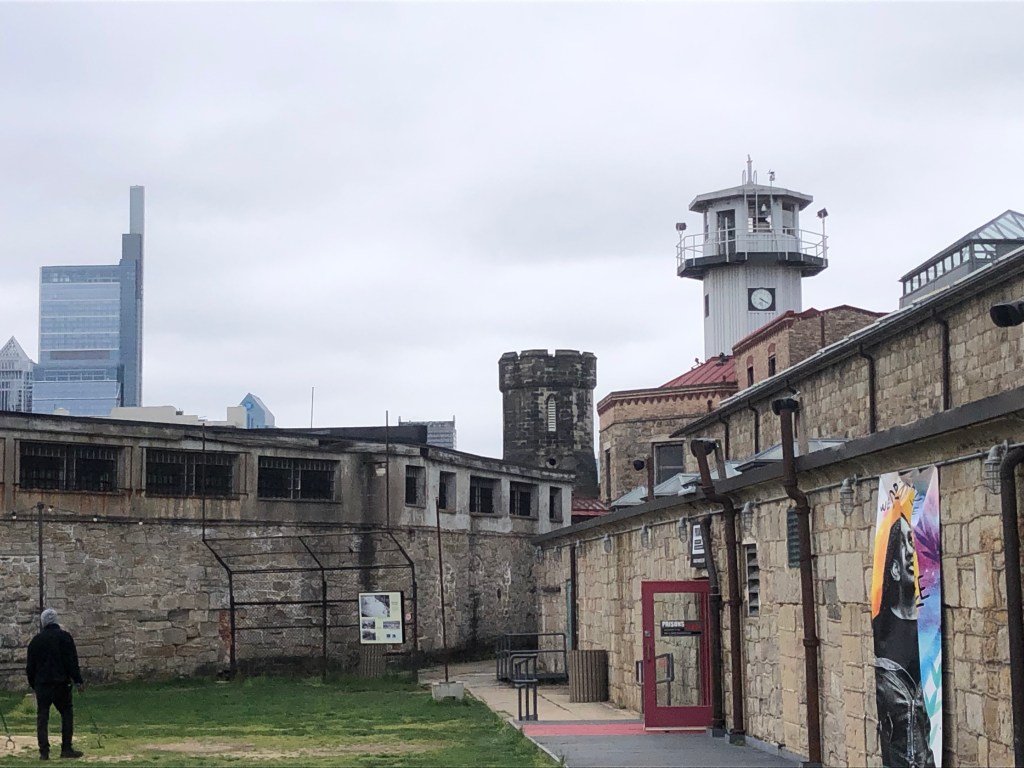
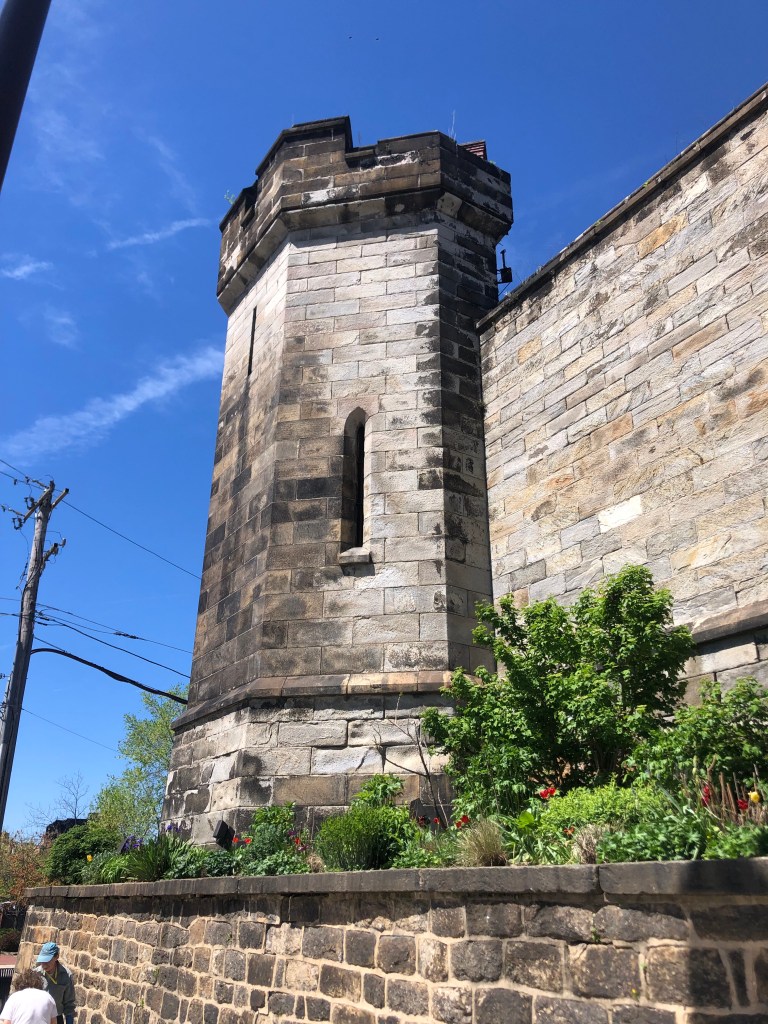
View from the exercise yard today. Original 1829 turret in the middle; 1950s guard tower to the right; modern Philadelphia skyline to the left.

For decades the prison simply decayed in place and was eventually slated for demolition. But it was saved by preservationists at the last minute, and since the 1990s it has been maintained in a state of arrested decay, with tours offered most days of the week.
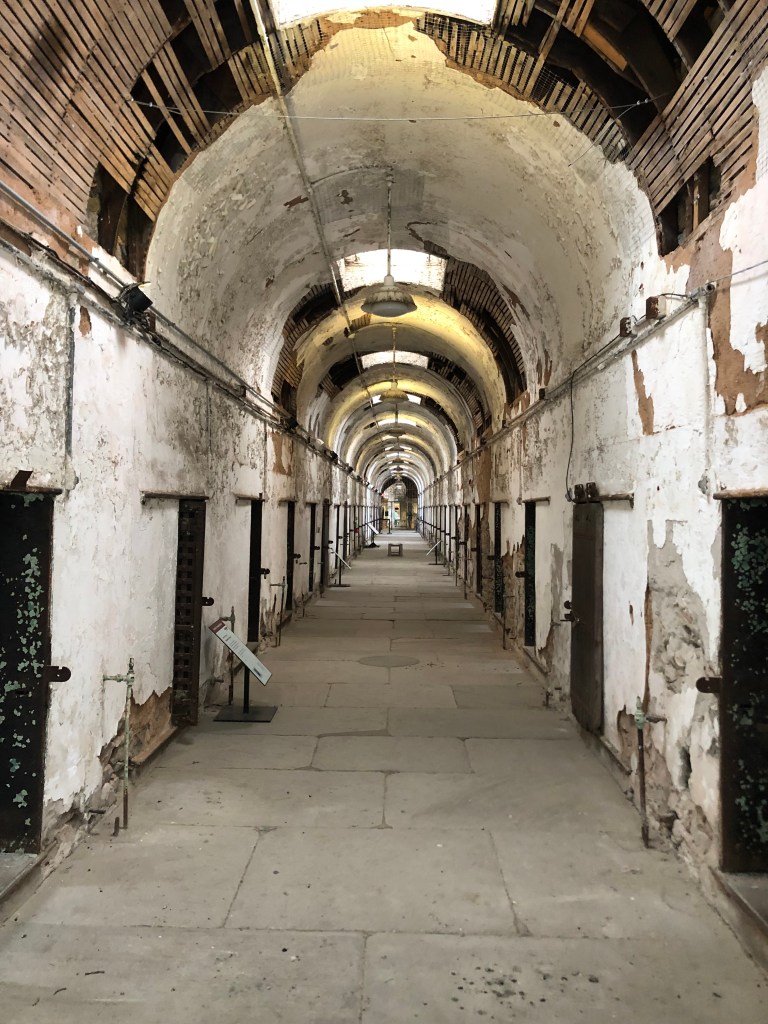
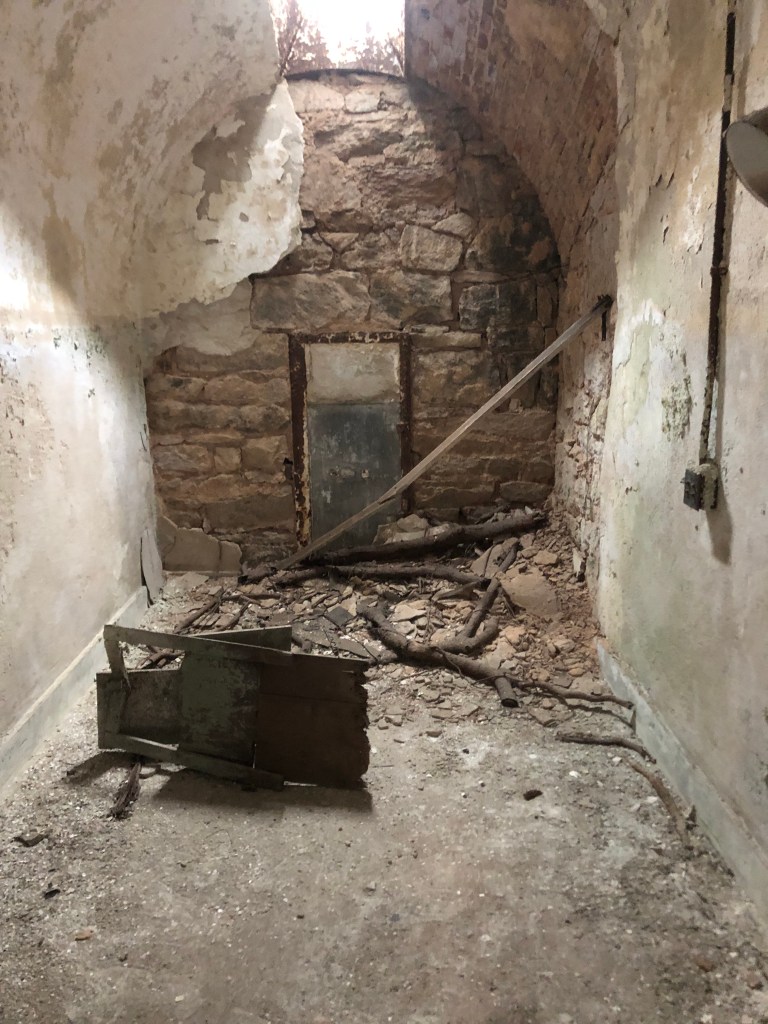
And if you think this looks a little spooky, they do a Halloween Haunted House event as a fundraiser each October.
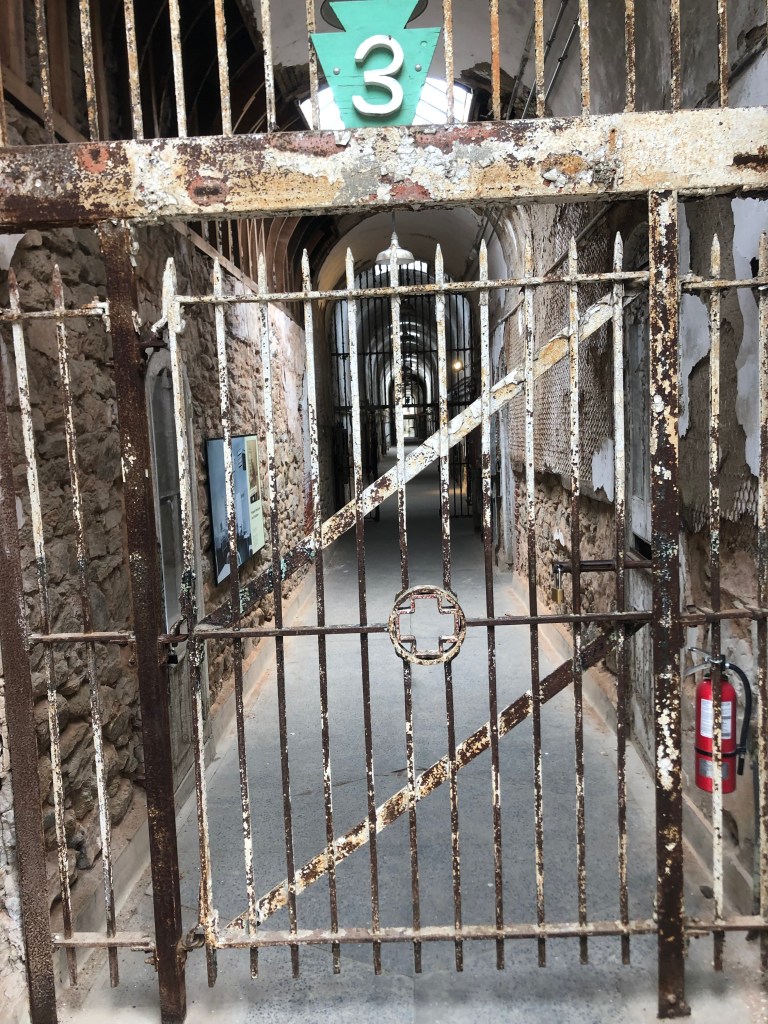
The Hospital Block (note the red cross symbol in the center). Al Capone had his tonsils out here in 1929. Seriously.
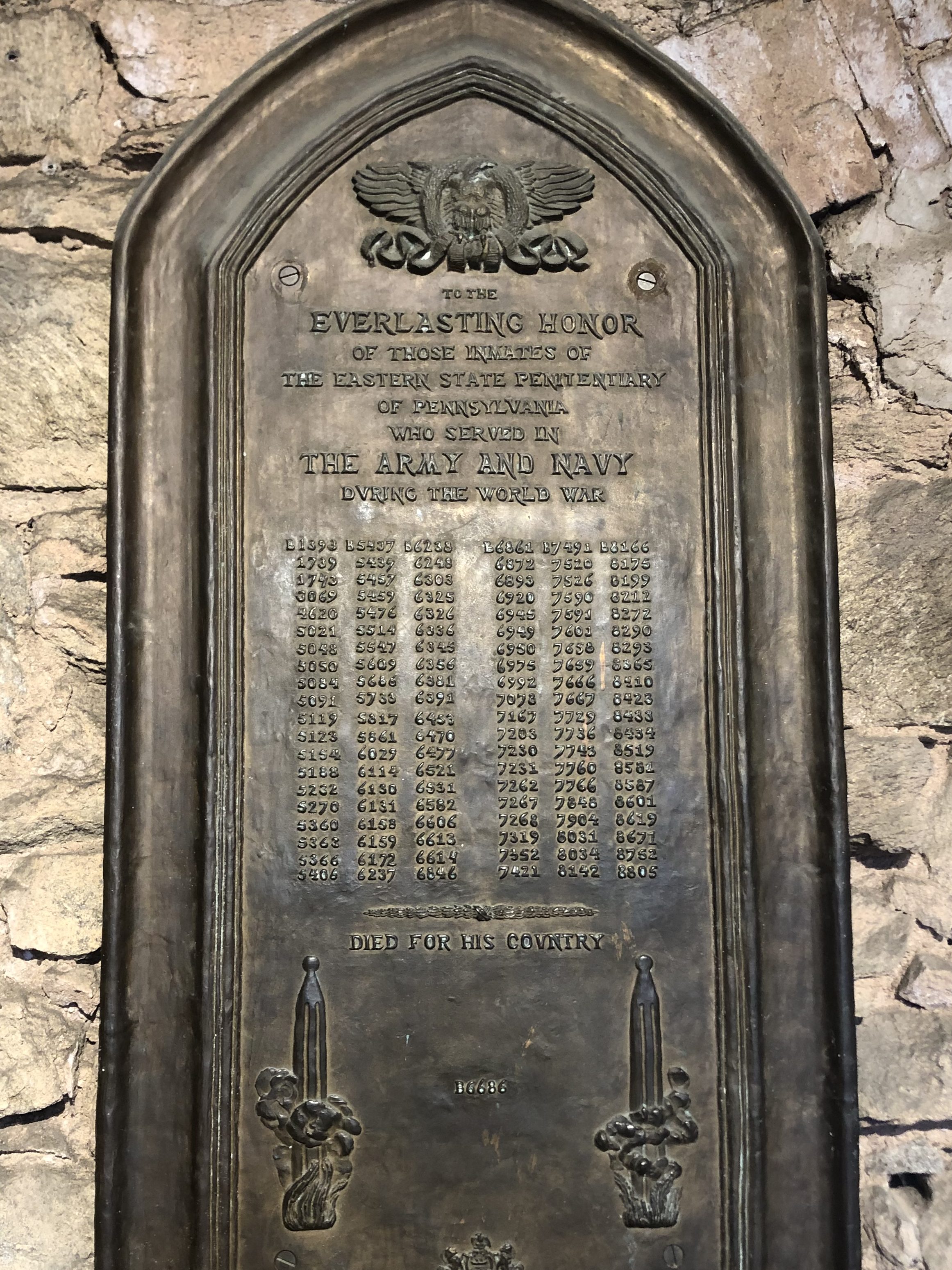
Plaque listing prisoners who died fighting the First World War. (Over 100 prisoners were paroled to fight in the war.) Note that they are identified here only by their inmate number.

It was a sobering visit. And while one can certainly find fault with the system of incarceration, we can thank Ben Franklin (among others) for helping to move the country away from the horrific practices of the 18th century.

My next visit of the day is harder to connect with Ben Franklin: the Edgar Allan Poe house on N. 7th Street. But there is a connection. Poe wrote a short story titled “The Business Man” that, some scholars claim, is meant as a satire of Benjamin Franklin’s autobiography. (Poe actually wrote several satirical pieces that ridicule the concept of a “self-made man” and conceit more generally.)
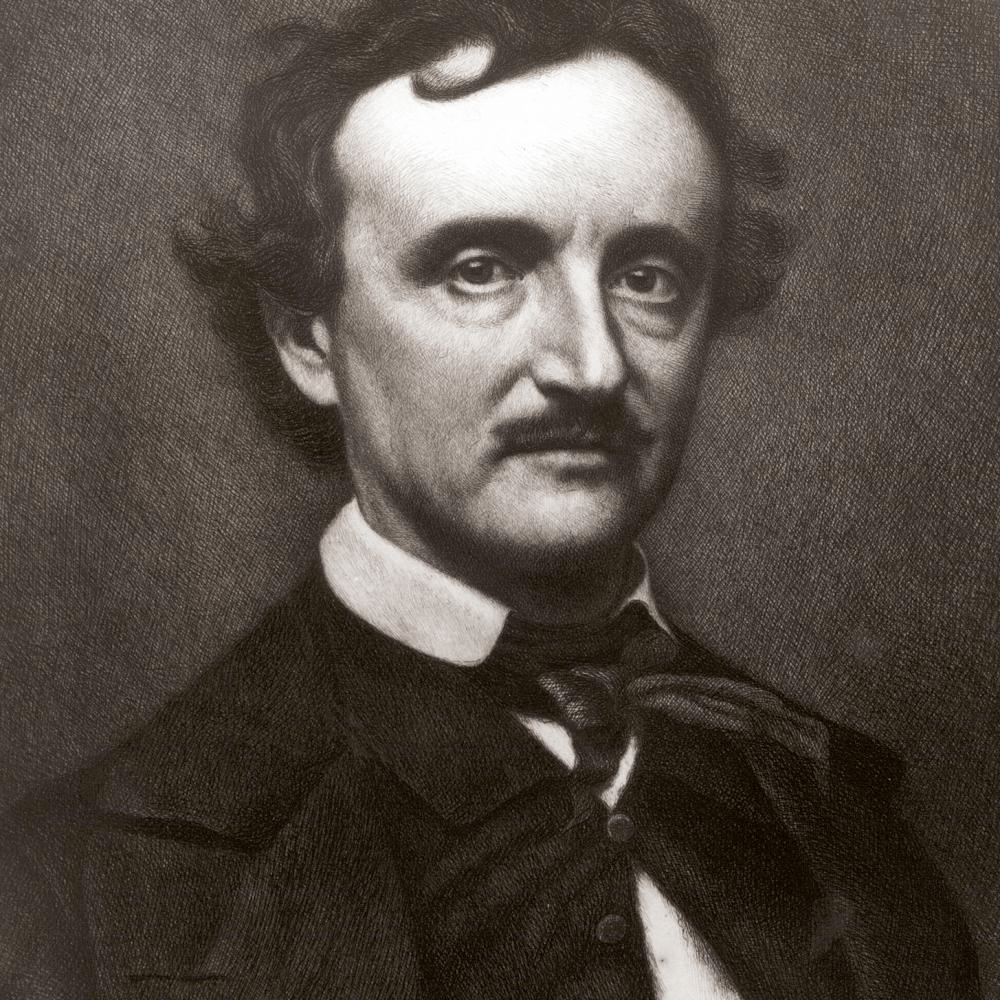
Anyway, as we learned a couple of days ago at The Philadelphia Free Library, Edgar Allan Poe had called Philadelphia home for about six years, from 1838 to 1844. The last year of that time was spent at the house on N. 7th Street, which is now a US Parks Service site.
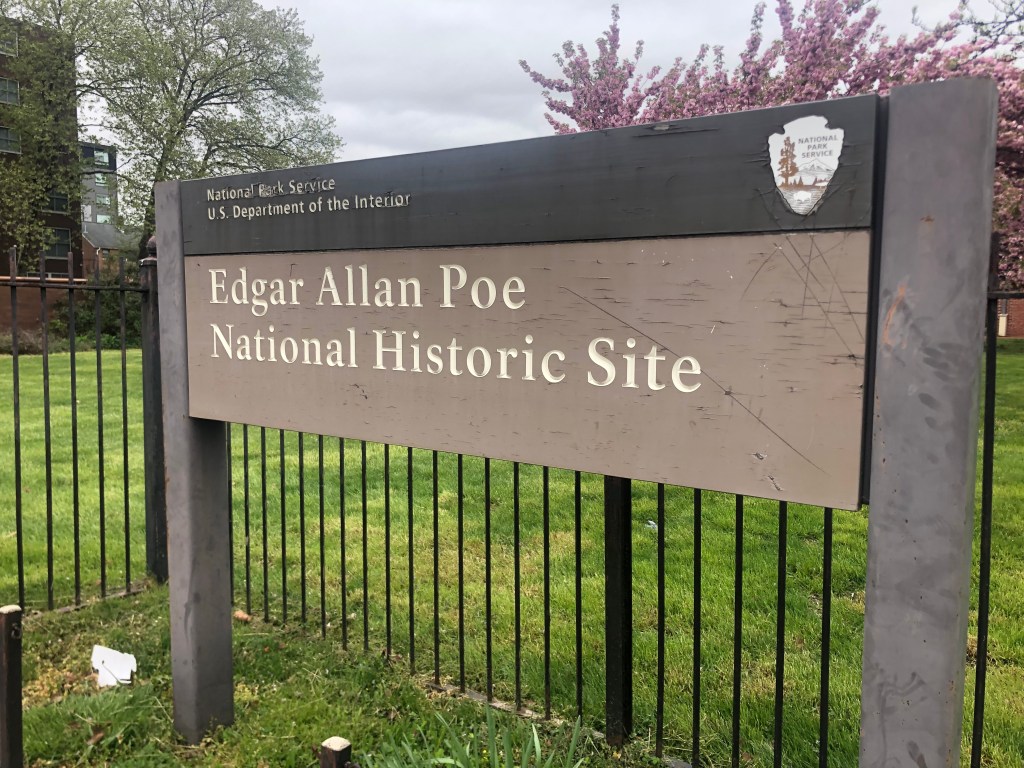
The house is a small, three-story brick structure that was built sometime between 1840 and 1842, so it was still quite new when Poe lived there. After Poe moved out the house changed hands dozens of times, with very little if any attention to its Poe connection. Finally it was purchased by Richard Gimbel (son of the department store magnate), who was a Poe fanboy. After his death in 1970, it eventually ended up with the National Park Service.
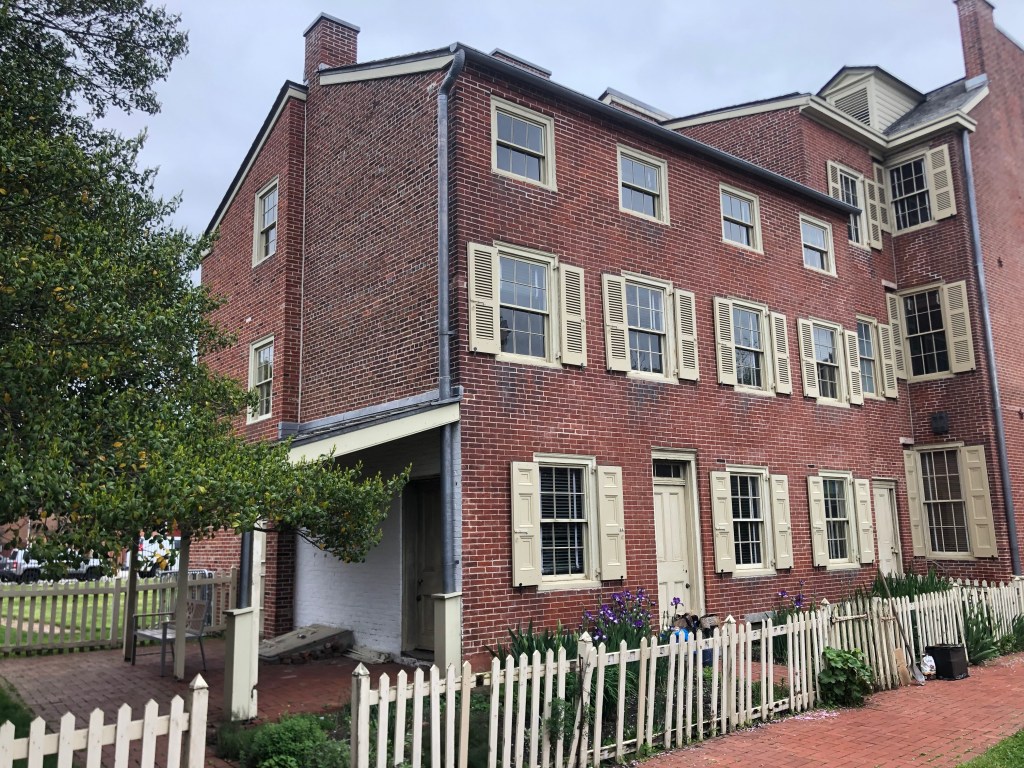
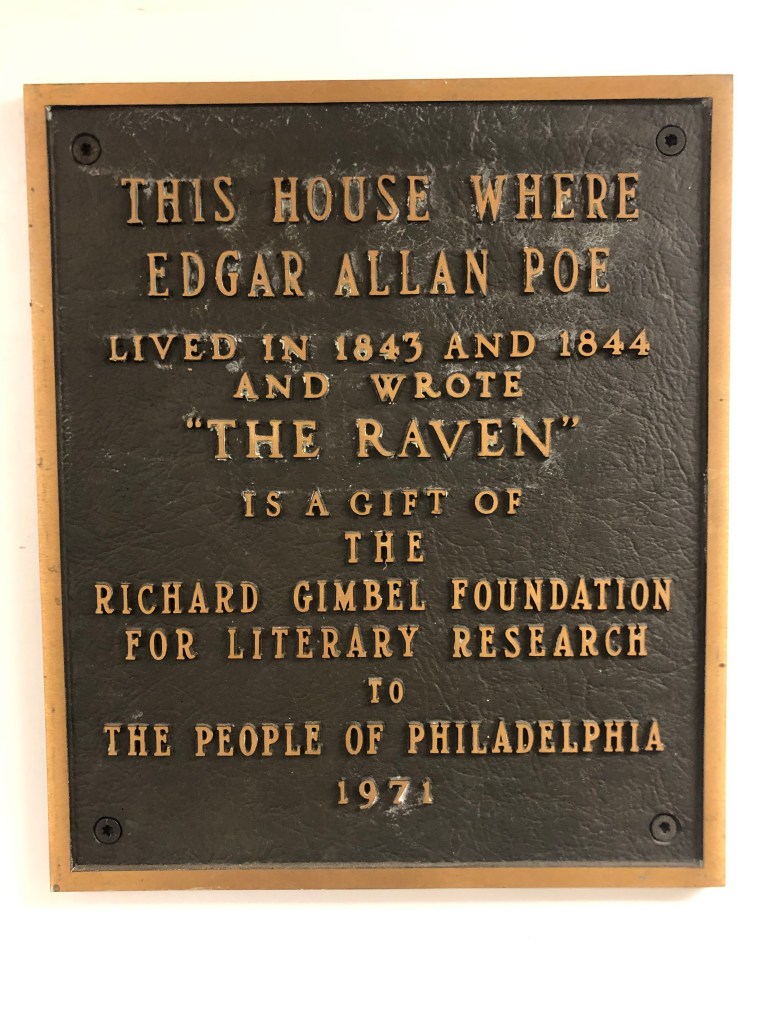
Poe’s house today.

The house is mostly unfurnished, but the Park Rangers told me the floorplan and “bones” of the house are virtually unchanged from Poe’s day. In fact, I think this unfurnished space is more conducive to Poe’s spirit than one filled with period antiques and interactive displays and such. I found it quite easy to imagine Poe in this house, climbing these stairs, writing next to that window.
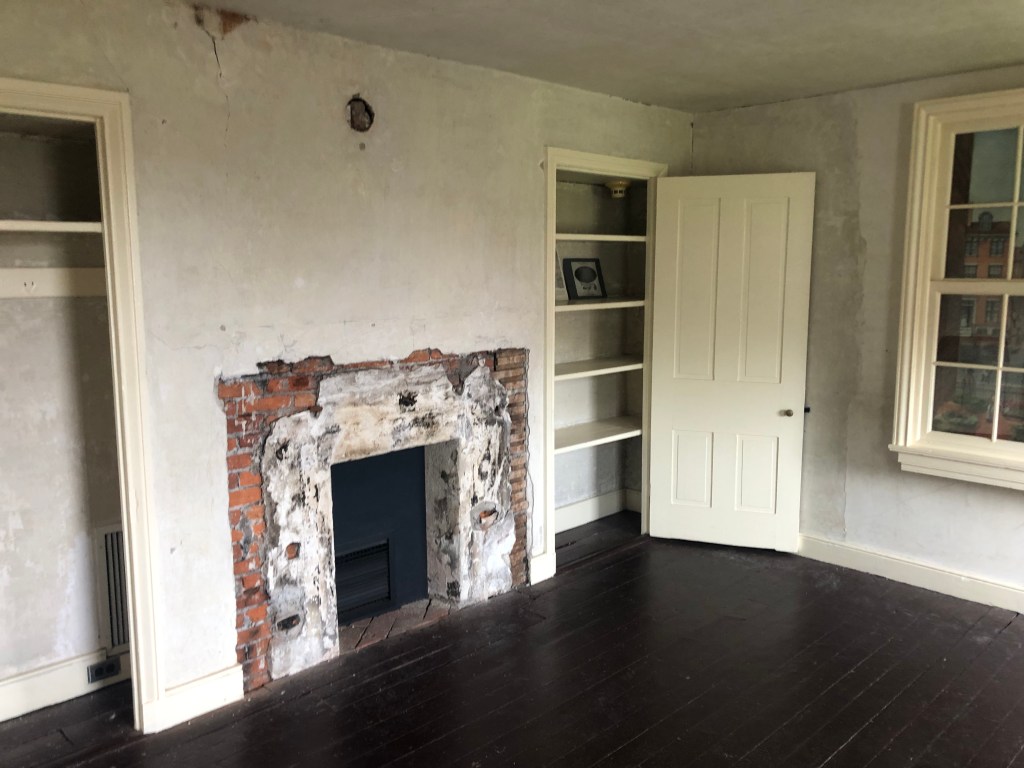
Poe wrote a number of his best-known stories while living in Philadelphia. It’s difficult to connect specific tales with each of his four Philadelphia homes. But the basement of this house is very, very suggestive of the basement in “The Black Cat.”
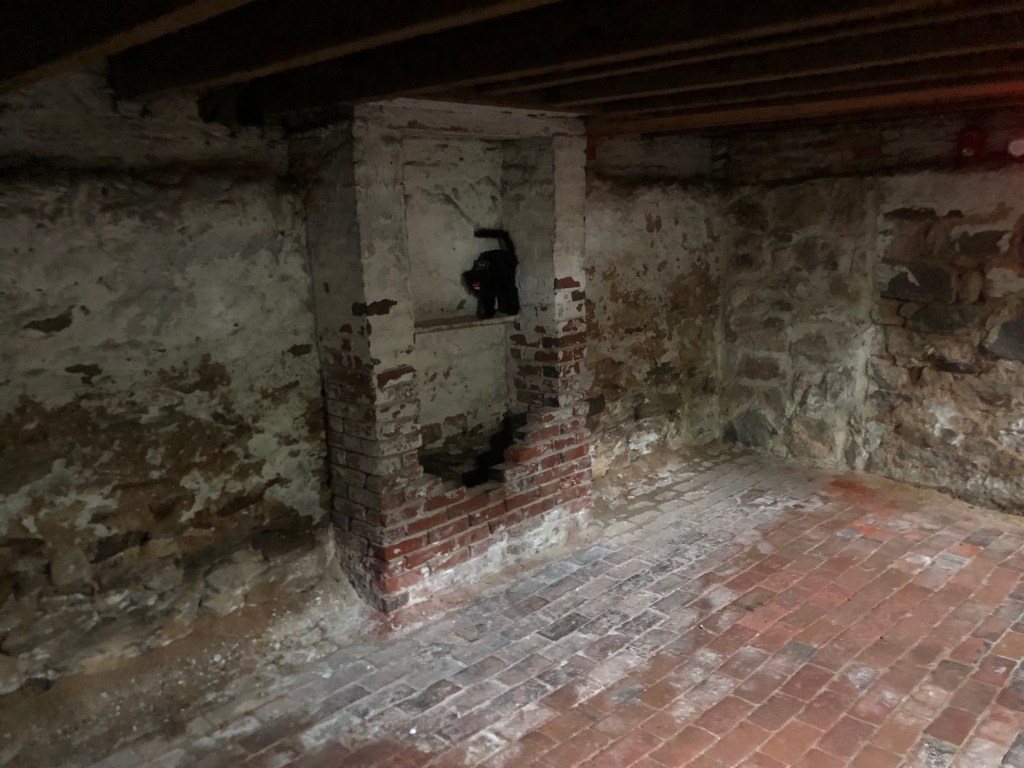
“In one of the [cellar] walls was a projection, caused by a false chimney, or fireplace…. I made no doubt that I could readily displace the bricks at this point, insert the corpse, and wall the whole up as before, so that no eye could detect any thing suspicious.”

Do yourself a favor and re-read the story.

While visiting the yard surrounding the house I ran into a trio of women tending the planting beds. They are Daughters of the American Revolution and they care for the plants once a week. They are very enthusiastic, and explained in some detail the types of herbs and flowers that Mrs. Poe probably grew out here.
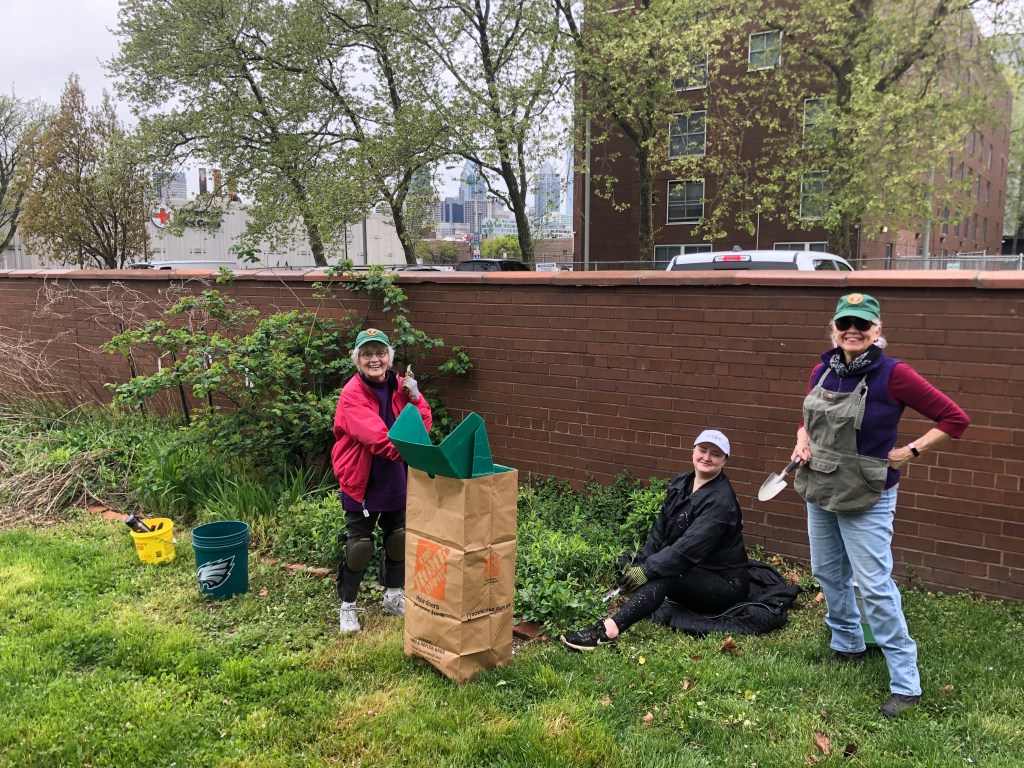
Let’s call them Ligeia, Morella, and Annabel Lee.

Also in the garden area was this sculpture of a raven. I’ve got to say, though: It looks a little, uh, Third Reich for my tastes. I thought Dickens’ stuffed raven (Grip) looked more like it belonged on a pallid bust of Pallas.
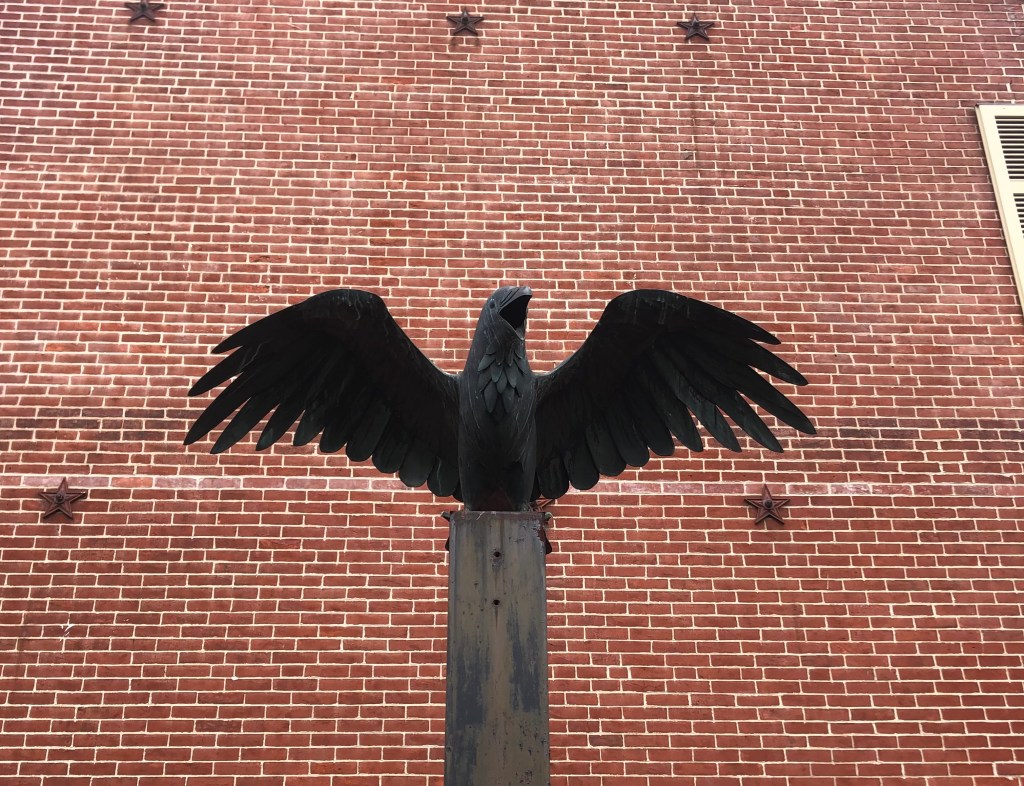
“Nevermore, mein Fuhrer!”

Finally, as I was leaving Poe’s house, I noticed a neighboring building with a Poe mural. It does seem that Philadelphia takes its Poe connections seriously.
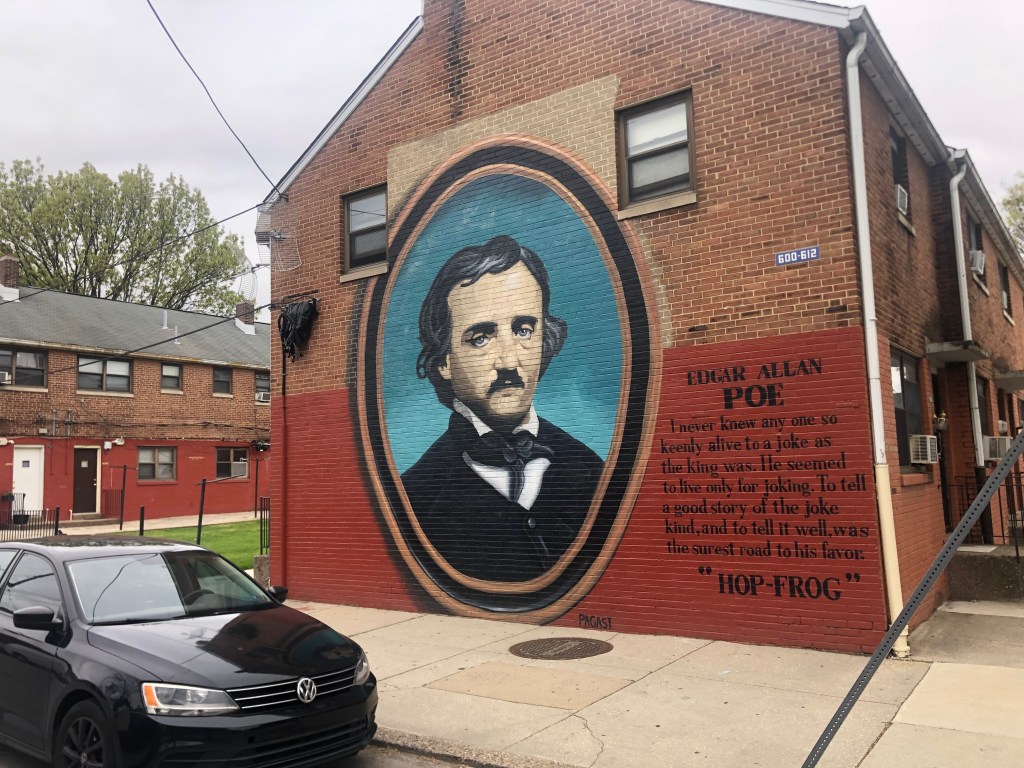
The Park Rangers at the Poe house told me there are two other Poe homes in existence. The one in Baltimore (which I describe in this 2022 blog post, which also contains an Easter Egg related to The Thinker!) and one in The Bronx (which will have to be the subject of a later trip). I did impress the Rangers by pointing out that there’s a third extant Poe domicile in the form of his dorm room at UVA. (I describe it in this blog post.)

BREW OF THE DAY

My final Ben Franklin experience today took place at Victory Brewing Company. The connection here is simply that it’s located at 1776 Benjamin Franklin Parkway.
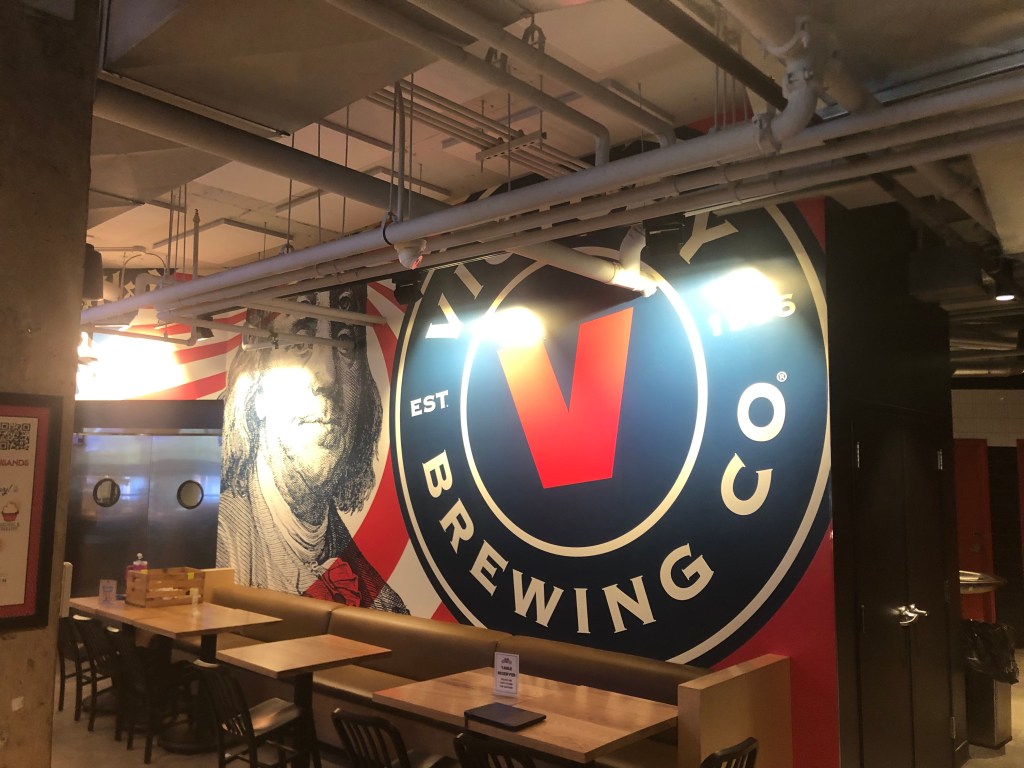
Ben would approve.

In 1996 Victory Brewing was established in Downingtown, PA (which you will recall is home to the diner featured in The Blob). This Philadelphia location opened in 2021.

I ordered Victory’s Moonglow, which is a weizenbock. As you know, a weizenbock is a like a bock, but much of the barley is replaced with wheat. It’s a German style that you might find at the Munich Oktoberfest.
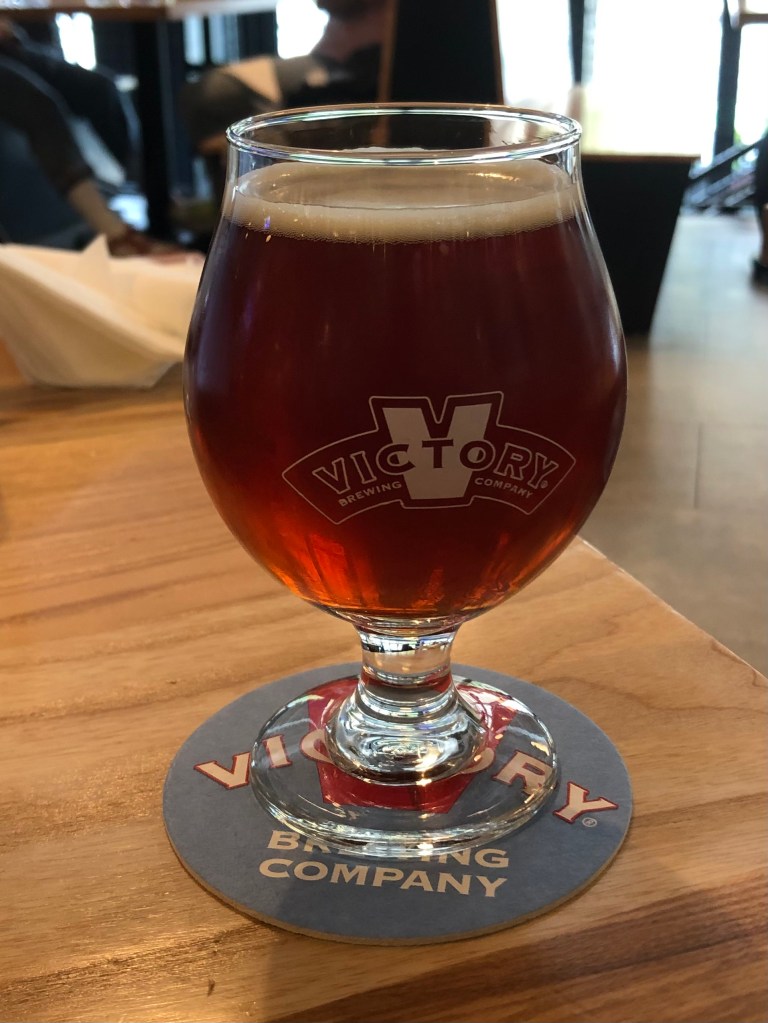
Victory’s version displays a medium copper color, almost no head, and high carbonation. At the front it’s quite sweet, and reminiscent of a classic saison. You can’t help but notice the distinct flavor of dried apricot and raisins. Then there’s a burst of spices mid-palate, including clove, cinnamon, and maybe anise. This morphs into the distinctive flavor of banana Runts, which I consumed by the handful in the 1990s. Finally there’s a little bit of menthol on the finish. Overall, it’s an interestingly complex beer. At 8.7 percent ABV, it’s a beer for sipping rather than quaffing. But I ordered a second one anyway. I’m compelled to give it 4.5 stars out of 5.

bridges · cemeteries · churches · Obelisks · Road trips · trains

Philadelphia Stories

I’ve been working on a top-secret project (which will likely be revealed by the end of the year) and it involves, oddly, Benjamin Franklin. I’m not making this up. And this project has made clear to me how much my grasp of American history is lacking.

Growing up in California, I never learned much about the Continental Congress or the Revolutionary War or really anything that took place before 1849. I’ve made a few attempts to remedy this, including my trip with friend Vic to Salem, Mass.

So I’m now trying to fill in some of the gaps in my education Which is why this morning I found myself in The Quaker City for a few days of exploration. What could go wrong?

My crash course on Philadelphia actually began on the plane ride. I’d taken a red-eye from Sacramento, and my seatmate was a garrulous Philadelphian (if you’ll permit me that redundant phrase). He was on his way home after a vacation with his wife, but they were taking separate planes. It seems there was some kind of booking mix-up related to the use of frequent flyer points. But the real point, for my purposes, is that he was unexpectedly flying solo and looking for someone to talk to. And having learned that I was going to be sight-seeing around his home turf, he spent the next few thousand miles sharing his insights about the city. (Did you know that Elphreth’s Alley is the oldest continuously-habitated street in America?)

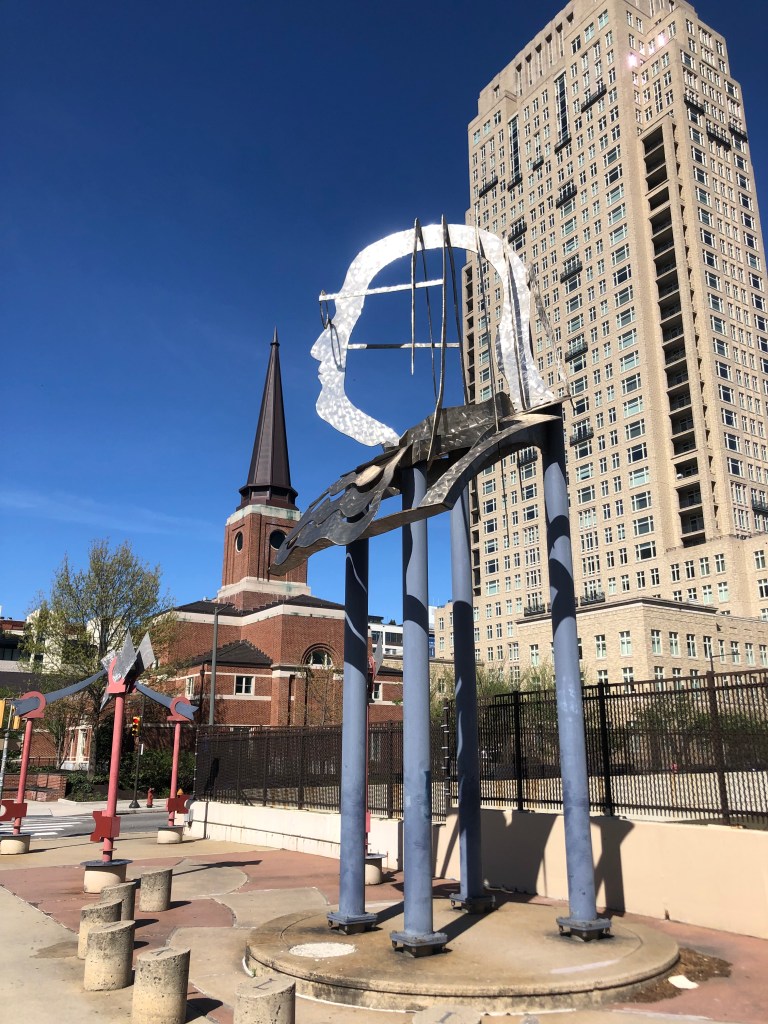
Anyway, I got breakfast and a Nissan Sentra near the airport and set out for downtown Philly. Ben Franklin is certainly well represented around the city. Bridges, parkways, institutes, boulevards, schools, and various other features of the city are named after Franklin. There’s even a large, modern sculpture of his distinctive bespectacled face and stringy hair on a random street corner.

“Big Ben” sculpture from 1992.

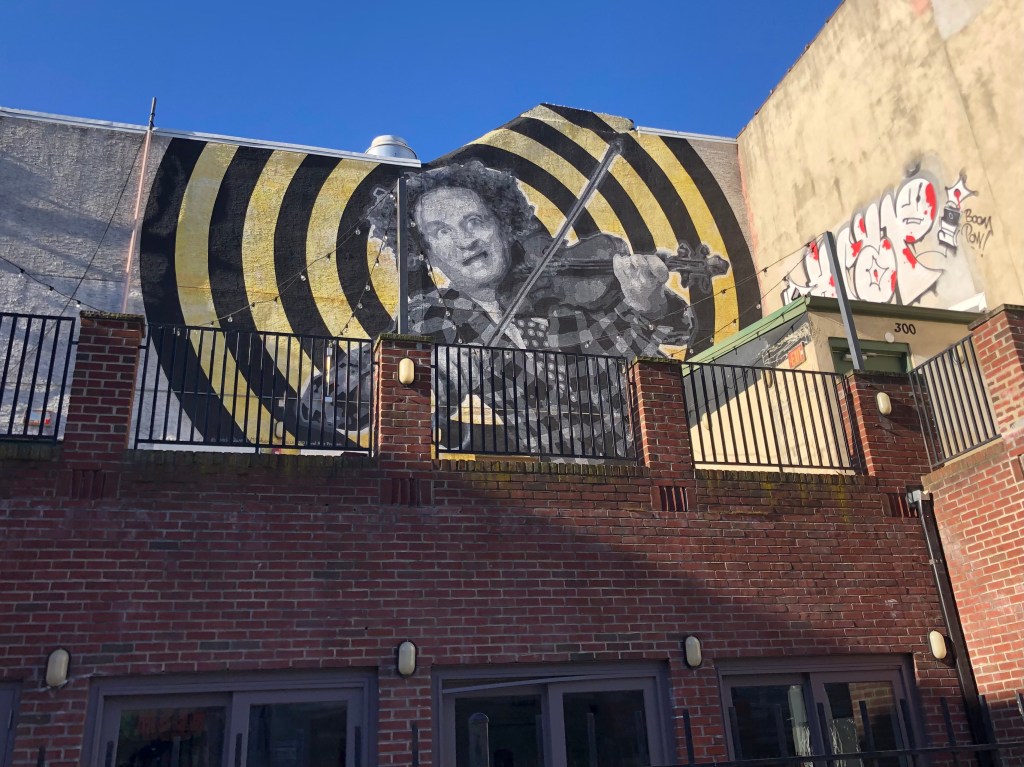
While chatting up the National Park ranger at the Ben Franklin Museum, I learned the following story: Some years back the Philadelphia Inquirer was taking up a collection for a Frank Sinatra mural somewhere in the city. A rival paper objected, pointing out in an editorial that Philadelphia should instead create a mural for one of its native sons. And, perhaps as a joke, the editorial noted that Larry Fine (of Three Stooges fame) is one such native son. The idea nevertheless caught on, donations were made, and the mural was painted at the location (S. 3rd and South Street) where Fine was born.

Giving Ben Franklin a run for his money.
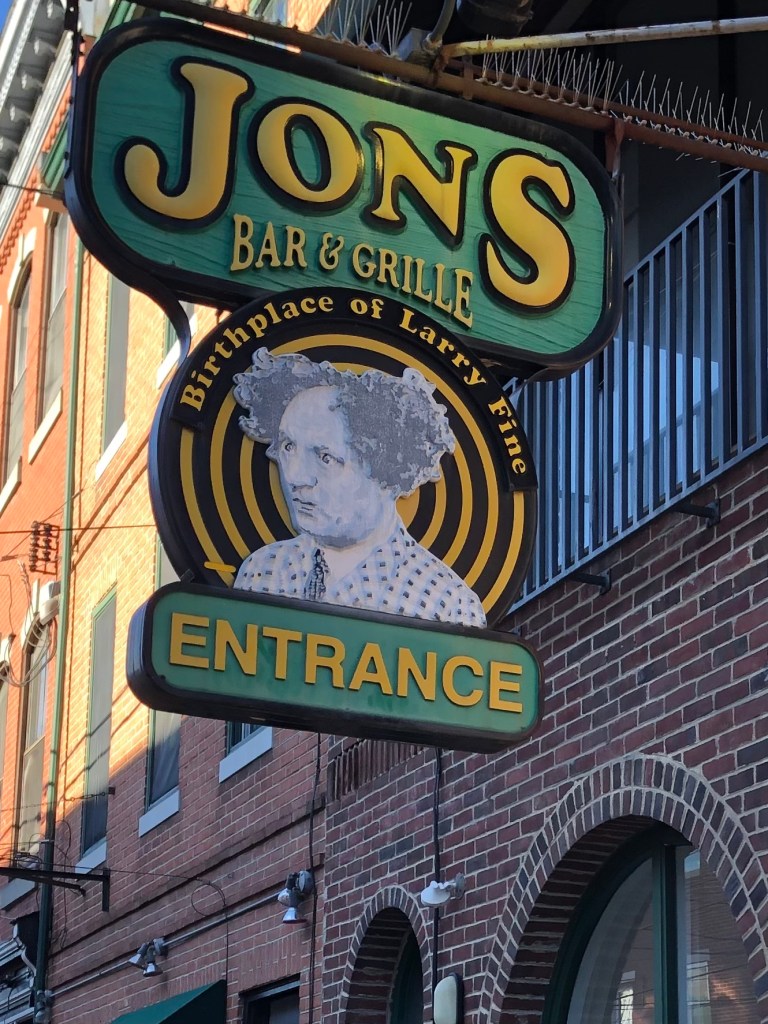
A bar in the same building capitalizes on the Fine connection as well.

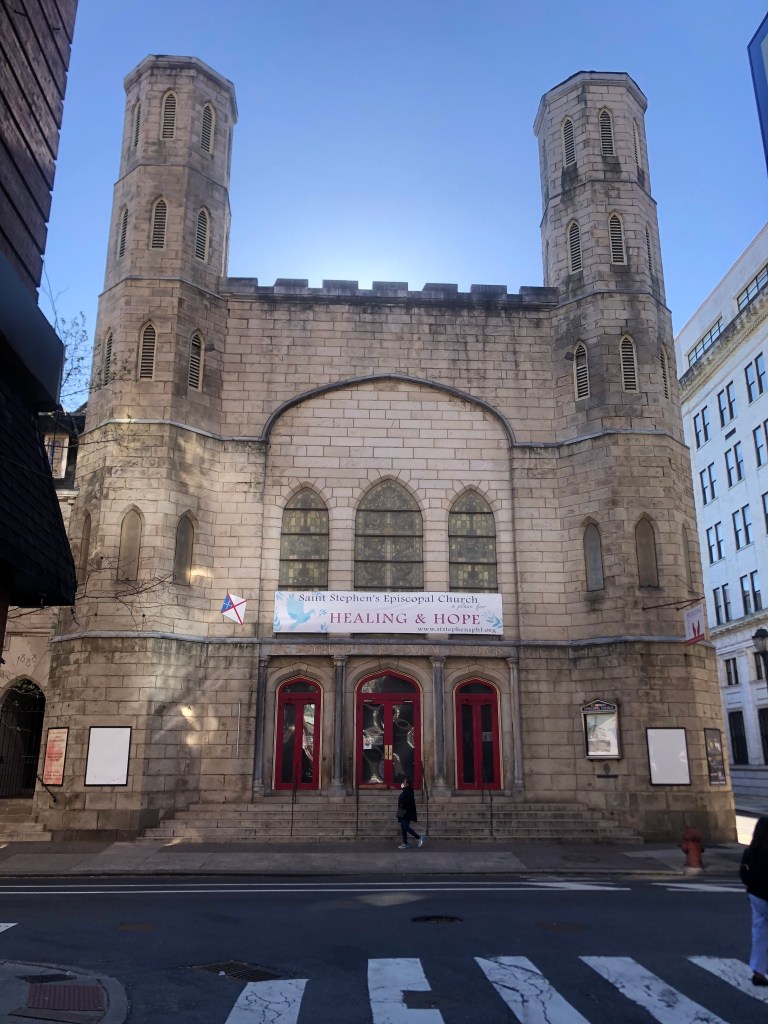
But I digress. I was talking about how Ben Franklin has captured this city’s imagination. And in addition to all the named structures and graven images, the city has been tagged with various plaques that commemorate Franklin’s various activities in the area. For example, on St. Stephen’s Church is a brass plaque which claims Ben Franklin conducted his famous kite experiment on this site in 1752.

Built in 1823 at 10th and Ludlow, which may or may not be where Ben flew his kite.

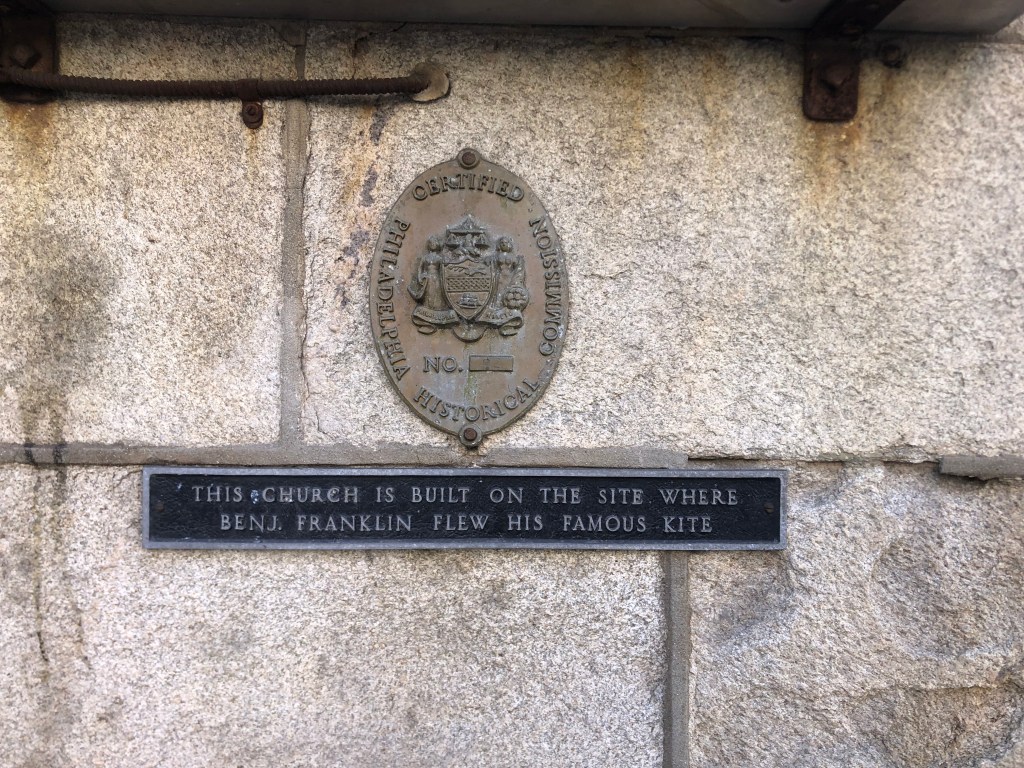
Here’s a closer look at the plaque:

Now, it turns out that there’s considerable debate as to whether this is really the site of Frankin’s kite adventure. And while the “Certified” marker above the plaque would seem to lend credence to the plaque’s claim, it turns out the marker relates to the church building, and not to the plaque.

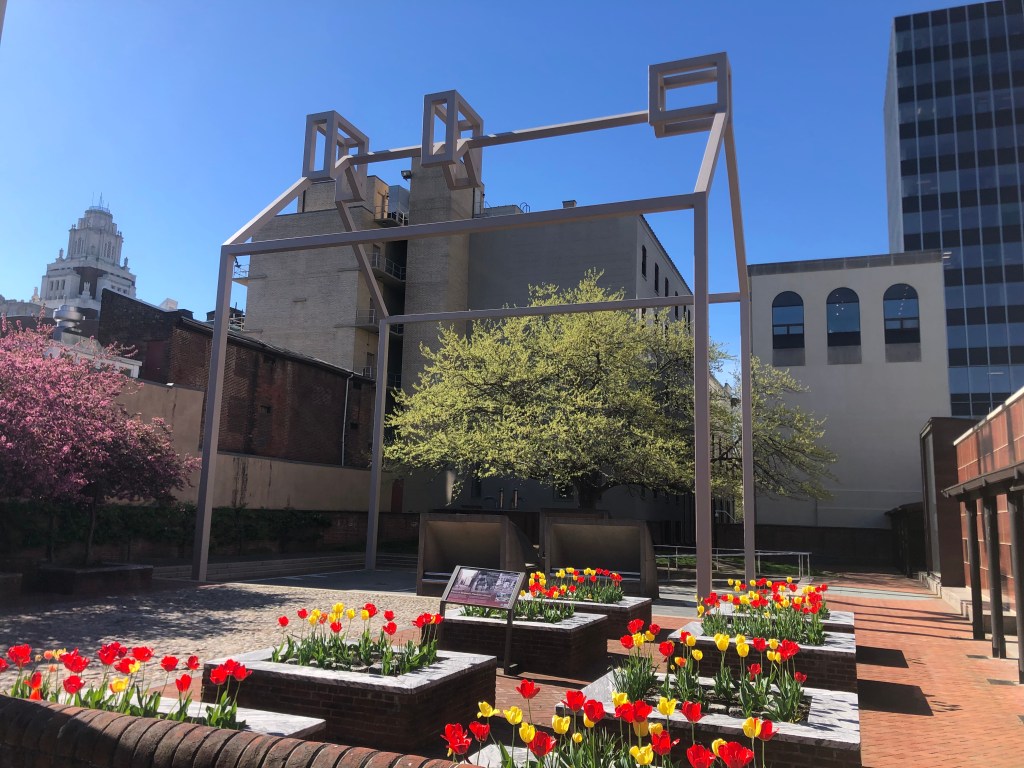
A few blocks from the dubious kite claim is a bare steel pipe structure outlining where Franklin’s last family home had stood. Ben’s kids had the house razed some years after he died. But in the 1940s, archeological efforts uncovered the foundations of the house. The steel “ghost house” was erected in the 1970s, since there were insufficient records or drawings to reconstruct the house itself.

The ghostly outline of Franklin’s house, marking its exact location some two and a half centuries ago.

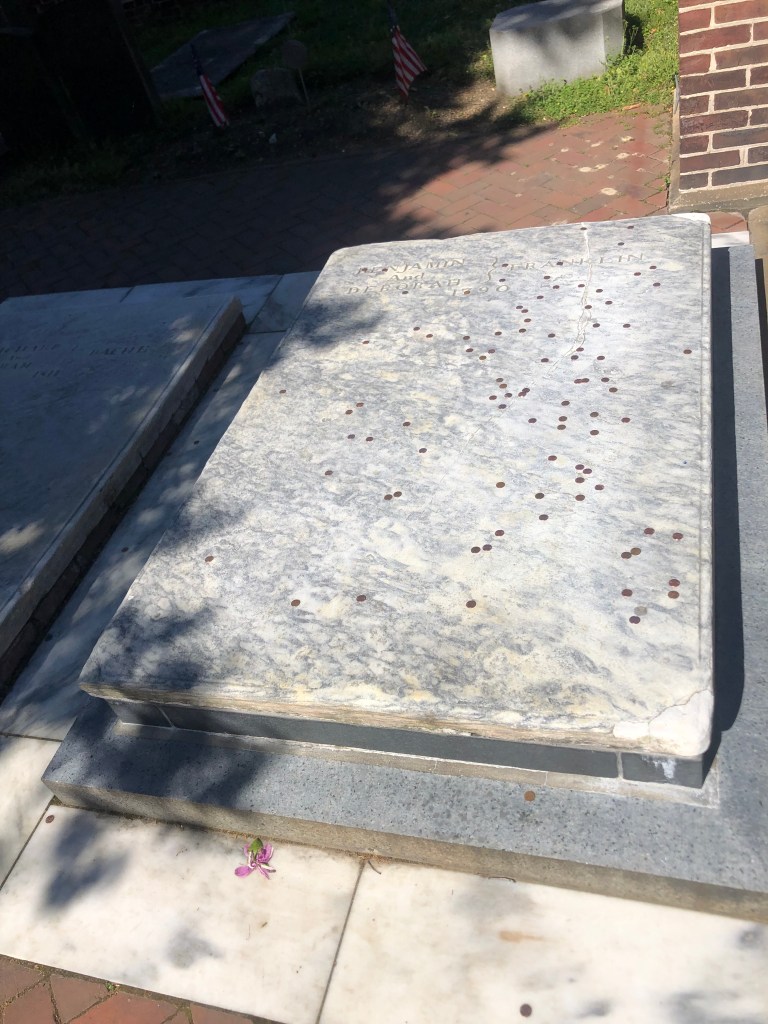
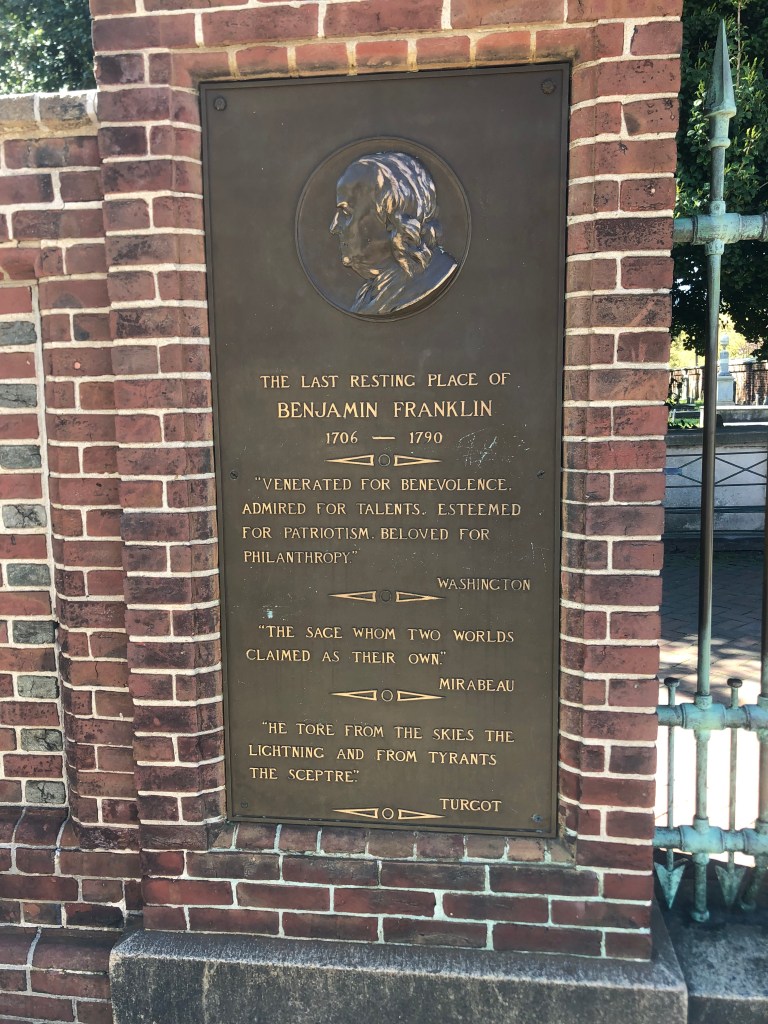
Finally, and inevitably, Franklin’s body rests in Philadelphia, not far from the ghost house. He is buried at Christ Church Burial Ground under a smooth marble tablet that’s perpetually covered with a scattering of pennies from passersby.

“A penny saved is a penny earned.”
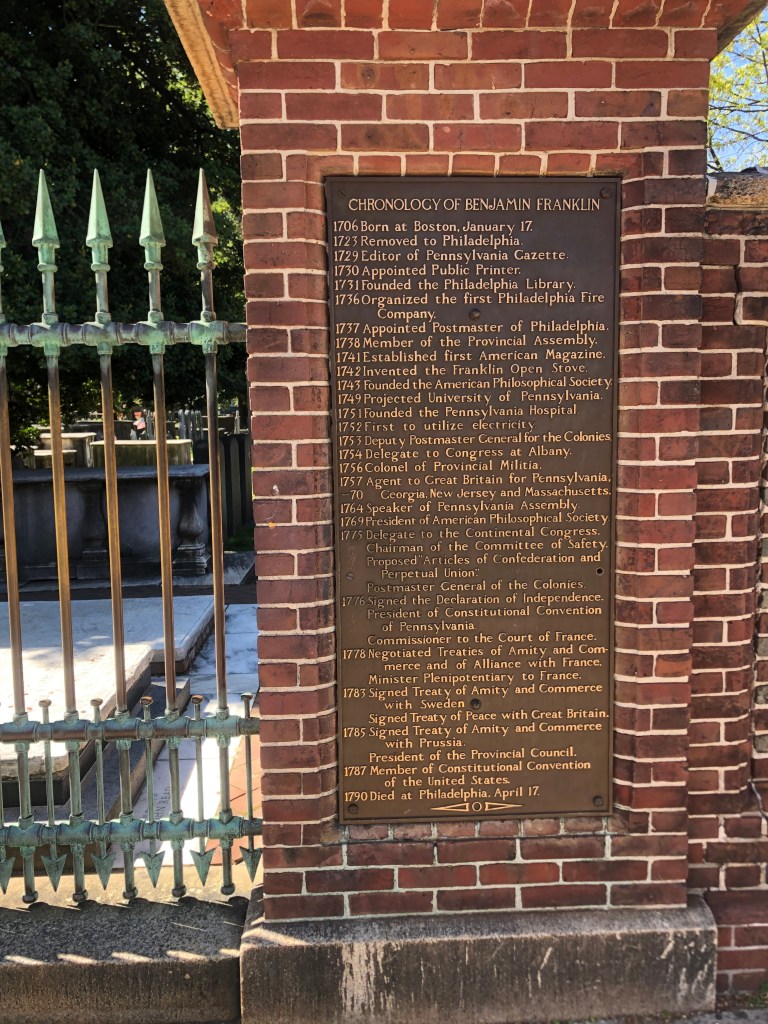
Even allowing for some resume-padding, it’s an impressive list of accomplishments.

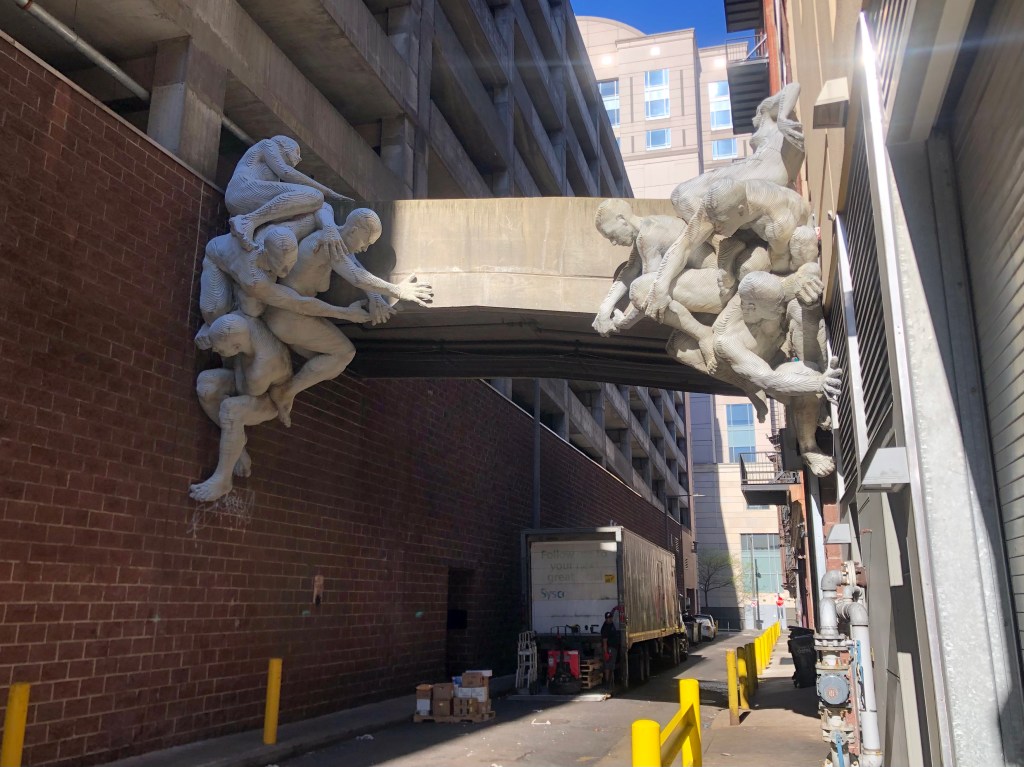
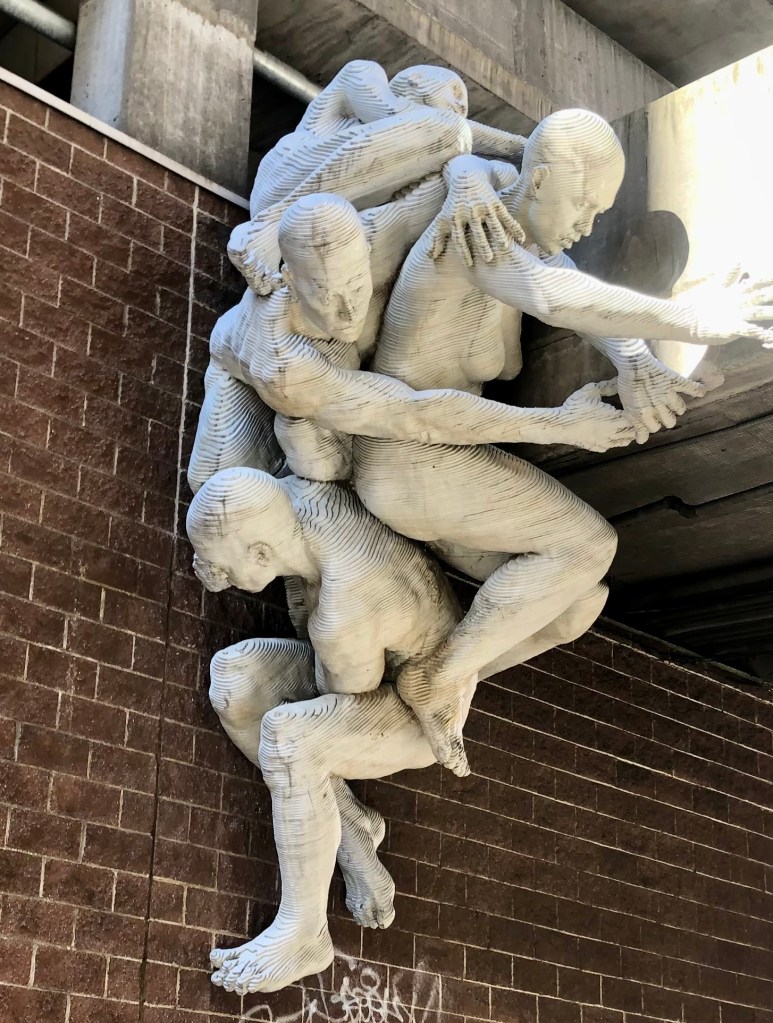
Of course, Philadelphia isn’t all Ben Franklin and Larry Fine. For example, there are these random nudes built into a pedestrian walkway. For no discernible reason.

There’s got to be a flying buttress joke in here somewhere...

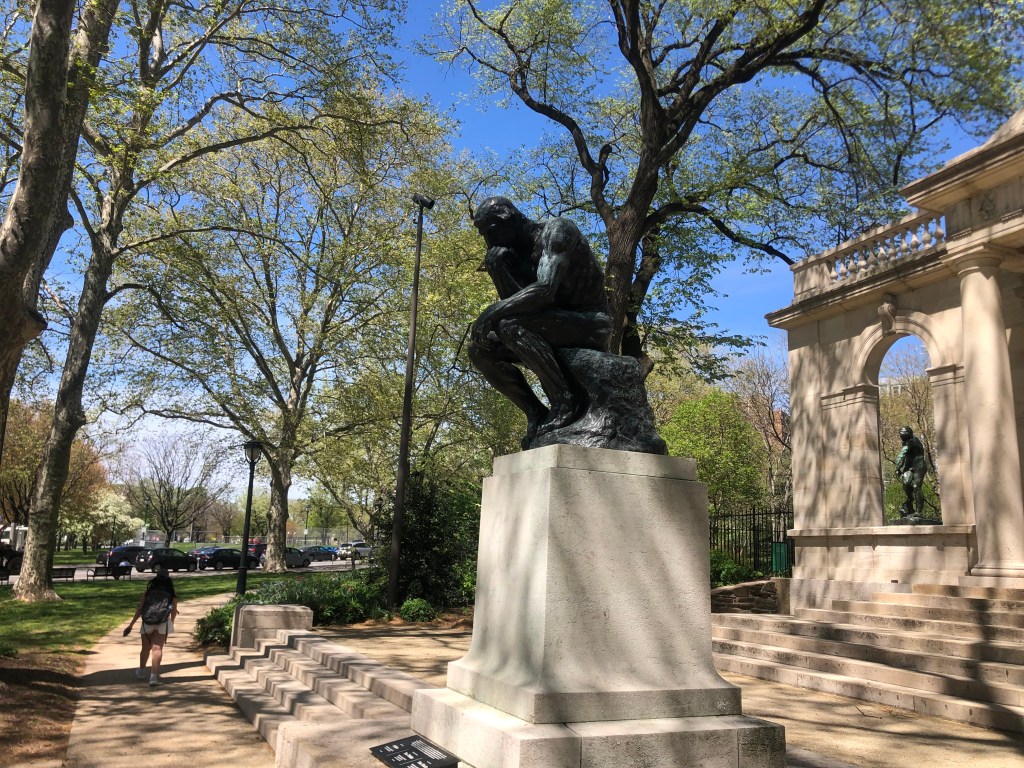
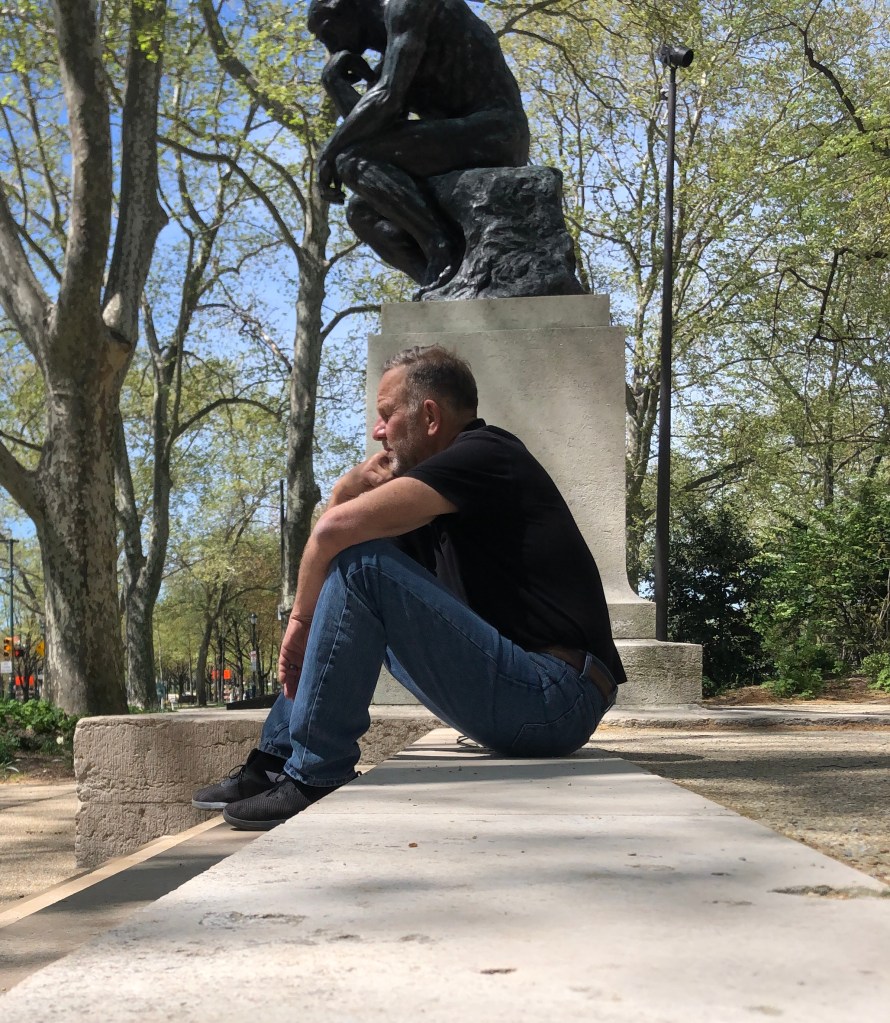
There’s also Auguste Rodin’s bronze sculpture The Thinker on the grounds of Philadelphia’s Rodin Museum:

I think I can…I think I can…

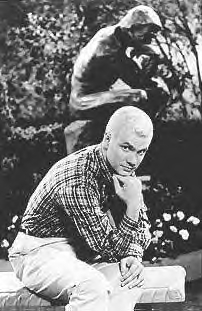
You probably know of this piece. Rodin actually cast a number of identical bronze Thinkers. I remember once seeing one at Stanford University. But I’ll forever associate it with Dobie Gillis, who had a habit of sitting next to the statue in a copycat pose.

Kind of inevitable.

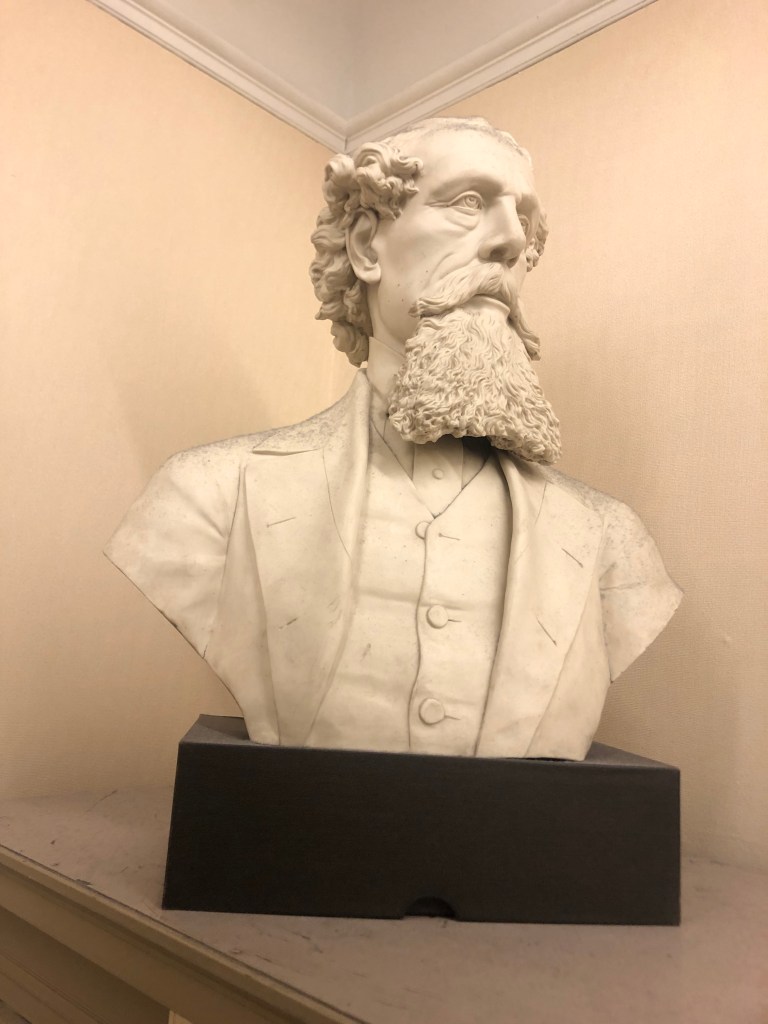
And if that’s not enough, today I also ran into some literary luminaries that you don’t often associate with Philadelphia. In the Philadelphia Free Library’s Central branch (built almost a century ago in the beau arts style) one finds a bust of Charles Dickens in the Rare Books Room.

Have you ever noticed how Charles Dickens resembles Don Quixote?

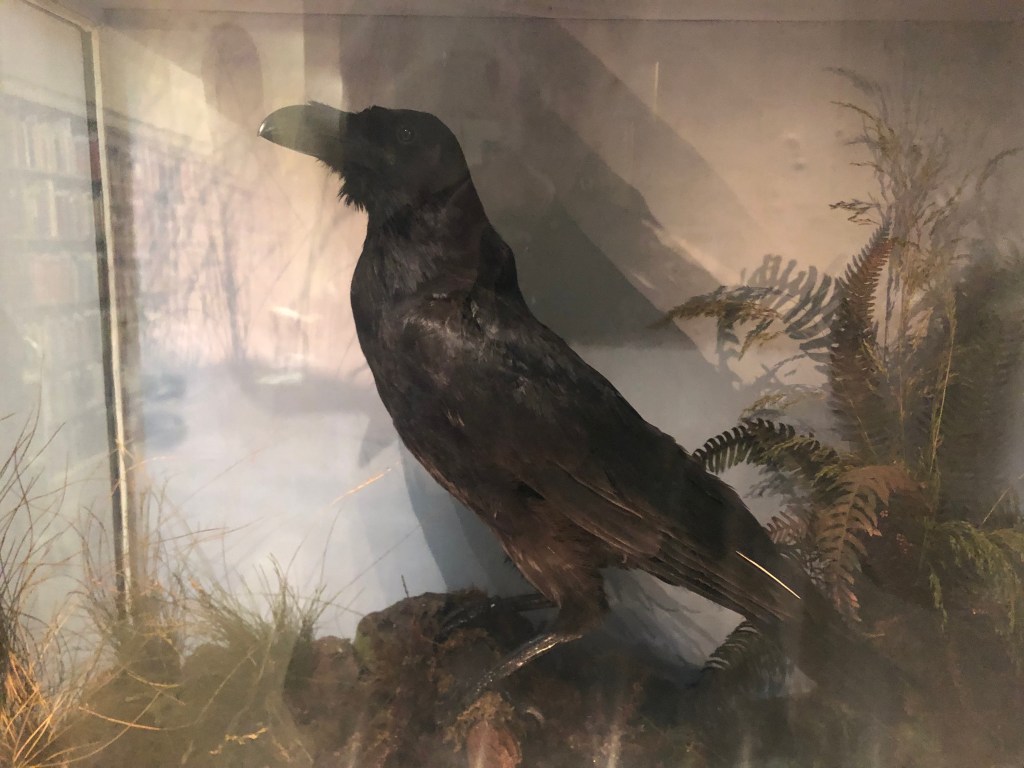
Not far from the Dickens’ bust is his actual pet bird, now stuffed and mounted in a glass box.

That’s so Raven.

The bird is (was?) a raven by the name of Grip. Grip even gets some speaking lines in Dickens’ novel Barnaby Rudge. But she (for Grip is a female) also played a much more important literary role: She is said to be the inspiration for Edgar Allan Poe’s The Raven.

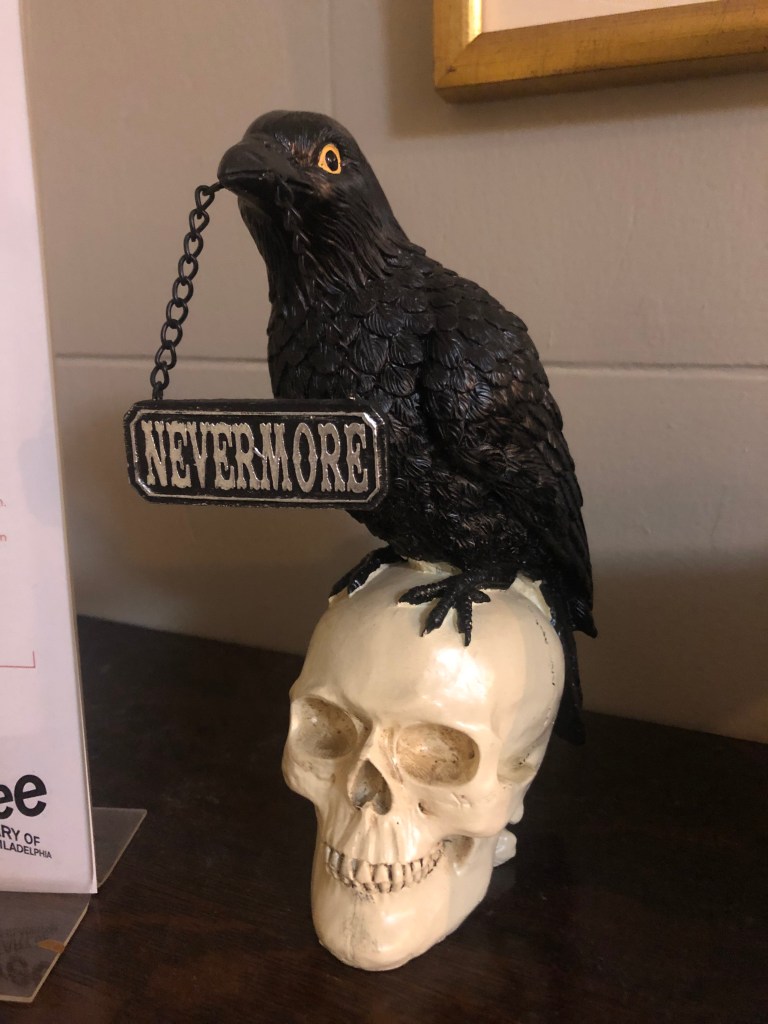
Wasn’t Nevermore the title of a Nirvana album?

As we all know, Poe lived in Philadelphia for six years. And one of his Philadelphia homes still stands. I will be visiting it on Friday, so we’ll be returning to this theme later.

It’s now getting late, but I do have two more items to share from today. The first is:

OBELISK CORNER

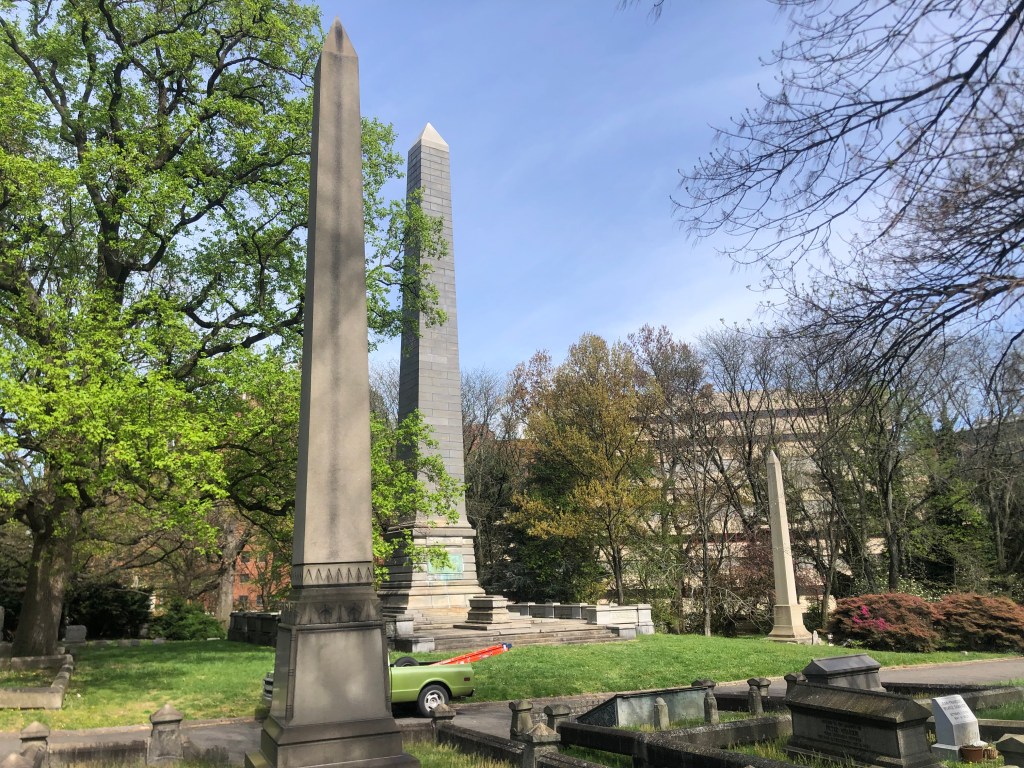
I was taking an afternoon walk through Philadelphia’s Woodlands Cemetery. It dates back to the 1840s, and has a distinctive Victorian air about it. Many of the grave markers take the form of obelisks, with some quite large specimens cropping up here and there.

…or are you just happy to see me?

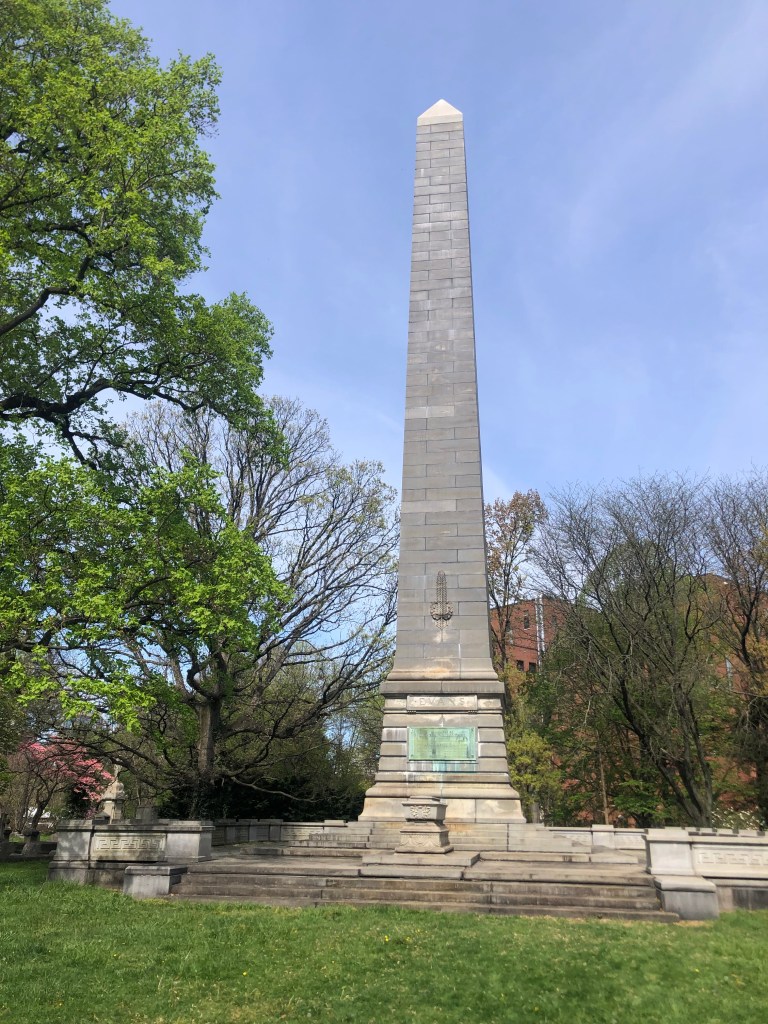
But take a closer look at that one in the center. Though it doesn’t appear especially large in the photo, it’s actually about 15 stories high. In fact, it’s the largest gravestone in the Continental U.S. Let’s take a closer look:

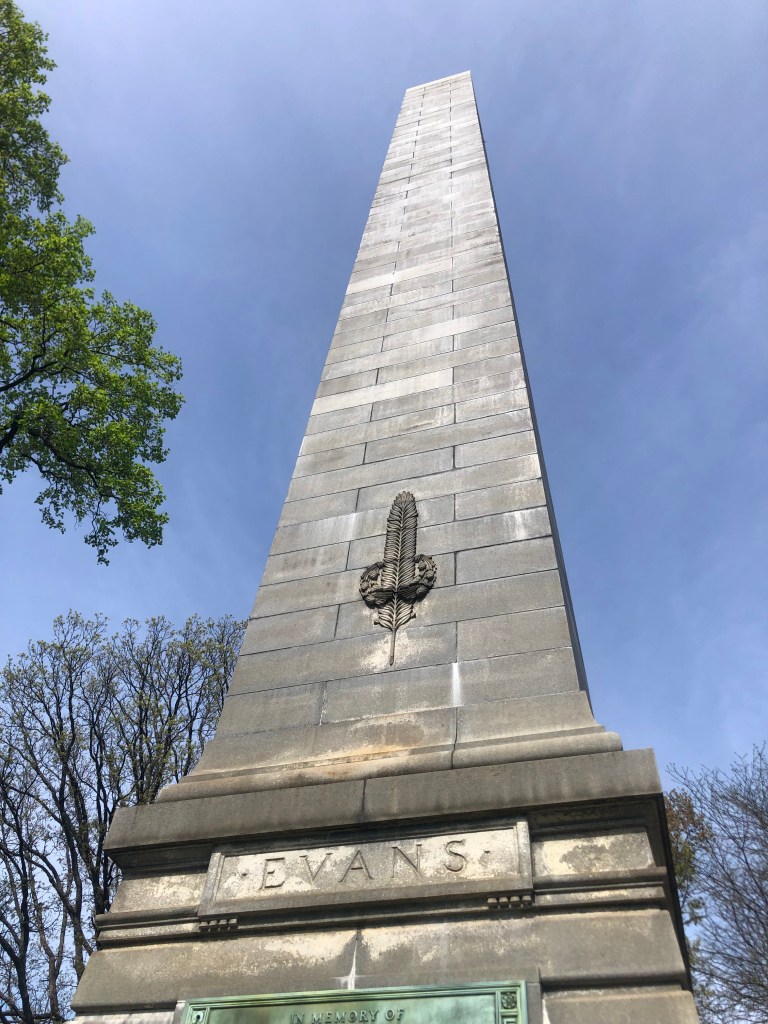
For perspective, note the two stacked sarcophagi at the foot of the obelisk.

The obelisk marks the grave of one Thomas Wiltberger Evans, who died in 1897. You never heard of him either? It seems that the man with the country’s tallest headstone was a….dentist.

And now, let’s finish up with the

BREW OF THE DAY

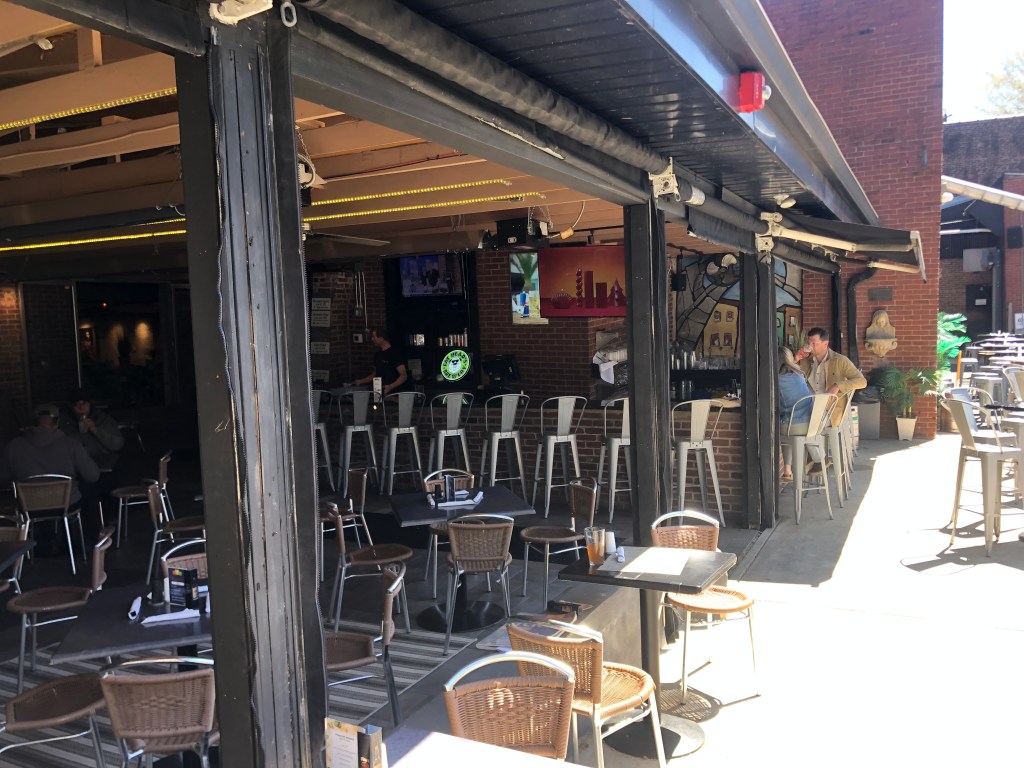
I drank my BOTD at Manayunk Brewing Company, which sits in a cavernous, historic cotton mill on the banks of the Schuylkill River. The cotton mill dates back to 1822, and it operated (making cotton or, later, wool) until 1992. At that point it became a brewery.

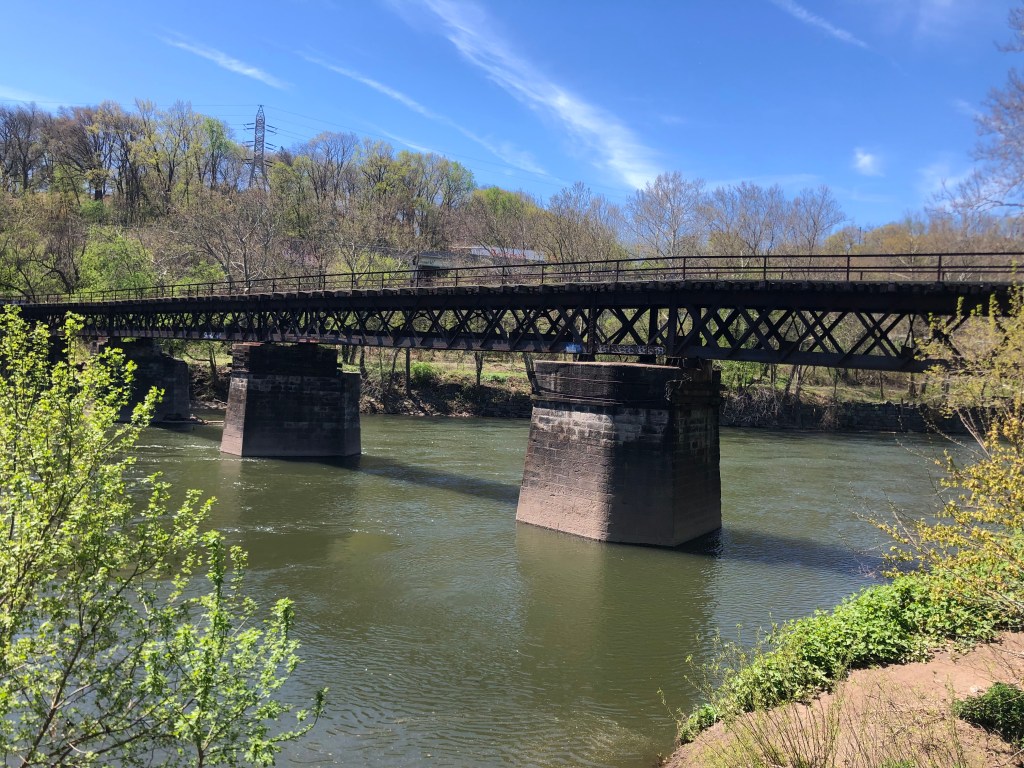
My words can’t do justice to the wonderful setting. Not only is the historic building awe-inspiring, but there’s an old railroad (?) bridge crossing the river right behind the brewery. And I had a great spot in the sun to enjoy the view.

First cotton, then wool, now ales.
I couldn’t find any info on this bridge that’s directly behind the old cotton mill. Uncle Ed, please help!

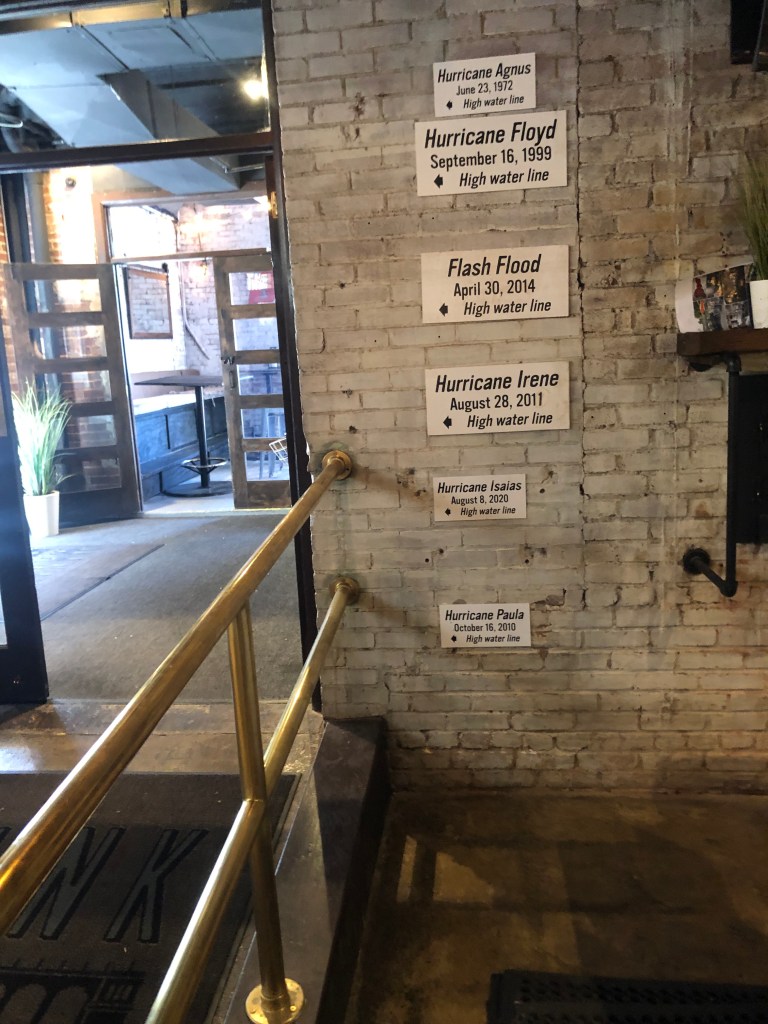
I had my heart set on getting one of Manayunk’s home-made brews. But sadly, my server informed me that they lost their entire brewing setup to a flood a few years back. It seems that flooding has been a recurrent problem, judging from the “high water mark” signs in the bar.

However, a few of their beer recipes are still being faithfully produced by local brewing partners. I selected the Schuylkill Punch, which is being brewed by Yards Brewing.

“How would you like a nice Hawaiian Punch?”

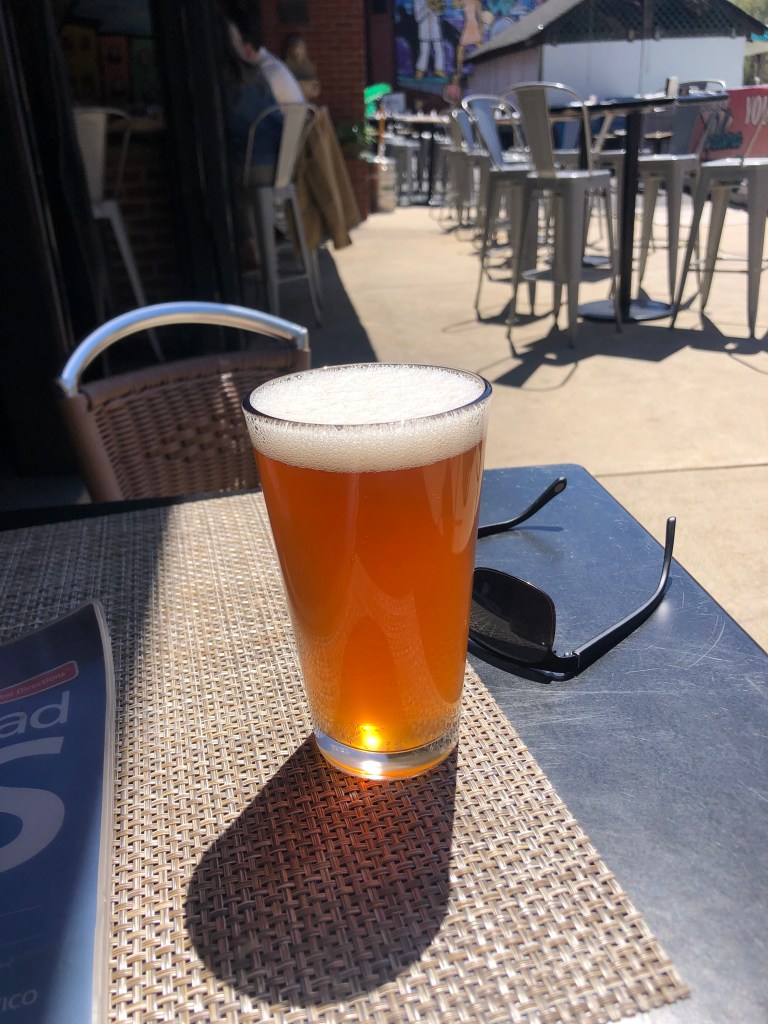
This is nothing like what I normally drink. It’s light, with a body light iced tea. There’s almost no malt. And with an ABV of 4.5 percent, it has about half the alcohol of my usual brews.

But this is an exceedingly smooth beer, and it complemented the warm weather perfectly. It’s slightly sweet, with distinct citrus notes of grapefruit, lemon, and some tropical fruits. Carbonation is low, but it has a nice head. Overall, I’d call this a “session” beer, especially if your session is outdoors on a warm day next to the Schuylkill River. I give it 3.5 stars out of five. If they could up the flavor a bit (maybe brewing it with more fruit), I’d knock it up to a solid 4.

cemeteries · Halloween Cocktails · Obelisks

Zombie All You Can Be

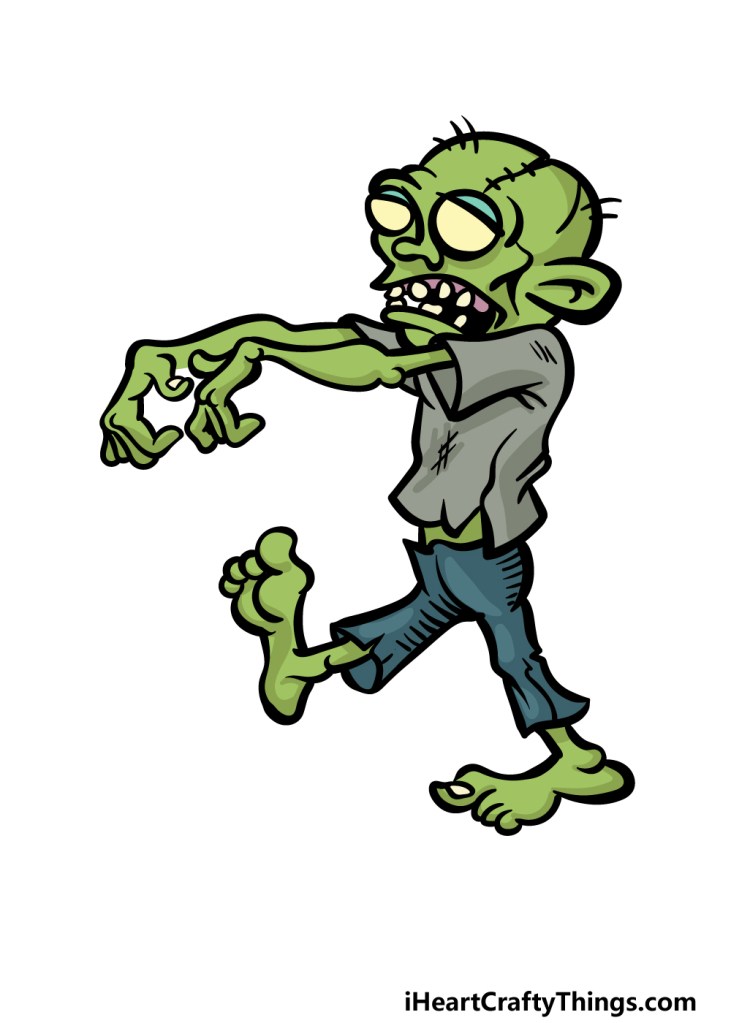
C/o “I heart crafty things,” obviously.

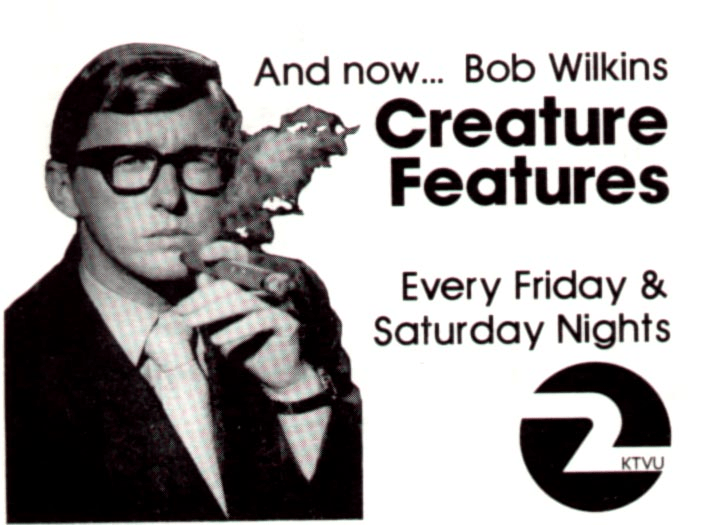
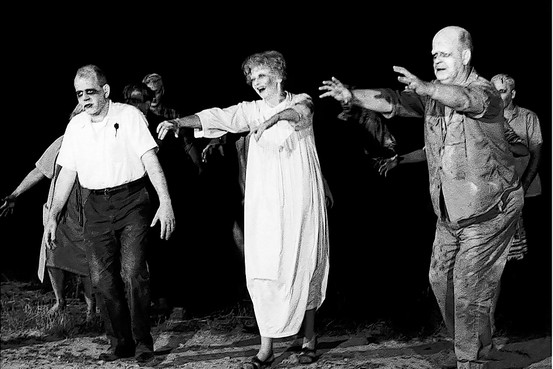
I’m not sure when it happened, but Zombies are cool again. They sure weren’t in 1932 when Bela Lugosi starred in the shlocky embarrassment called White Zombie. They sure weren’t in 1968 when George Romero made the ground-breaking horror film, Night of the Living Dead. They sure weren’t when the low-budget Italian horror film named Baron Blood appeared on Channel 2’s Creature Features in 1972, giving me nightmares for a week.

Zombies were always too clumsy to be cool, too disgusting to be slick like Dracula, too inarticulate to really even have much of a personality.

Is the one on the left a zombie accountant?

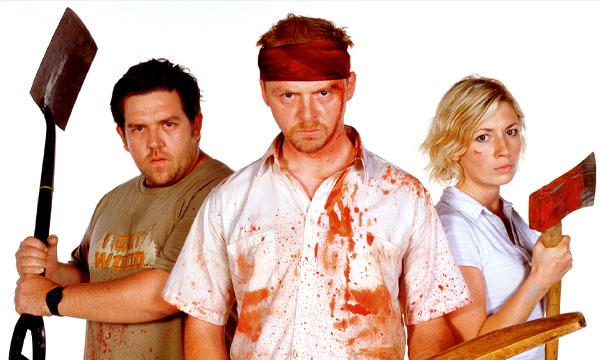
But somewhere along the line, zombies became cool. It might have been when Simon Pegg starred in 2004’s campy Shaun of the Dead. Or maybe it’s when urban hipsters started holding Zombie Walks. Or maybe it was the profusion of zombie-themed internet games like “Resident Evil” and “The Walking Dead.” All I know is: Zombies are no longer relegated to the lame zone in the pantheon of movie monsters.

Ghostbusters meets White Zombie

So, given all that, perhaps the Zombie can bring a little cachet to our list of Halloween cocktails.

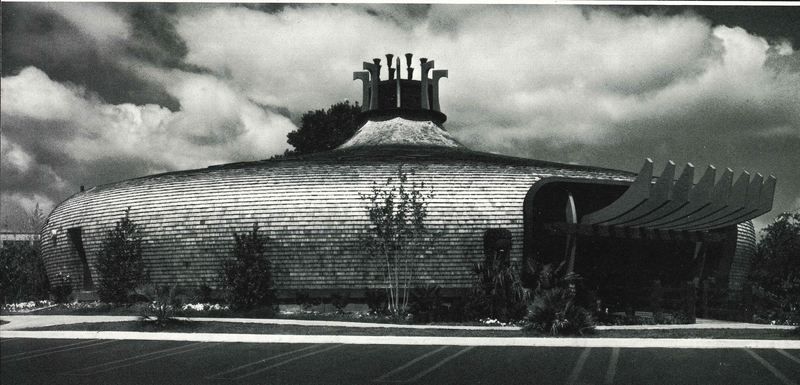
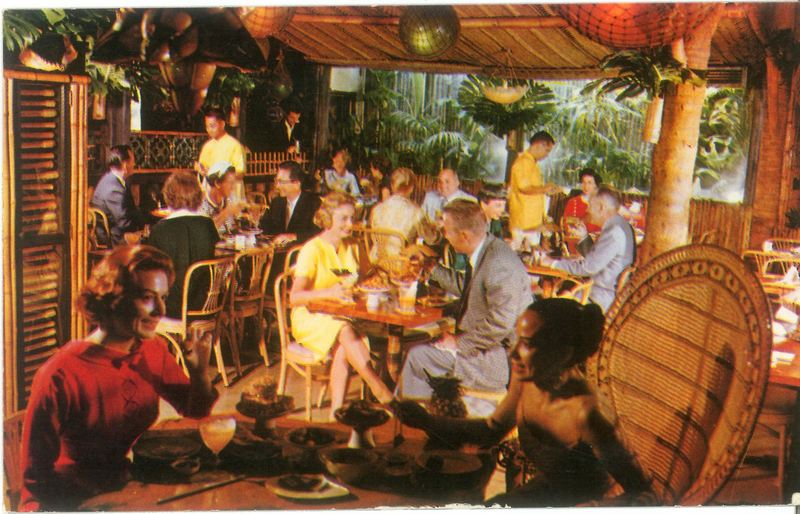
It’s said that the Zombie was invented by Donn Beach, founder of the Don The Beachcomber chain of prototypical “tiki bar” restaurants. When I was a wee lad, one such establishment was located in San Jose, on Stevens Creek Boulevard. I spied it through the car window many times, but alas, I never darkened its doorstep.

San Jose’s Don the Beachcomber, looking like a 1950’s spaceship.

Donn Beach opened his first bar, called Don’s Beachcomber, in Hollywood in 1933. It was successful, and he and his wife developed a chain of Donn the Beachcomber restaurants that numbered 16 at its height. The restaurants cashed in on the post-war Tiki fad that gripped the nation.

But let’s get back to Zombies. Beach is credited with creating the Zombie cocktail. Supposedly he came up with the drink as a courtesy to a favorite customer, who was hung over and was facing an important business meeting. The unnamed customer drank the concoction, and subsequently informed Beach that the drink had turned him “into a Zombie.” Beach recognized the marketing potential, and his drink was henceforth called the “Zombie.”

So, let’s now acknowledge that the Zombie really has nothing to do with Halloween. Its claim to fame is being a high-alcohol drink that goes down easy due to a variety of fruity juices and syrups.

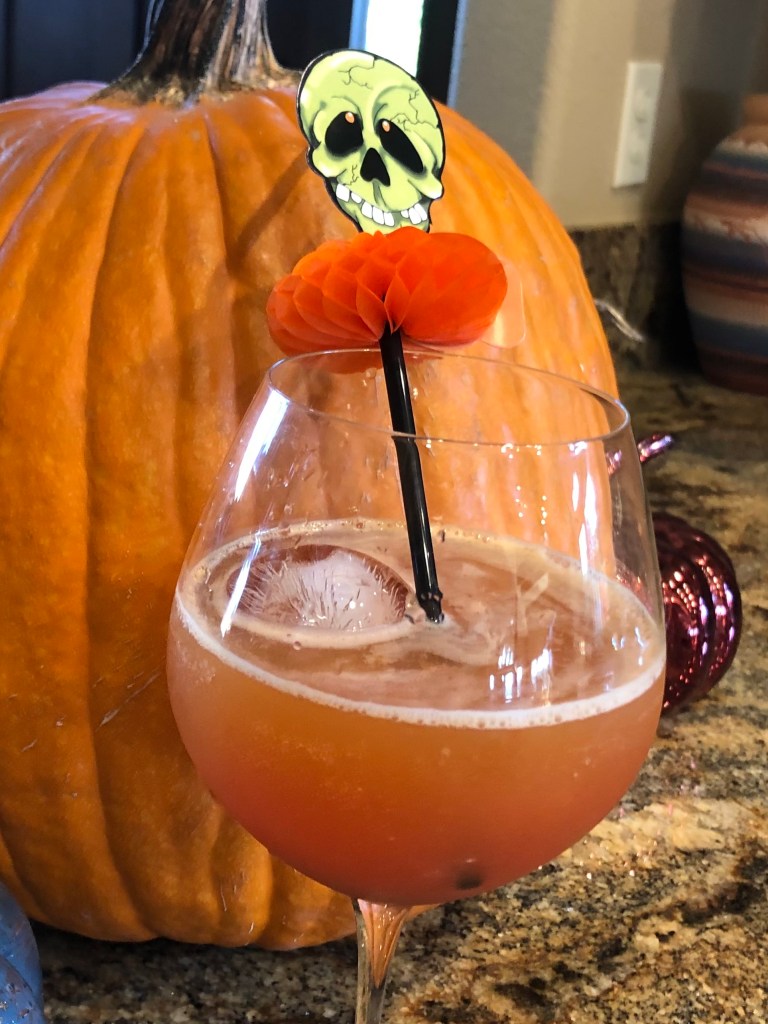
The Recipe: You’ll need four (!) rums: Pour 1 oz. each of white, spiced, and dark rums into a shaker, and hold in reserve 1/2 oz. of 151. Now, to disguise the rum, add 1 oz of lemon juice, 1 oz of lime juice, 1 oz of pineapple juice, 1 oz of passion fruit syrup, and 3 dashes of orange bitters. Shake and pour into a suitable glass with ice. Now, add 1/2 oz of grenadine and the 151. Drink and pass out.

RIP Donn Beach.

The Ratings: The appearance is nothing special. Just a tropical drink. 1 point.

The taste is very tropical–the fruit juices really come through, though I think it was too strong on the lemon. The fruit juices really hide the 3.5 oz of rum, which I guess is the point. Nevertheless, the taste certainly isn’t evocative of Halloween. It’s more of your standard summer drink. 2 points.

As a Halloween name, Zombie is hard to beat. 2 points.

Total: 5 points.


RAVEN’S CORNER

In honor of Edgar Allan Poe and my recent lightning trip to Richmond, I thought I’d share a few raven (or a least big black bird) sightings.

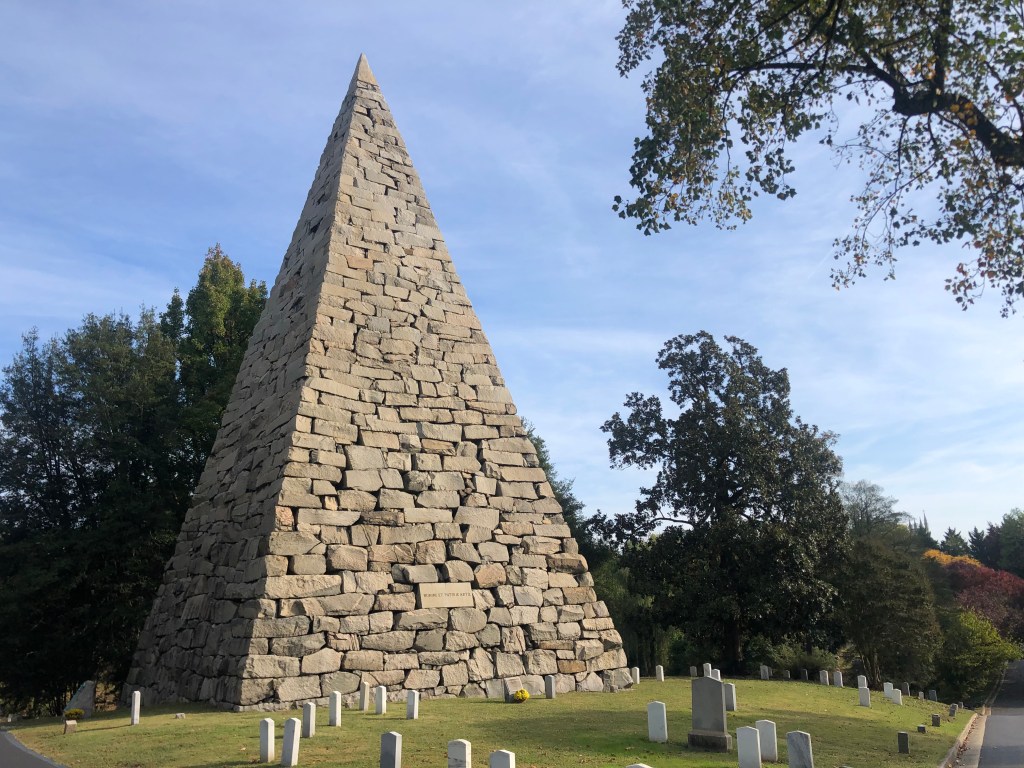
This morning Chris and I visited Richmond’s Hollywood Cemetery (est. 1847). In the midst of the confederate section (Hollywood contains about 18,000 confederate dead), there stands a 90-foot-tall granite pyramid erected in 1869.

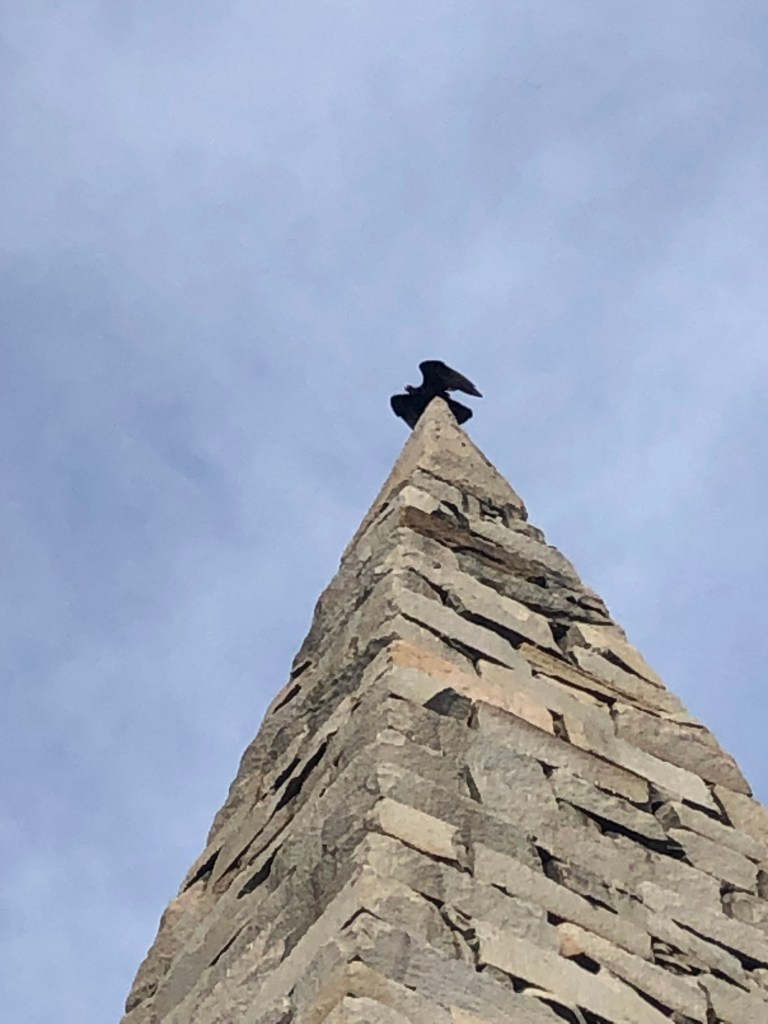
But what’s this at the apex of the pyramid?

“Then this ebony bird beguiling my sad fancy into smiling….”

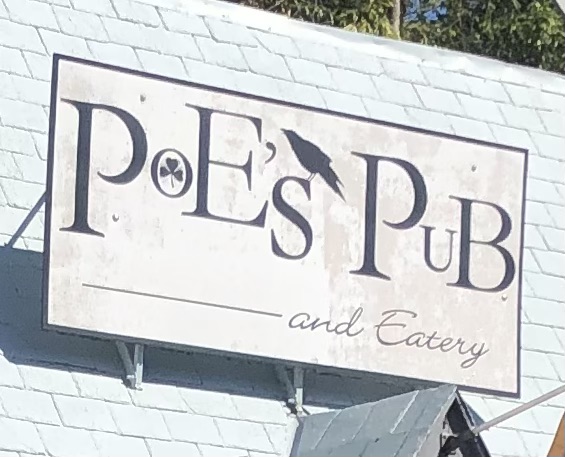
Ravens have been incorporated into some of Richmond’s signage, such as Poe’s Pub.

That’s either a stylized raven, or a rocket ship.

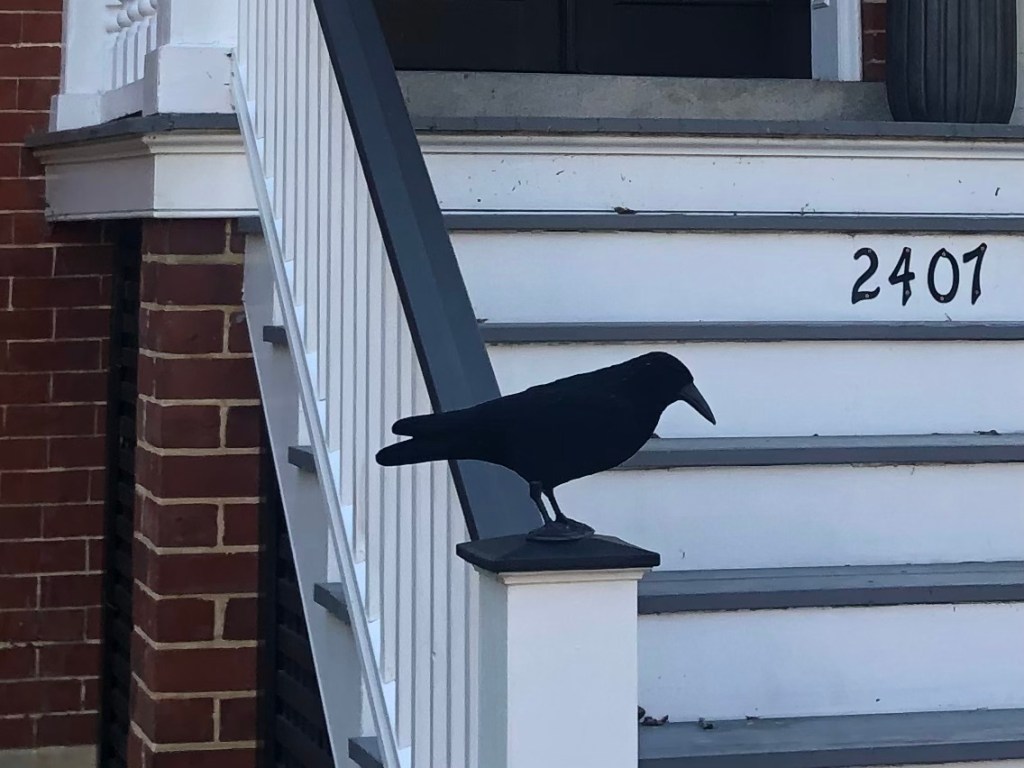
We appreciated that the owners of the Shelton House (where Poe’s last fiancee lived) have seen fit to plant a fake raven at the front steps.

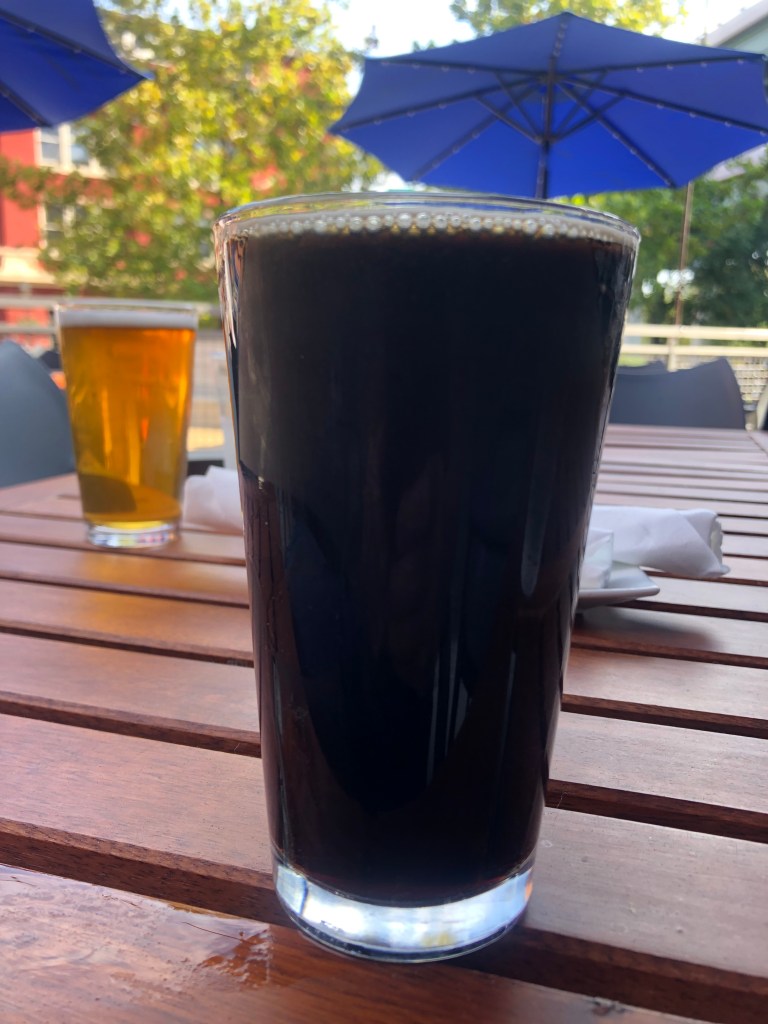
And, cap things off, today’s Beer of the Day is something called the Raven’s Roost Baltic Porter.

Dark as a raven is the Baltic Porter from Raven’s Roost.

This BOTD isn’t as thick as the Imperial Stouts that I’m partial toward. The body is actually rather thinner than you’d expect from something this dark. It’s also lightly hopped and lightly carbonated. Overall, it’s a rather tame beer. And yet it’s also very flavorful, with a strong chocolate profile and sweet maltiness. Clocking in at 7.1 ABV, it will improve your mood but it won’t kick your ass. I give it four out of five stars.

cemeteries · churches · Halloween Cocktails · trains

Poe-tober 2022

Chartreuse? Nevermore!

We interrupt this month of Halloween cocktails to bring you breaking news that I’m in Virginia for an Edgar Allan Poe pilgrimage. I will give you the gory details in a moment, but first let me share some other breaking news:

The Twentieth Anniversary Edition of the Dome of Foam is live!

Uncle Edward’s Fever Dream

I am aware that a number of my readers respond positively to any railroad-themed content from my road trips, so they will be especially heartened by this news. The Dome o’ Foam, for those of you not already familiar, is a quirky, hard-to-define, and entirely mesmerizing collection of railroad history and miscellanea, focusing in particular on the Southern Pacific Railroad. The Dome is the brainchild of my Uncle Edward — E.O. Gibson, to you. Alert readers will recall that Uncle Ed has periodically made appearances in this blog. The new, 20th anniversary edition of his site contains a dizzying array of new content, updates on old content, photographs, personal stories, and cartoons. You owe it to yourself to check it out here.


So, on to my Poe trip. As everyone should have learned as a school child, Edgar Allan Poe lived in various cities of the East during the 19th century, focused largely on Richmond, VA (where he grew up) and Baltimore, MD (where he died under mysterious circumstances). Three years ago (before Covid shut down public gatherings) my friend Chris and I attended the International Edgar Allan Poe festival, held literally in Poe’s old neighborhood in Baltimore, MD. Today Chris and I bookended that trip with a visit to Poe’s old neighborhood in Richmond VA.

Before beauty filters.

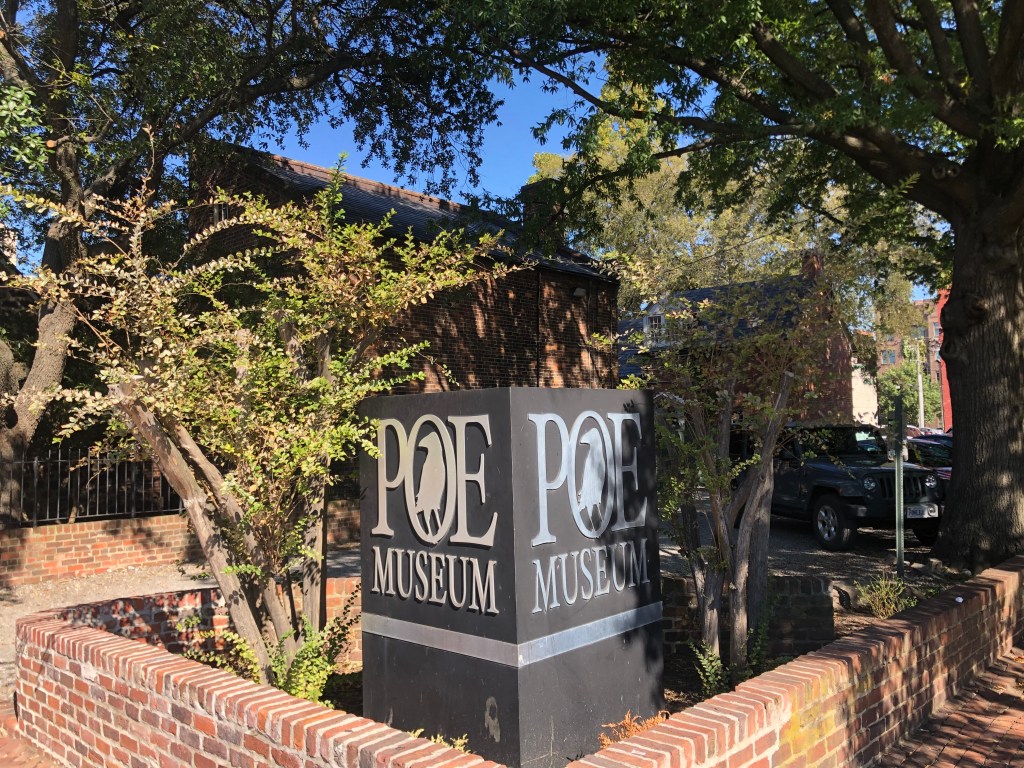
The main Poe attraction in Richmond is the Poe Museum on E. Main Street. You may recall that I drove right by the museum on my Route 50 trip in 2018, as Route 50 becomes Richmond’s Main Street and takes you right through the neighborhood. Alas, the museum was closed when I passed it. So this time, I was finally able to darken its doorstep.

Better late than never.

It’s a remarkable museum, with the world’s largest collection of authentic Poe memorabilia: His bed, writing desk, walking cane, various letters, articles of clothing, photographs and daguereotypes, books, other personal effects, and even the staircase and fireplace mantel from prior Poe residences. It also has a meditation garden and major shrine to Poe.

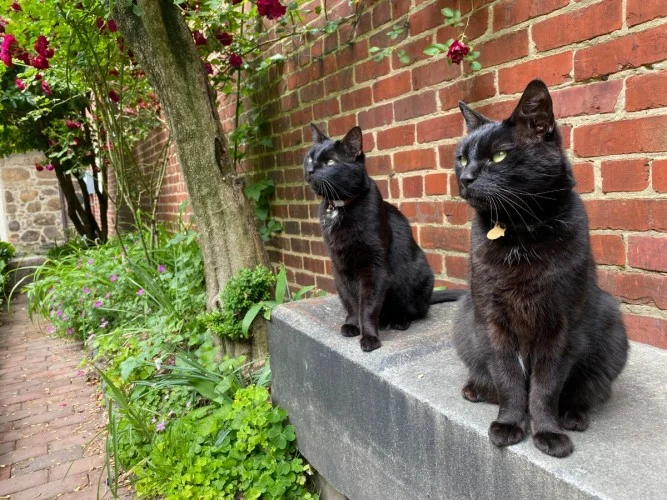
Two cats–Edgar and Pluto–roam the museum grounds like the own the place…which in a way they do.

Edgar and Pluto…or is that Pluto and Edgar?

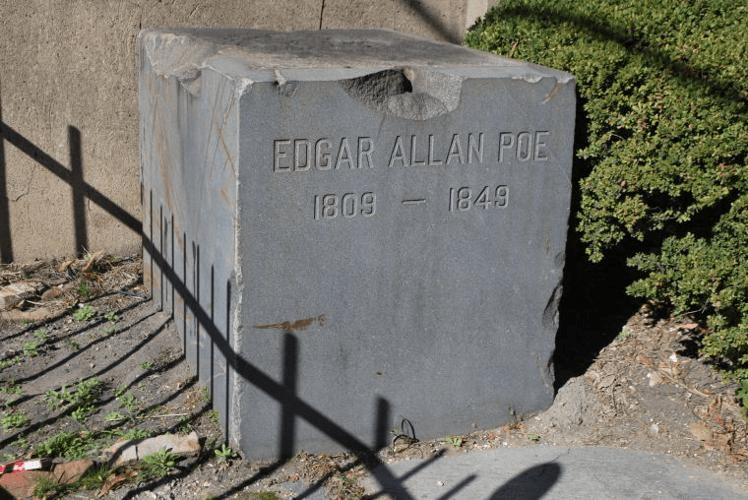
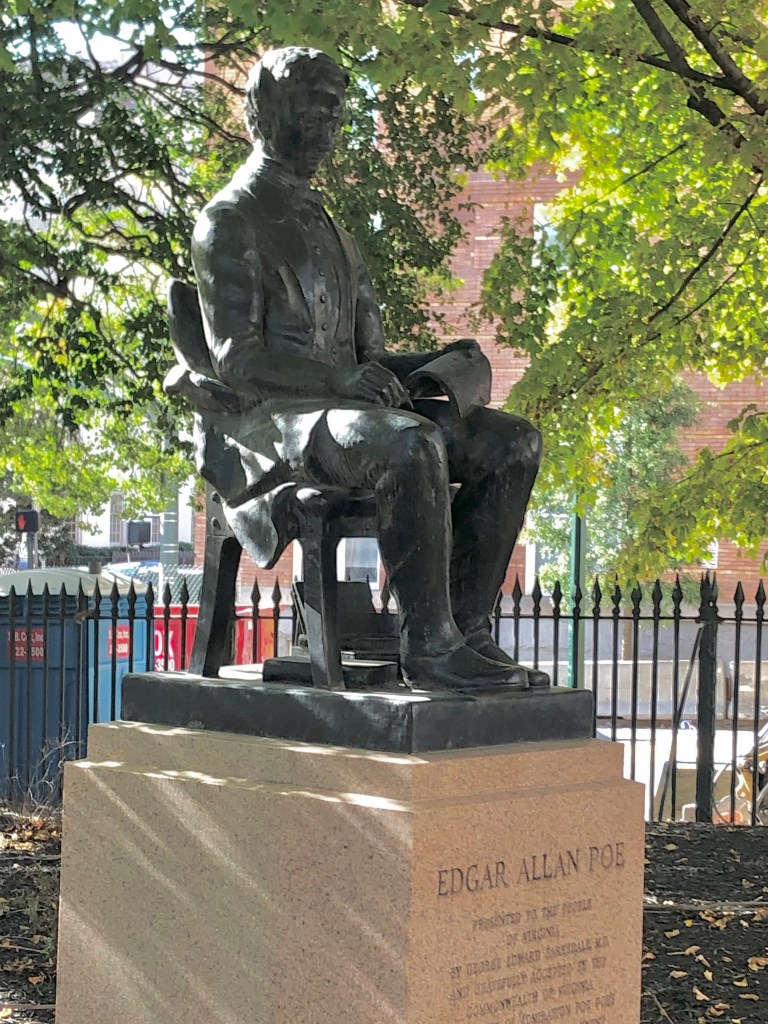
In front of the museum is a large granite block with Poe’s name and birth and death years inscribed on it. No, it’s not a giant tombstone; it’s the pedestal base for a Poe statue that was created in the mid-1950s–when Richmond finally decided to embrace Poe.

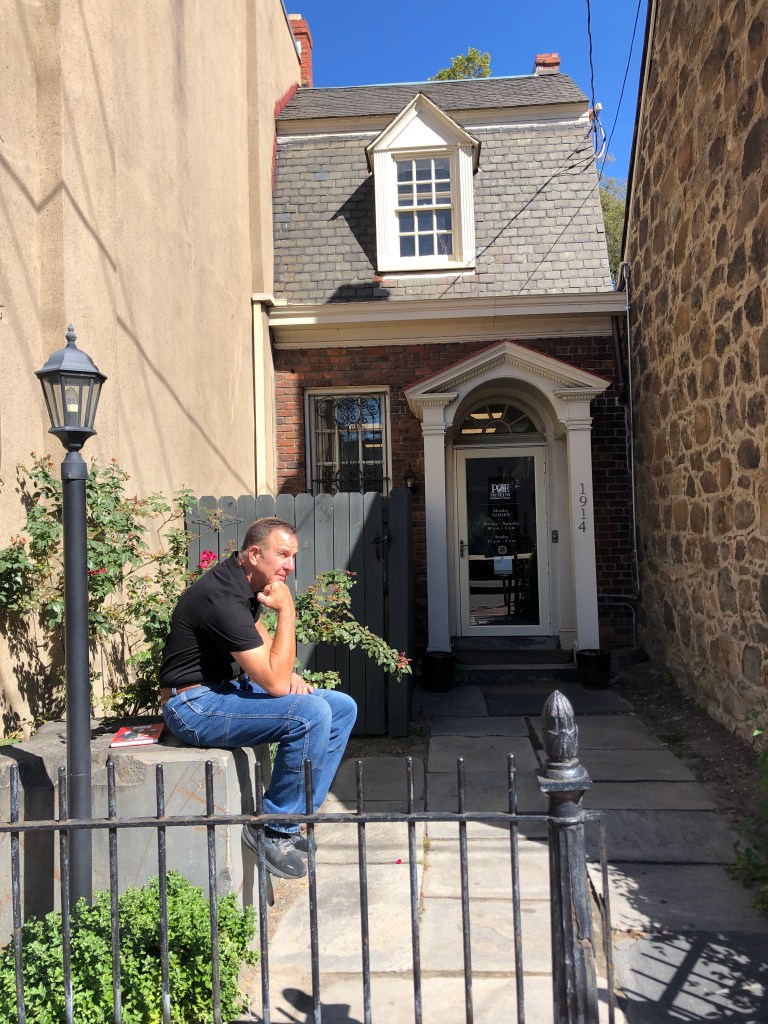
Channeling my inner Dobie Gillis

For reasons that aren’t entirely clear, the pedestal base was discovered in a local landfill by some kids many years later (in 1973, to be exact). It seems that it had been rejected by the city, and a new one had been cut. This “new” base sits, with the statue atop it, in Richmond’s capitol park.

Poe statue in Capitol Park

After the museum, Chris and I visited a number of other Poe-related sites in Richmond, as depicted below.

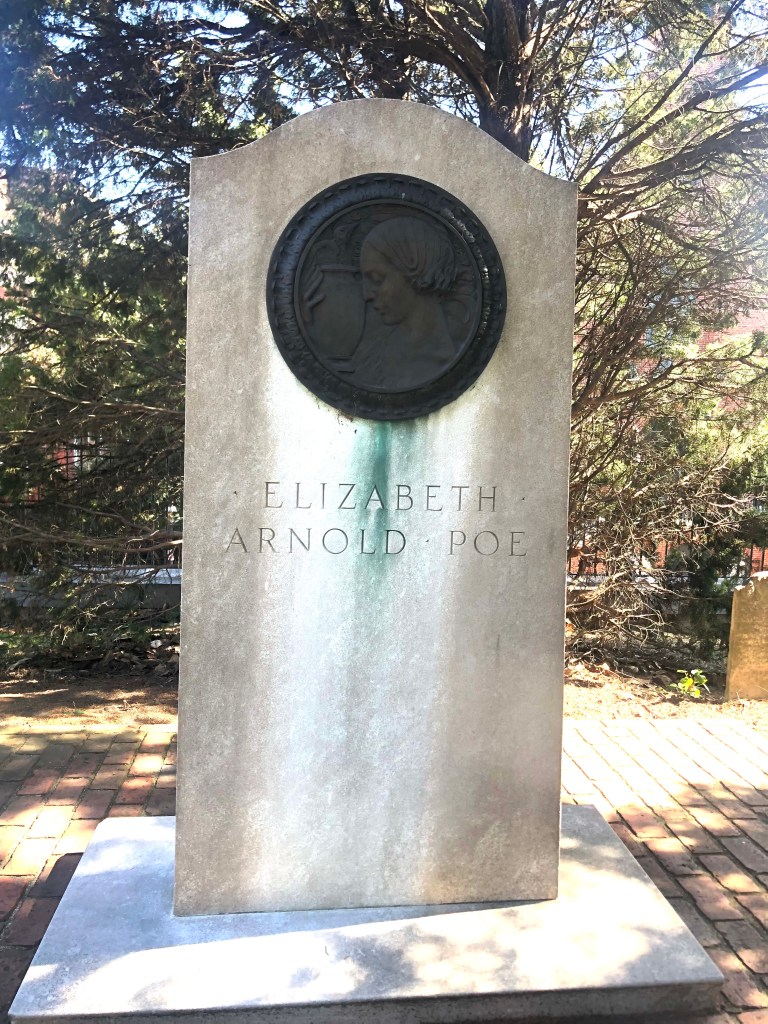
Grave marker for Poe’s mother–an English actress who died of tuberculosis in Richmond at age 24, when Poe was only 2.
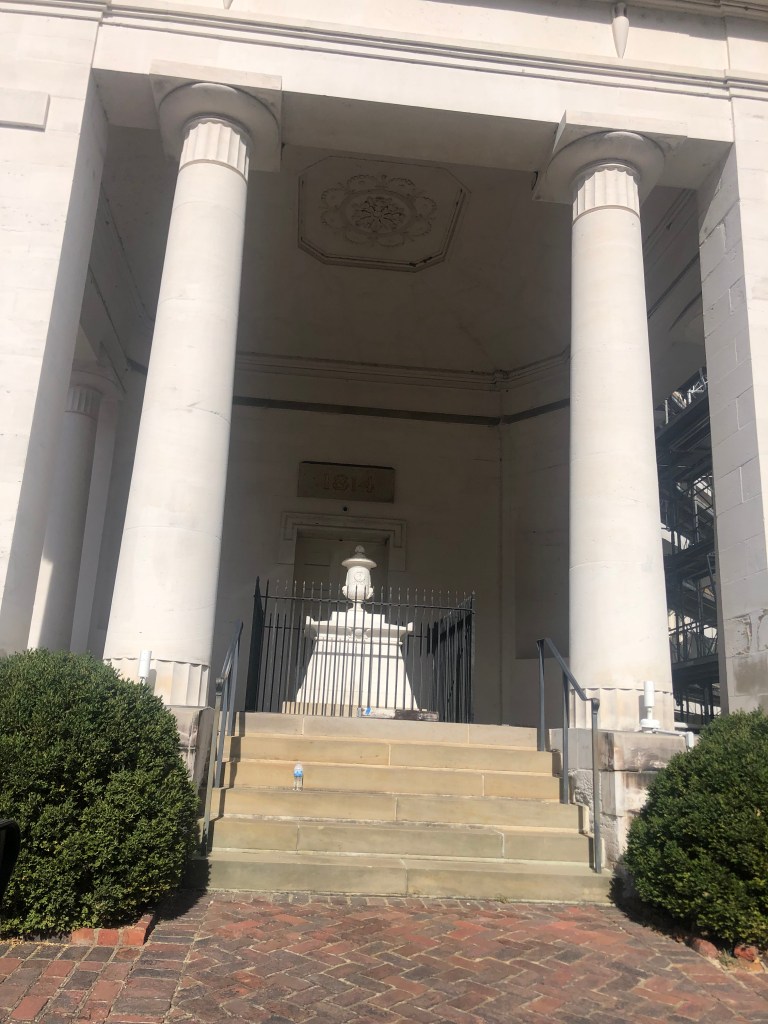
Richmond’s Monument Church, where John and Frances Allan were parishioners. The Allans took in the orphaned Edgar Poe (as his father had abandoned the family before Eliza Poe’s death). This is how Edgar Poe became Edgar Allan Poe.
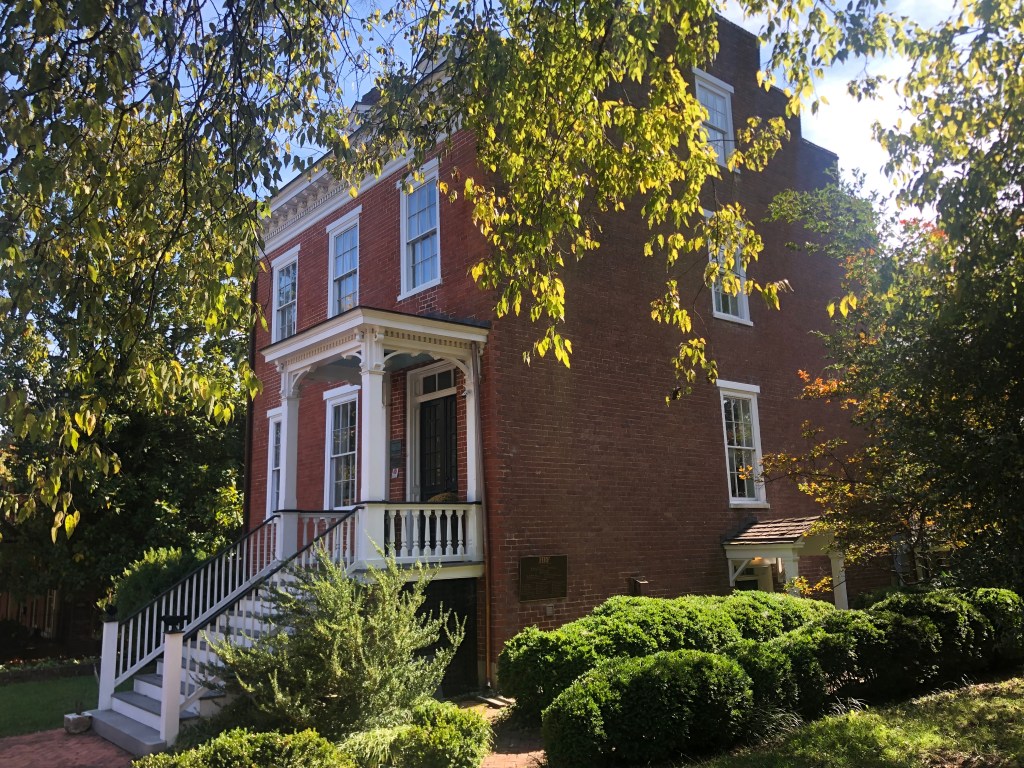
The house of Elmira Shelton. Poe became engaged to Elmira at the tender age of 16, just before leaving for UVA. Her father disapproved of the courtship, and intercepted Poe’s letters to Elmira. Thinking that Poe had forgotten about her, Elmira married another man. Later, Poe famously married his own 13-year-old cousin. But after she died of tuberculosis and Elmira’s husband also died, Poe and Elmira again became engaged. To complete the tragedy, Poe himself died at age 40 just a week and a half before he and Elmira were to be married.
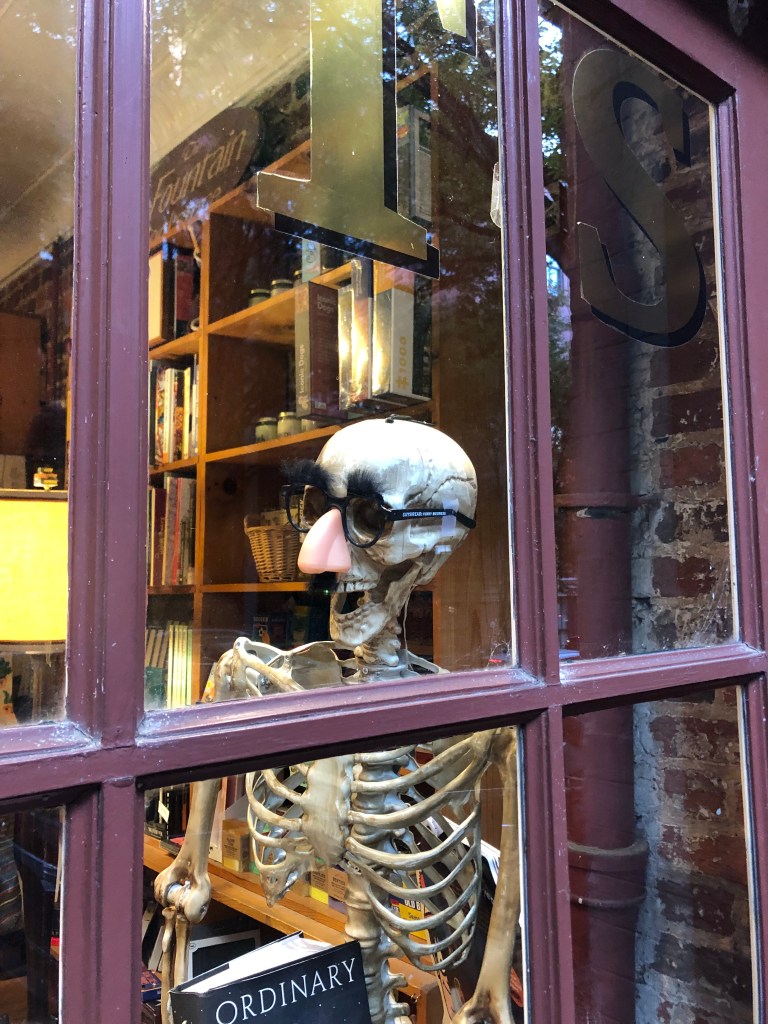
Skeleton in a local bookstore. It’s not directly Poe-related, but somehow it’s appropriate.
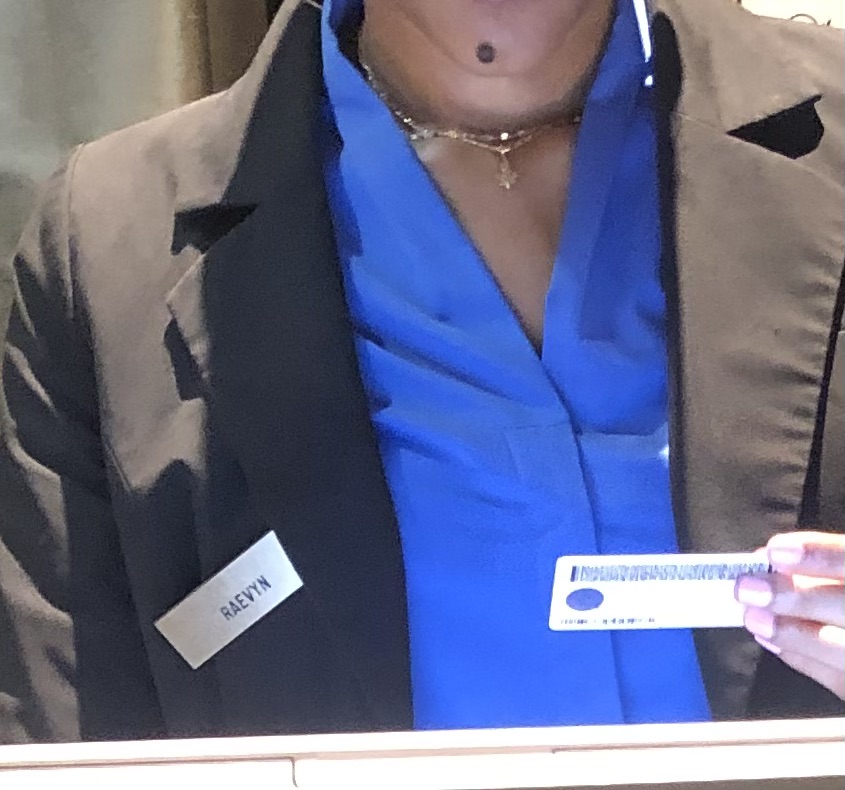
And to round out our Poe-themed day, the receptionist at our hotel is named “Raevyn” (as in, Raven).I’m not making this up.

I hope that all this explains why I wasn’t able to prepare a Halloween cocktail for the blog today. I promise to double-up my cocktail posts when I get home.

Halloween Cocktails

Absinthe makes the heart grow fonder

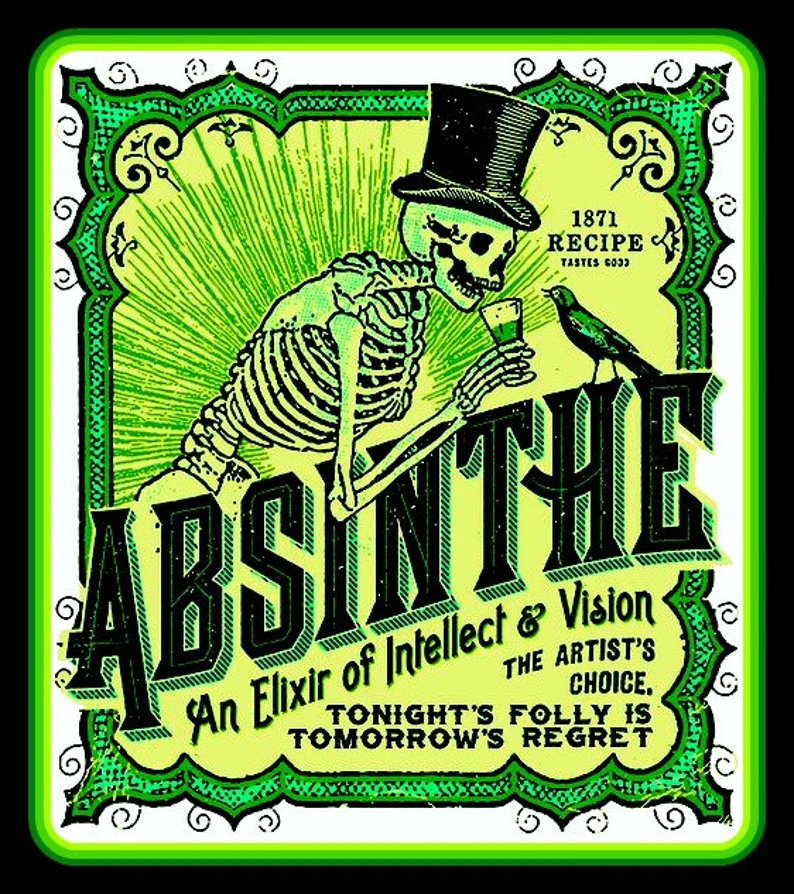
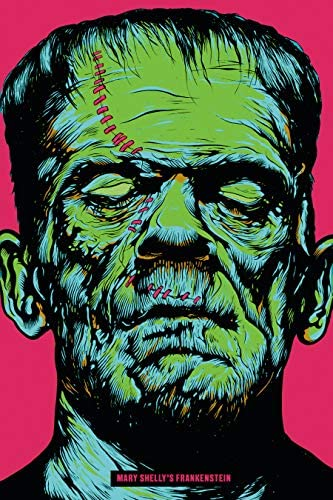
One drink that shows up on a couple of Halloween cocktail lists is absinthe–not as a mere ingredient, but rather as the whole drink. The unearthly green color is in the Frankenstein vein, but more to the point, it has a mysterious and Byzantine history that involves hallucinogenics, evil spirits, and the likes of Edgar Allan Poe. Let’s review:

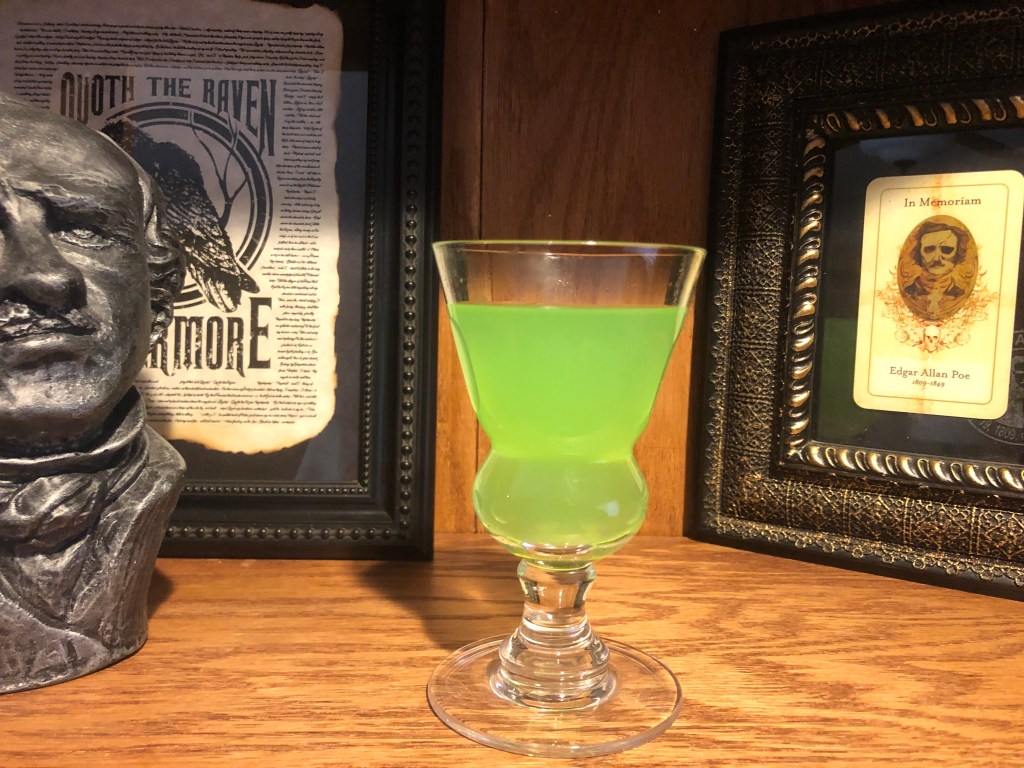
Color me absinthe

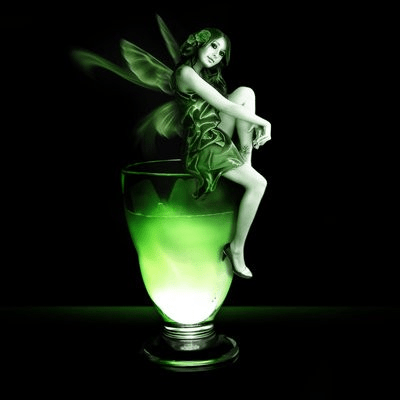
Absinthe is a high-alcohol spirit made from wormwood, anise, fennel, and various other exotic and ordinary ingredients. It tastes strongly of anise, and has been compared (usually favorably) to Jagermeister. Absinthe has a distinct green color which, in the more authentic (and expensive) versions occurs naturally from the ingredients. In the 19th Century absinthe became a popular drink among the Bohemian set, who would gather in cafes and drink the stuff all evening. They called the drink “The Green Fairy” for its supposed magical effects.

Tinkerbell she’s not.

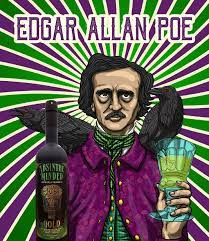
Conservatives railed against absinthe as a hallucinogenic spirit that was wreaking havoc with young people. Those claims were overblown, although absinthe does include trace amounts of thujone. As is often the case, the moral outrage from conservatives made absinthe all the more popular among the hipsters. Notable absinthe drinkers (addicts?) included Edgar Allan Poe, Oscar Wilde, and Lord Byron, which would be enough to solidify its Bohemian street cred.

Rhapsodic Bohemian (“He’s just a Poe boy from a Poe family…)

For most of the 20th century absinthe was banned in the US and most of Europe. It wasn’t until 2007 that America’s ban was lifted. Because we’re fortunate enough to be living in the post-absinthe Prohibition era, we’re able to add this drink to our October list. So what are we waiting for?

The recipe: With its high alcohol content (the stuff I used is 100 proof), absinthe is traditionally diluted with water. Also, as absinthe contains no sugar (and thus it is not classified as a liqueur), the drink is normally prepared with the addition of a sugar cube. Now, there are two ways to do this preparation: the French method and the Bohemian method. Guess which one I used?

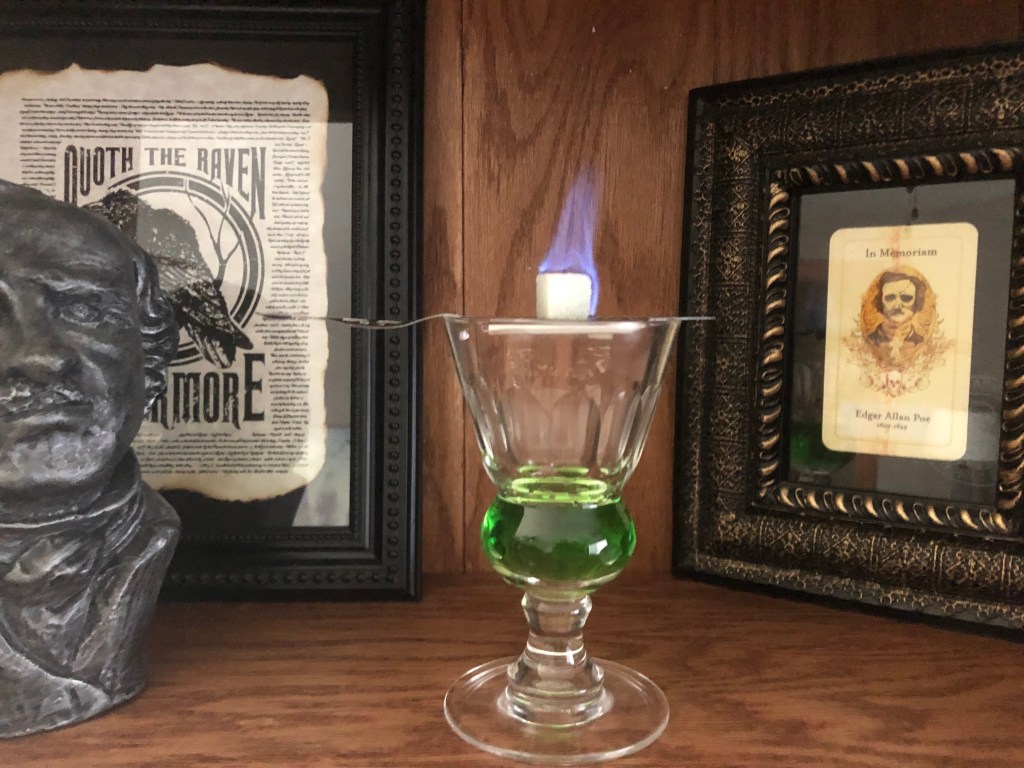
There is a distinct ritual to all this. First you need to get yourself an absinthe glass, whose shape makes it easy to measure the exact amount of absinthe to pour from the bottle. Then you need to get a slotted absinthe spoon. (All this stuff is available on Amazon.) Rest the spoon on top of the glass, and place a sugar cube on the spoon. (I had to go out to the barn and steal a sugar cube from the horses’ treat stash.) Now, pour a little more absinthe over the sugar cube to soak it with alcohol. Then light it on fire. I’m not making this up.

Horse treats burn, evidently.

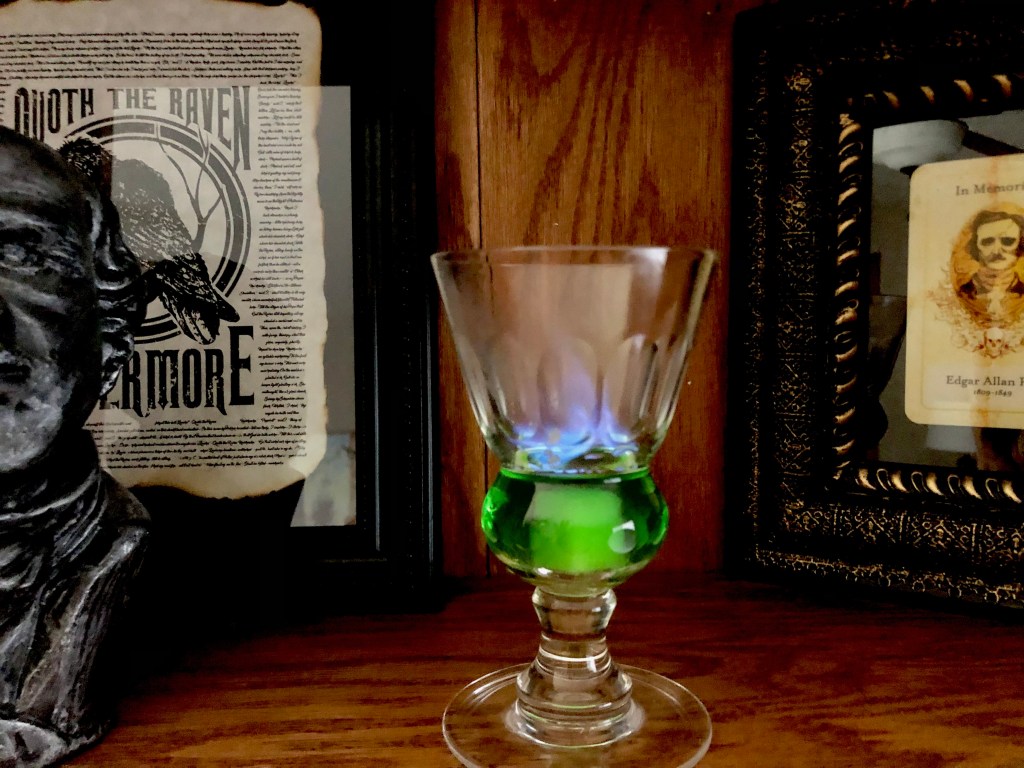
Now, dump the flaming sugar cube into the absinthe, setting it ablaze.

Trouble and toil indeed!

And finally douse the flames with a shot glass full of water. Everything mixes together, with some of the ingredients dissolving and some coming out of solution, resulting in a cloudy liquid called louche. Drink up and meet the Green Fairy!

I didn’t get much of a louche. I’m told that’s because I used a cheap absinthe.

The Ratings: I’m going to consider all the ritual to be part of the “appearance,” and for that I’m awarding full points. The whole process is quite Steampunk, and all the flames and color changes remind one of a mad scientist’s laboratory. The final product looks suitably Gothic in its fussy stemware. 4 points.

But how did it taste? The resulting drink felt more watery than I expected it would be. I used 1 oz of absinthe and 3 parts of water, while Wikipedia says one typically uses between 5 and 7 parts water! So, I guess this preparation is supposed to be watery. The water of course dilutes the alcohol content, which would allow you to spend all day drinking the stuff in a Parisian cafe. Still, even though I thought it watery, it wasn’t unpleasantly so. The taste stands up to the water, with the botanicals fighting each other on your tongue, and there’s a sweet, medicinal bite that hangs on the finish. Clearly this is for sipping rather than quaffing. I can see how you could get used to this. The taste pairs really well with a standard Bohemian lifestyle, but for drinking under more prosaic circumstances, it’s really not appropriate “cocktail” fare. Therefore I’ll rate the taste in the middle at 2.

I’m not sure about how to rate the name. The simple name of the spirit doesn’t exactly evoke Halloween, but absinthe’s close association with insanity, hallucinations, and moral degradation surely helps nudge up the rating. And of course the nickname–Green Fairy–is a worthy Halloween name. So I’ll give it 2 points.

Grand Total: 8 points


Mixology Mailbag–

Acclaimed mixologist and family friend Erin R informs me that my misadventures with Chartreuse were my own damn fault. Apparently the amount of Chartreuse I was using in those drinks was absurd. She writes: “The internet is full of bad information and I blame that [the online recipe] for Steve’s mishaps here. Chartreuse should be used sparingly, most recipes use a quarter to half ounce. There are people who take shots of it, but that’s insane and very expensive!”

Erin also offers a superior Corpse Reviver recipe, which I may try before this month is out. Plus, I’m trying to commission her to design her own Halloween drink. Stay tuned.